Apple Stock Heads to $300 on AI Chief Replacement and Anchor Intel’s Foundry
Apple shares continue their advance despite leadership reshuffle, uneven product reception, and shifting supply-chain dynamics.
Quick overview
- Apple shares have been on a steady rise since April, despite challenges from trade tensions and mixed product reception.
- The stock rebounded sharply after initial tariff concerns, breaking above the $283 mark and aiming for $300.
- Rumors of a partnership with Intel for next-generation chip production have boosted market confidence in Apple's hardware strategy.
- The recent iPhone 17 launch received a muted response, highlighting the need for new catalysts to sustain Apple's growth momentum.
Live AAPL Chart
[[AAPL-graph]]
Apple shares continue their advance despite leadership reshuffle, uneven product reception, and shifting supply-chain dynamics.
Apple’s Rally Persists As Investors Look Beyond Recent Headwinds
Apple (NASDAQ: AAPL) has been steadily climbing since April, even as market sentiment wavered due to U.S.–China trade flare-ups and a product cycle that left investors less than enthusiastic. Yet buyers have continued to return to the stock, supporting a persistent uptrend that has carried Apple toward fresh record highs.
Tariff Volatility And Swift Recovery
The escalation of U.S. tariffs on Chinese goods by President Donald Trump briefly knocked Apple’s stock lower, sparking a selloff across the technology sector. Given Apple’s significant dependence on Chinese manufacturing, the announcement triggered immediate concern about potential cost pressures and supply-chain disruptions.
APPL Chart Weekly – Extending Record Highs
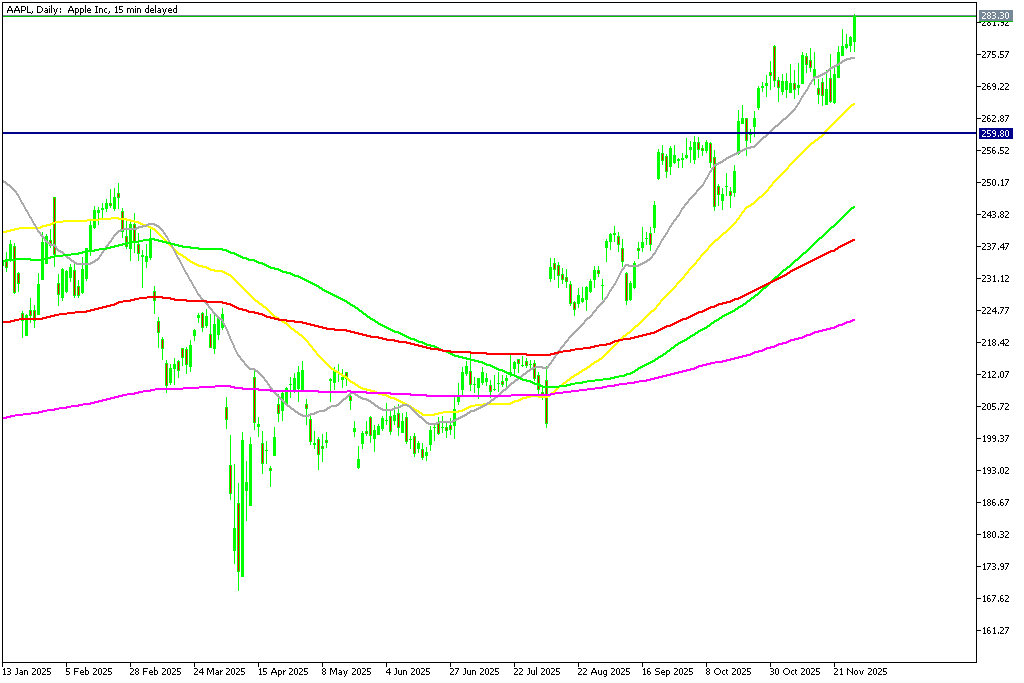
However, once negotiations showed signs of progress and a resolution emerged, markets quickly stabilized. Apple rebounded sharply, reclaiming its uptrend and breaking above the $283 mark on Monday. With momentum firming, many traders now view the $300 level as a realistic near-term target.
Apple Announces Major Transition in AI Leadership
Apple confirmed Monday that John Giannandrea, senior vice president for Machine Learning and AI Strategy, will step down and transition into an advisory role before retiring in spring 2026. His departure marks a notable change for a company now valued at $4.17 trillion and pushing aggressively into next-generation AI initiatives.
To support its evolving strategy, Apple has appointed Amar Subramanya as vice president of AI, reporting to Craig Federighi, senior vice president of Software Engineering. Subramanya will take charge of Apple’s Foundation Models, machine-learning research, and AI safety efforts—core areas for Apple’s future product ecosystem.
Subramanya brings extensive experience, most recently serving as Microsoft’s corporate vice president of AI. Before that, he spent 16 years at Google, where he led engineering for the Gemini Assistant. His appointment signals Apple’s intent to strengthen both its technical depth and leadership structure as competition intensifies across the AI landscape.
Intel Partnership Rumors Boost Market Confidence
Fresh supply-chain reports on November 28, 2025 added another positive catalyst. Intel is reportedly making headway in securing Apple’s next major foundry contract, potentially producing next-generation M-series chips on its advanced 18AP process node.
According to industry leaks, Apple expects revised Process Design Kits (PDKs) in early 2026, which will determine whether the node meets Apple’s performance and efficiency standards. Should the technology validate successfully, volume production could begin by mid-2027 and power upcoming MacBook Air, iPad, and Mac Mini models.
The prospect of Apple diversifying its chip manufacturing and Intel scoring a high-profile win lifted sentiment for both companies’ shares, reinforcing confidence in Apple’s longer-term hardware strategy.
Muted Response To The iPhone 17 Lineup
September’s “Awe Dropping” event, however, failed to deliver the excitement many investors hoped for. The unveiling of the iPhone 17 and iPhone 17 Air featured refined aesthetics and better battery optimization, but the updates were largely seen as incremental.
Apple’s stock popped briefly during the presentation before reversing, closing lower for the second consecutive day as traders digested the absence of standout new features or major AI-driven advances.
Looking Ahead: Stability With A Need For Catalysts
Apple’s long-term fundamentals remain solid — a loyal ecosystem, durable cash flows, and continued expansion into services. Still, near-term trading conditions may stay choppy as markets react to shifting trade policies and evolving supply-chain developments.
Analysts note that while the broader outlook stays constructive, Apple could need a fresh catalyst — perhaps deeper AI integration or renewed product innovation — to propel the stock’s next major leg higher.
- Check out our free forex signals
- Follow the top economic events on FX Leaders economic calendar
- Trade better, discover more Forex Trading Strategies
- Open a FREE Trading Account



 Save
Save