Nvidia Stock NVDA Clears Resistance as Trump Clears Path for the H200 China Chip Shipment
After U.S. President Donald Trump announced plans to allow shipments of H200 chips to China, Nvidia's erratic week took a dramatic turn for
Quick overview
- Nvidia's stock surged after President Trump announced the approval of H200 chip shipments to China, reversing a week of selling pressure.
- The announcement has reshaped sentiment in the semiconductor sector, benefiting Nvidia and other major chipmakers like AMD and Intel.
- Despite the positive news, concerns about AI spending and geopolitical constraints remain, highlighting the challenges Nvidia faces moving forward.
- Nvidia's strong operational performance continues, but investors are now demanding evidence of sustained growth amid rising expectations and competitive pressures.
Live NVDA Chart
[[NVDA-graph]]
After U.S. President Donald Trump announced plans to allow shipments of H200 chips to China, Nvidia’s erratic week took a dramatic turn for the better, with NVDA surging in late trading.
Nvidia Jumps as Washington Softens Semiconductor Export Limits
The mood surrounding Nvidia has shifted dramatically within a matter of hours. After several days of selling pressure driven by fading market confidence in the AI boom, the stock mounted an impressive rebound, climbing nearly 2% during Monday’s U.S. session and surging more than 2% further after hours. The catalyst arrived from an unexpected direction: a forceful statement from President Donald Trump confirming that his administration will allow Nvidia to export its H200 processors to approved entities in China.
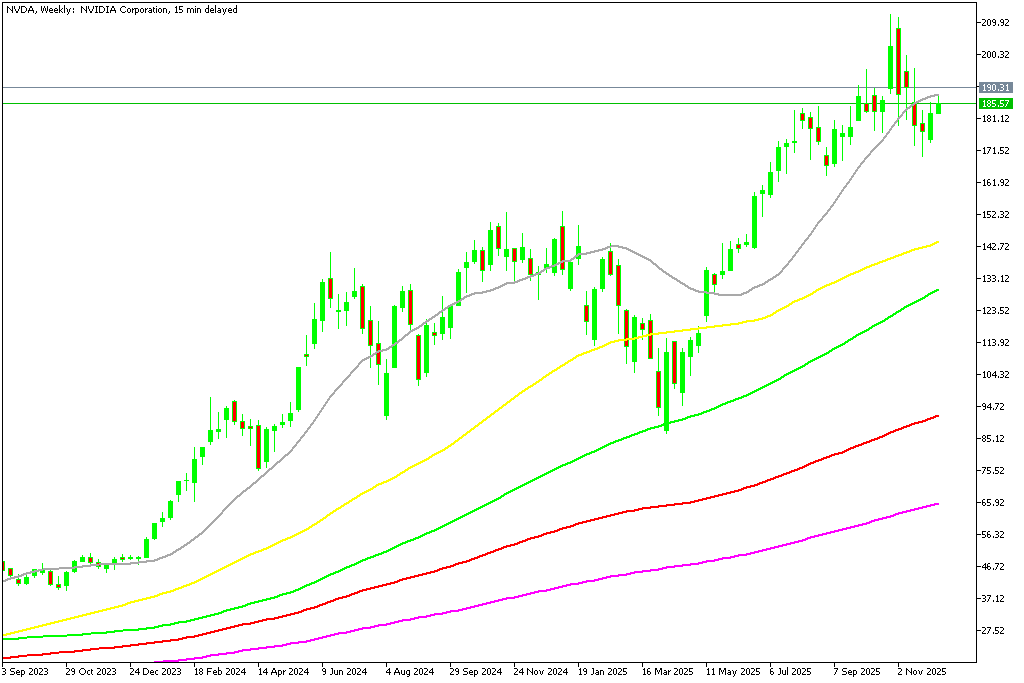
The announcement instantly reshaped sentiment across the semiconductor sector. Nvidia, AMD, Intel, and other major chipmakers have spent months navigating a patchwork of restrictions that limited their ability to sell high-performance components in one of their most important markets. With Trump signalling a broader relaxation—albeit one framed within national-security boundaries—the door reopened to meaningful revenue streams that had been at risk of evaporating. Nvidia’s after-hours rally to roughly $190.90 from the $185.50 close reflected how swiftly investors recalibrated expectations.
Nvidia Chart Weekly – Tomorrow Traders Wil See NVDA Above the 20 SMA
Trump’s comments on Truth Social left little ambiguity. He declared that the United States would authorise H200 deliveries to China and other countries under a framework requiring a 25% payment to the U.S. government. He positioned the policy as simultaneously pro-security and pro-innovation, arguing that prior rules forced American companies to develop weakened chips few customers wanted. Trump emphasised that the decision would apply not only to Nvidia but also to AMD, Intel, and other American semiconductor leaders—an assertion that helped lift the entire industry.
A Turning Point for the AI Trade
The timing of the announcement could not have been more consequential. Investor confidence in the AI era has cooled over the past month, particularly after Nvidia’s most recent earnings release. The results were objectively exceptional, but the stock’s reaction—brief strength followed by persistent weakness—exposed deeper anxieties about whether the explosive AI growth narrative has stretched valuations too far. Nvidia’s performance had become a barometer for the whole sector. Its post-earnings decline reflected a market no longer willing to assume that rapid growth will continue unhindered.
With Monday’s move, the narrative has shifted again. Nvidia’s rebound does not erase structural concerns around AI spending, but it does soften one of the biggest headwinds pressuring the stock: uncertainty over geopolitical constraints. China remains an enormous source of demand for advanced AI hardware, and even limited access carries significant financial implications.
Momentum Struggles Give Way to Geopolitical Relief
Before the late-day turnaround, Nvidia’s technical picture appeared fragile. The stock had slipped beneath its 20-week moving average earlier in November—a level that historically acted as a cushion during sell-offs. Negative momentum was building, and traders were beginning to question whether a deeper correction toward the 50-week average was unavoidable.
Monday’s bounce shifted that outlook, at least temporarily. The surge in after-hours trading lifted NVDA back above the 20-week SMA and placed the stock within reach of the psychologically important $200 region. With geopolitical clarity now improving, the next sessions may reveal whether Nvidia can convert this jolt of optimism into a renewed attempt at higher levels.
Exceptional Results Meet Exceptional Expectations
While the market’s emotional landscape has been volatile, Nvidia’s operational performance remains extraordinarily strong. Revenue soared past expectations in the latest quarter, profitability expanded sharply, and forward guidance pointed to ongoing demand for AI accelerators, GPU clusters, and related infrastructure. The company continues to enjoy elevated margins, supported by unmatched pricing power and the rapid adoption of its latest architectures.
Research and development spending is increasing aggressively as Nvidia expands its technological leadership, and the company is steadily moving deeper into adjacent verticals such as AI infrastructure, power-efficient computing, and large-scale data-center integration. These strategic moves reflect a company preparing not just for the next product cycle but for the next decade of digital transformation.
Yet this very strength presents a problem: much of it is already embedded in the share price. Investors know Nvidia is dominant; they know demand is enormous; they know margins are extraordinary. The challenge is not whether Nvidia can execute—history suggests that it can—but whether the current valuation captures too much of tomorrow’s success upfront.
The Brookfield Partnership and the Road Ahead
Adding complexity is Nvidia’s deepening partnership with Brookfield Asset Management. Their joint plan to build AI infrastructure worth up to $100 billion highlights a new chapter for Nvidia. Rather than functioning solely as a high-margin chip designer, the company may increasingly find itself involved in power supply, data-center operations, and large-scale infrastructure development. It is a bold evolution that could broaden Nvidia’s long-term footprint but may also introduce new capital commitments and risks.
Combined with fluctuating export rules, intensifying geopolitical scrutiny, and the sheer scale of AI-related investment worldwide, Nvidia’s future is poised to remain both promising and unpredictable.
From Perfect Confidence to Demanding Justification
The core shift in the market is psychological. For most of the AI boom, Nvidia benefited from an era of unchallenged optimism. Investors were willing to price in extraordinary growth levels far into the future, trusting the company to deliver without interruption. That sentiment has cooled. The bar is now dramatically higher, and even Nvidia must continue proving that its dominance can persist without margin erosion, competitive threats, or regulatory hurdles.
This does not diminish Nvidia’s importance in the technology ecosystem. It remains the centrepiece of the AI hardware world and one of the most profitable companies in history. But investors are no longer operating on faith alone. They want evidence that the next leg of growth is both real and durable.
Conclusion: A Market Caught Between Optimism and Reality
Nvidia’s latest rebound underscores just how sensitive the stock—and the entire AI sector—has become to geopolitical shifts and policy signals. Trump’s decision to permit H200 exports to China rekindled optimism, easing fears of long-term revenue compression and reinforcing Nvidia’s global reach. But the broader narrative remains more complicated. Nvidia is still growing at a scale that few companies can match, yet it faces rising expectations, tightening competitive pressures, and shifting geopolitical boundaries.
The coming months will test whether Nvidia can convert its technological superiority into sustained, defensible earnings power—without leaning too heavily on an AI narrative that markets are beginning to scrutinize more closely than ever.
- Check out our free forex signals
- Follow the top economic events on FX Leaders economic calendar
- Trade better, discover more Forex Trading Strategies
- Open a FREE Trading Account


 Save
Save