Mexican Peso Reverses Losses as Markets Focus on Trump’s China Visit

The Mexican peso appreciated against the U.S. dollar in Wednesday’s session, recovering earlier losses as investors continued to monitor U.S. President Donald Trump’s visit to China and his expected meeting with Chinese President Xi Jinping.

Earlier in the day, the peso had weakened after U.S. inflation data came in above expectations, alongside a downgrade in Mexico’s sovereign debt outlook by S&P Global.

The exchange rate closed at 17.1807 pesos per dollar, compared with 17.2228 in the previous session, according to Banco de México. This represents a gain of 4.21 centavos, or 0.24%.

During the session, the peso traded between a high of 17.2530 and a low of 17.1651. Meanwhile, the U.S. Dollar Index (DXY), which measures the greenback against a basket of six major currencies, rose 0.20% to 98.49 points.

[[USD/MXN-graph]]

The 17.20 level remains a short-term technical pivot, given the sideways range observed over the last six sessions, while key support is seen at the yearly low of 17.08.

Trump–Xi meeting in focus

Markets remain focused on the high-profile meeting between Trump and Xi in Beijing, with investors watching closely for signals on trade relations between the world’s two largest economies. Broader geopolitical risks, including the conflict in the Middle East and tensions over Taiwan, are also part of the backdrop.

Reports indicate Trump arrived in Beijing accompanied by prominent business leaders, including Elon Musk and Larry Fink.

U.S. inflation adds pressure to markets

Markets also adjusted expectations after U.S. producer price data showed the largest monthly increase in four years. The Producer Price Index (PPI) rose 1.4% in April, following a revised 0.7% increase in March.

As a result, expectations for a Federal Reserve rate cut this year have declined, according to CME’s FedWatch tool. In contrast, bets on potential rate hikes have begun to reappear.

Domestic headwinds add pressure

Separately, S&P Global revised Mexico’s sovereign credit outlook from “stable” to “negative,” increasing the risk premium on Mexican assets. Finance Minister Edgar Amador said government measures would help reverse the decision over time.

U.S. Senate Confirms Kevin Warsh as New Federal Reserve Chair

The U.S. Senate has confirmed Kevin Warsh as the new Chair of the Federal Reserve, setting the stage for a leadership transition at the central bank.

With a vote of 54 to 45, the Senate approved Warsh’s nomination for a four-year term, just one day after advancing his confirmation as a member of the Federal Reserve Board. In this way, Warsh will replace Jerome Powell, whose term as Fed Chair ends this Friday.

The next Federal Open Market Committee (FOMC) meeting is scheduled for June 16–17, when policymakers will announce their latest interest rate decision alongside the quarterly update of key economic projections.

Words from Scott Bessent

Following the confirmation, U.S. Treasury Secretary Scott Bessent stated: “Today, the Republican bloc, together with Democrats who put country over ideology, confirmed President Donald Trump’s nominee, Kevin Warsh, as the next Chair of the Federal Reserve.”

He added: “Chairman Warsh will usher in a new era for an institution that needs accountability, sound policy guidance, and a renewed sense of purpose to help steer our economy. His leadership lays the foundation for every American family to build and grow in the world’s largest economy.”

Senator Cynthia Lummis of Wyoming, a well-known advocate for the crypto industry, also commented: “The Federal Reserve has long needed reform. With Kevin Warsh confirmed as Chair, U.S. businesses and digital asset holders finally have a leader at the Fed ready to implement it.”

The current U.S. benchmark interest rate stands in the 3.50%–3.75% range. The Federal Open Market Committee (FOMC) opted to keep rates unchanged at its April 29 meeting, marking its third consecutive pause.

How Warsh arrives at the Fed

The 56-year-old lawyer and financier will take charge of the central bank at a critical moment, as rising inflation could complicate the interest rate cuts repeatedly called for by President Donald Trump.

The U.S. Consumer Price Index rose 0.6% in April, following a 0.9% increase in March, according to the Bureau of Labor Statistics. On a year-over-year basis, inflation accelerated to 3.8% in April, up from 3.3% in March, marking the highest reading since May 2023.

Wall Street Hits New Records Led by Tech Stocks as Focus Shifts to China

U.S. stocks closed mostly higher on Wednesday, February 12, led by technology shares, even after producer inflation data came in above expectations just one day after a similar upside surprise in consumer prices.

Wall Street operators are ready for the earnings season.

Investor attention is now focused on Donald Trump’s visit to China, where he is set to meet with Xi Jinping. Several major tech CEOs, including Jensen Huang of NVIDIA and Tim Cook of Apple, accompanied the president on the trip.

In this context, the Dow Jones Industrial Average slipped 0.1% to 49,693.20 points, while the S&P 500 rose 0.6% to 7,444.04 and the Nasdaq Composite gained 1.2% to close at 26,402.34.

[[SPX-graph]]

Tech stocks push Wall Street to fresh highs

Although U.S. producer inflation data initially dominated market attention, investors quickly shifted focus to China, where Trump arrived to a formal red-carpet welcome. The U.S. president is expected to participate in an official arrival ceremony on Thursday before meeting with Xi and holding several interviews.

The two leaders are expected to discuss a wide range of issues, including trade and Taiwan. Trump stated that he intends to pressure Xi to “open” China further to American companies.

However, tensions involving the United States and Iran are likely to overshadow much of the summit. Analysts suggest that China, as a major importer of Iranian crude oil, could potentially play a role in guaranteeing a longer-term peace agreement, although expectations for a breakthrough remain limited.

Diplomatic efforts between Washington and Tehran appear to have stalled. Earlier this week, Trump rejected Iran’s response to a U.S. peace proposal, calling it “unacceptable” and “garbage.” Reports also circulated regarding the possibility of renewed military strikes against Iran by the White House.

For its part, Tehran has given no indication that it plans to make further concessions aimed at easing tensions with Trump.

Oil falls despite concerns over Middle East supply

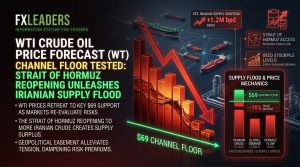
At the core of investor concerns is the continued disruption surrounding the Strait of Hormuz, the critical maritime route off Iran’s southern coast through which roughly one-fifth of the world’s oil supply passes. The passage remains effectively restricted, as it has been for weeks.

In a note to clients, analysts at Deutsche Bank said there is “growing concern among investors that a U.S.-Iran agreement appears further away than many had expected following the more positive headlines seen last week.”

[[USOIL-graph]]

As a result, oil prices remain well above the $70-per-barrel level seen before the joint U.S.-Israeli offensive against Iran launched in late February. Still, Brent crude futures — the global oil benchmark — fell 2% on Wednesday to $105.57 per barrel.

At the same time, the International Energy Agency warned that global oil supply may fail to meet total demand this year, as the war continues to disrupt energy production across the Middle East.

Bitcoin Falls Below $80,000 as Cautious Sentiment Dominates Markets

The cryptocurrency market traded moderately lower on Tuesday, with Bitcoin falling 1.3% over the past 24 hours to $79,473, while Ethereum slipped 1.1% and lost the key $2,300 level, trading around $2,257.

Bitcoin remains close to $80K this week.

Among altcoins, the picture was mixed. Dogecoin led gains with a 2.7% rebound, while Solana was the day’s worst performer, dropping 4%. XRP, Cardano, and Chainlink traded with more limited moves.

Meanwhile, the Fear & Greed Index fell to 42 points, returning to “fear” territory, while spot Bitcoin ETFs recorded net outflows of $233 million on Tuesday, reflecting a more cautious stance from institutional investors in the short term.

[[BTC/USD-graph]]

In this context, the $80,000–$81,000 region remains an important support zone for Bitcoin, while a more sustained recovery will likely depend on renewed institutional inflows and a more favorable macroeconomic backdrop.

U.S. inflation data comes in hotter than expected

The crypto market continues to digest an unfavorable macroeconomic report. The U.S. Bureau of Labor Statistics announced that the Consumer Price Index (CPI) rose to 3.8% in April, above analysts’ expectations.

The main driver behind the increase was higher energy prices linked directly to the conflict in the Middle East. Core inflation — which excludes food and energy — also surprised to the upside, rising to 2.8%, compared with the 2.7% expected by the market.

Although annual inflation accelerated, strengthening the U.S. dollar and reducing part of investors’ appetite for risk assets, Bitcoin managed to remain near key levels, showing resilience even in a more challenging macroeconomic environment.

[[ETH/USD-graph]]

Clarity Act and Trump-Xi summit in focus

On the regulatory front, investors are also watching for developments surrounding the CLARITY Act, the proposed U.S. crypto market structure legislation. The bill is expected to be reviewed next week, potentially becoming a new catalyst for the sector.

At the same time, markets remain focused on the upcoming meeting between Donald Trump and Xi Jinping, which could influence broader sentiment across global financial and digital asset markets.

Michael Burry Warns of Possible Market Bubble Formation

Michael Burry, the founder of Scion Asset Management and the investor who famously predicted the 2008 housing crash (depicted in The Big Short), has once again raised alarms about a potential bubble forming in financial markets.

Wall Street operators are ready for the earnings season.

Burry argues that the current equity rally — driven largely by enthusiasm around artificial intelligence — is showing similarities to the late stages of the dot-com bubble in the late 1990s.

In a recent statement, he said the market has “jumped the shark,” suggesting that prices have entered an irrational phase disconnected from fundamentals such as employment or consumer confidence. Instead, he described the market as continuing to rise simply because it has been rising.

AI-driven euphoria under scrutiny

The investor emphasized that today’s market narrative is increasingly concentrated around what he called a “two-letter thesis,” referring to AI. According to Burry, the current environment feels similar to the final months of the 1999–2000 tech bubble.

His comments come amid a powerful rally in technology stocks, particularly companies tied to semiconductors and artificial intelligence. The Philadelphia Semiconductor Index, for example, has posted one of its fastest gains since March 2000 — just before the dot-com crash.

Burry also suggested that today’s moves in the Nasdaq can be “more extreme” than those seen during the late-1990s tech boom, based on data compiled by Yahoo Finance.

Bearish bets against tech and semiconductors

The Scion Asset Management founder has reportedly disclosed bearish positions against several technology companies and semiconductor-related ETFs. These trades target firms tied to the AI investment boom, echoing the contrarian positioning he famously adopted ahead of the 2008 financial crisis.

His warnings add to a growing debate on Wall Street about whether the rapid rise in AI-linked equities reflects a sustainable structural shift — or the early stages of another speculative bubble.

U.S. Inflation Jumps to 3.8% Amid Fuel Price Shock

The April reading came in above market expectations, which had already anticipated a sharp acceleration compared to March. Core inflation, which excludes energy and food, also picked up.

Oil prices shocked the USA and the world.

U.S. inflation accelerated more than expected in April, rising 3.8% year-over-year and marking its largest jump since May 2023. The increase was driven largely by a surge in fuel prices, as the war in the Middle East disrupted global energy supply chains.

Markets were caught off guard by the Consumer Price Index (CPI) report, as analysts had forecast a 3.7% annual increase. On a monthly basis, however, the headline figure matched expectations at +0.6%.

Energy prices drive the inflation shock

Energy prices once again played a central role. While gasoline and fuel oil prices rose around 5% month-over-month in April — compared with a 21% spike in March — the year-over-year picture remains extreme, with gasoline up 28.4% and fuel oil surging 54.3%.

Another key reading was core inflation, which excludes food and energy. It rose 2.8% year-over-year, above both the 2.7% forecast and March’s 2.6%. On a monthly basis, core inflation also surprised to the upside, increasing 0.4%, double the pace of March.

The data from the U.S. Bureau of Labor Statistics heightened concerns among investors. In recent days, markets had already begun pricing out the possibility of a Federal Reserve rate cut this year, despite the upcoming transition to new Fed leadership under Kevin Warsh, selected by Donald Trump to replace Jerome Powell.

In fact, traders are now even assigning a small probability to a rate hike toward the end of the year, reflecting growing concern that inflation may remain stickier than previously expected.

Which Wall Street CEOs Are Traveling With Trump to China?

U.S. President Donald Trump will arrive in Beijing this week alongside top executives from Tesla, Apple, BlackRock, Goldman Sachs, and Boeing to discuss trade, technology, artificial intelligence, and energy with Chinese President Xi Jinping. The summit comes amid the war in the Middle East and escalating technological tensions between Washington and Beijing.

Trump's deadline for new deals is approaching.
Trump’s deadline for new deals is approaching.

Trump’s visit to China is drawing intense attention from global markets and the corporate world alike. The White House confirmed that the president will travel with a powerful business delegation featuring some of the most influential CEOs from Wall Street and Silicon Valley, highlighting the economic and strategic importance of the meeting with Xi.

Among the executives expected to join the trip are Elon Musk, CEO of Tesla and SpaceX; Tim Cook, Apple’s outgoing CEO; and Larry Fink. Representatives from Boeing, Goldman Sachs, Citigroup, Mastercard, Qualcomm, Micron Technology, and Blackstone will also be part of the delegation.

The trip will mark the first official visit by a U.S. president to China in nearly a decade and takes place amid a particularly fragile geopolitical backdrop shaped by the conflict involving Iran, the United States, and Israel, partial disruptions in the Strait of Hormuz, and rising trade and technology tensions between Washington and Beijing.

Trade, AI, semiconductors and energy on the agenda

The meeting between Trump and Xi — originally scheduled for March but delayed due to the escalation in the Middle East — is expected to cover a broad agenda, including:

  • bilateral trade,
  • artificial intelligence,
  • rare earth exports,
  • semiconductors,
  • energy,
  • Taiwan,
  • and the conflict with Iran.

The makeup of the delegation also reflects the sectors currently viewed as strategic priorities for the White House: technology, finance, defense, energy, and global supply chains.

Alongside Musk, Cook, and Fink, the delegation will also include:

  • Kelly Ortberg, CEO of Boeing;
  • David Solomon, CEO of Goldman Sachs;
  • Jane Fraser, CEO of Citigroup;
  • Michael Miebach, CEO of Mastercard;
  • Cristiano Amon, CEO of Qualcomm;
  • and Stephen Schwarzman, CEO of Blackstone.

Boeing deal and notable absences draw attention

Boeing’s presence is particularly notable after reports emerged suggesting the company could finalize one of the largest commercial agreements in its history during the visit: the sale of 500 737 Max aircraft to China.

According to Bloomberg, the announcement could coincide with the presidential meeting as part of broader efforts to reset commercial relations between the two superpowers.

Beyond the size of the delegation, markets have also focused on several notable absences — most prominently Jensen Huang, CEO of NVIDIA.

Bitcoin Holds Above $80,000 Despite Weak U.S. Inflation Data

The crypto market traded cautiously on Tuesday, mirroring the tone seen across traditional financial markets.

Bitcoin is staying steady near $80K.

Bitcoin fell 0.5% but managed to hold near the $80,000 level, while Ethereum faced heavier pressure, dropping 2% over the past 24 hours and slipping below $2,300. The broader altcoin market showed mixed performance, with BNB rising around 1.2%, while TRON and XRP posted losses of up to 0.7%.

Geopolitical tensions continue to drive market sentiment. According to David Morrison, senior analyst at Trade Nation, recent market moves have been heavily influenced by U.S. President Donald Trump rejecting Iran’s response to a U.S.-backed peace proposal.

[[BTC/USD-graph]]

Investors are also closely watching Trump’s upcoming trip to China for talks with Xi Jinping, although expectations for meaningful progress remain low. Meanwhile, Israeli Prime Minister Benjamin Netanyahu reiterated that the conflict remains far from resolved.

After a relatively stable weekend, Bitcoin suddenly dropped to around $80,250 before rebounding above $82,000. Profit-taking later pushed the cryptocurrency back below the $80,000 mark, although it quickly recovered and appears to be holding that level as key support.

April CPI data takes center stage

Markets also reacted to the release of April’s U.S. Consumer Price Index (CPI), which showed inflation accelerating to 3.8% year-over-year — the highest reading in nearly three years. The impact of the war with Iran and tensions surrounding the Strait of Hormuz were clearly reflected in energy prices.

The stronger-than-expected inflation data could reduce expectations for near-term monetary easing and push bond yields higher, reinforcing a more defensive positioning across global markets.

Under that scenario, speculative assets — including cryptocurrencies — could face additional short-term pressure as capital rotates toward the strength of the U.S. dollar and yield-focused investments. The market reaction also highlights how closely digital assets are now trading in line with broader macroeconomic conditions and global liquidity expectations.

Intel Shares Have Surged Nearly 600% in Less Than a Year

Intel now has a market capitalization of $650 billion and ranks among the world’s 20 largest companies.

Intel chips are in extremely high demand.

Over the past year, the company has massively outperformed the S&P 500 and other major stock indexes, becoming one of the market’s top-performing stocks. The main drivers behind the rally have been the arrival of a new CEO and a strategic overhaul that is pushing the chipmaker back toward industry leadership.

From its late-July 2025 low to today, Intel shares — including its Argentine Cedears — have surged 570% in dollar terms. Year-to-date alone, the stock is up roughly 230%, while gains over the past month exceed 103%.

As a result, Intel’s market capitalization has climbed to $650 billion, compared to less than $90 billion in mid-2025.

Why Intel shares are soaring

Several factors explain the dramatic rally: a stronger-than-expected operational recovery, the artificial intelligence boom, strategic agreements with major tech companies, and strong support from the U.S. government.

The most recent catalyst was news of a preliminary agreement between Intel and Apple to manufacture chips designed by the iPhone maker.

According to reports published this week, the deal would allow Apple to diversify suppliers and reduce its dependence on TSMC, while giving Intel a massive new customer for its foundry business. Following the news, Intel shares jumped nearly 15% in a single session.

Investors have also welcomed the strategic shift led by new CEO Lip-Bu Tan, who took over in 2025. Market participants see Tan as an executive with a proven track record of successful restructurings in the tech industry and believe he can restore Intel’s competitiveness against rivals such as NVIDIA and AMD.

A stronger business outlook

Intel’s financial results have also improved significantly. In the first quarter of 2026, the company surprised Wall Street with earnings and revenue above expectations. Its data center business grew 22% year-over-year, driven by demand for AI-related infrastructure.

The company has also started to reestablish itself as a relevant player in CPUs for AI applications, an area where it had lost ground to Nvidia.

Another key factor is political and industrial support from the United States. Washington has launched multi-billion-dollar initiatives to strengthen domestic semiconductor manufacturing, making Intel a central part of that strategy.

The U.S. government even acquired a stake of nearly 10% in the company in an effort to revitalize domestic production of advanced chips.

In addition, Intel has secured new customers for its foundry division, including companies tied to cloud computing, defense, and artificial intelligence. The market increasingly believes Intel could finally compete with TSMC in advanced manufacturing — something that seemed highly unlikely just two years ago.

For these reasons, Intel’s bullish momentum could continue, potentially pushing the company into the exclusive trillion-dollar market capitalization club.

Wall Street Opens Higher, Lifted by Semiconductor Stocks

Tensions in the Middle East pushed oil prices higher, while Wall Street reacted cautiously to Donald Trump’s latest remarks, even as major indexes remained near record highs.

The main Wall Street indexes erased early losses and closed slightly higher on Monday, May 11, supported by gains in semiconductor stocks. Still, moves were limited following another diplomatic setback between Washington and Tehran. Investors also remained cautious ahead of key U.S. inflation data due later this week, which could reflect the sharp rise in oil prices caused by the war.

In this context, the Dow Jones Industrial Average rose 0.2% to 49,704.34 points, the S&P 500 gained 0.2% to 7,412.87, and the Nasdaq Composite advanced 0.1% to 26,274.13.

[[SPX-graph]]

Donald Trump rejects Iran’s response, says ceasefire is “incredibly weak”

Over the weekend, Iranian state media reported that Tehran had formally responded to a U.S. proposal aimed at ending the conflict, which has now lasted more than two months. The response demanded a halt to fighting on all fronts, recognition of Iran’s sovereignty over the strategic Strait of Hormuz, and U.S. compensation for war-related damages.

U.S. President Donald Trump reacted to Iran’s response within hours, writing on social media: “I don’t like it; it’s totally unacceptable.” Speaking to reporters at the start of the week, he added: “The plan is that they cannot have nuclear weapons, and they didn’t say that,” describing the proposal as “foolish.”

Trump claimed that Iran had agreed two days earlier to halt uranium enrichment and requested that the United States remove its nuclear material — which the Republican president referred to as “nuclear dust.” However, he said Tehran later reversed course and omitted any reference to nuclear activities in the proposal it submitted. In that context, Trump described the current ceasefire between the U.S. and Iran as “weak” and in a “critical situation.”

Trump also told Fox News that he was considering reviving “Project Liberty” to help guarantee the safe passage of commercial vessels through the Strait of Hormuz, a key route for global oil shipments.

Oil prices climbed following the latest diplomatic setback. July Brent crude futures, the global benchmark, rose 3% to $104.34 per barrel, while June U.S. West Texas Intermediate (WTI) crude futures gained 2.9% to $98.21 per barrel.

[[USOIL-graph]]

U.S. inflation data in focus

Beyond the Middle East, traders were also preparing for key U.S. inflation data, with the April Consumer Price Index (CPI) and Producer Price Index (PPI) reports scheduled for Tuesday and Wednesday, respectively.

The sharp rise in oil prices driven by the conflict with Iran has already pushed gasoline prices higher across U.S. gas stations, contributing to an acceleration in headline CPI and PPI readings in March. Core prices, which exclude food and energy, have so far remained relatively unaffected.

The Federal Reserve and monetary policy analysts are expected to closely monitor the inflation figures, especially after last week’s strong April jobs report suggested that the labor market is not currently a major concern for policymakers.