Wall Street Hits New Records Led by Tech Stocks as Focus Shifts to China
In this context, the Dow Jones Industrial Average slipped 0.1% to 49,693.20 points, while the S&P 500 rose 0.6% to 7,444.04.

Quick overview
- U.S. stocks closed mostly higher on February 12, driven by technology shares, despite producer inflation data exceeding expectations.
- Investor focus has shifted to Donald Trump's visit to China, where he is set to meet with Xi Jinping alongside major tech CEOs.
- The Dow Jones Industrial Average slipped 0.1%, while the S&P 500 and Nasdaq Composite rose by 0.6% and 1.2%, respectively.
- Concerns over U.S.-Iran tensions and disruptions in the Strait of Hormuz continue to impact oil prices, which fell 2% to $105.57 per barrel.
U.S. stocks closed mostly higher on Wednesday, February 12, led by technology shares, even after producer inflation data came in above expectations just one day after a similar upside surprise in consumer prices.
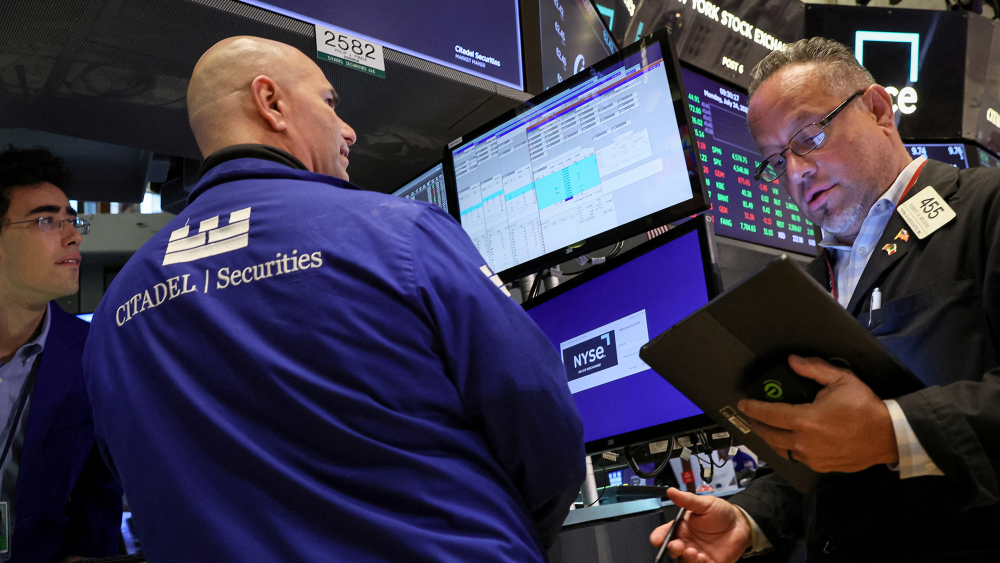
Investor attention is now focused on Donald Trump’s visit to China, where he is set to meet with Xi Jinping. Several major tech CEOs, including Jensen Huang of NVIDIA and Tim Cook of Apple, accompanied the president on the trip.
In this context, the Dow Jones Industrial Average slipped 0.1% to 49,693.20 points, while the S&P 500 rose 0.6% to 7,444.04 and the Nasdaq Composite gained 1.2% to close at 26,402.34.
Tech stocks push Wall Street to fresh highs
Although U.S. producer inflation data initially dominated market attention, investors quickly shifted focus to China, where Trump arrived to a formal red-carpet welcome. The U.S. president is expected to participate in an official arrival ceremony on Thursday before meeting with Xi and holding several interviews.
The two leaders are expected to discuss a wide range of issues, including trade and Taiwan. Trump stated that he intends to pressure Xi to “open” China further to American companies.
However, tensions involving the United States and Iran are likely to overshadow much of the summit. Analysts suggest that China, as a major importer of Iranian crude oil, could potentially play a role in guaranteeing a longer-term peace agreement, although expectations for a breakthrough remain limited.
Diplomatic efforts between Washington and Tehran appear to have stalled. Earlier this week, Trump rejected Iran’s response to a U.S. peace proposal, calling it “unacceptable” and “garbage.” Reports also circulated regarding the possibility of renewed military strikes against Iran by the White House.
For its part, Tehran has given no indication that it plans to make further concessions aimed at easing tensions with Trump.
Oil falls despite concerns over Middle East supply
At the core of investor concerns is the continued disruption surrounding the Strait of Hormuz, the critical maritime route off Iran’s southern coast through which roughly one-fifth of the world’s oil supply passes. The passage remains effectively restricted, as it has been for weeks.
In a note to clients, analysts at Deutsche Bank said there is “growing concern among investors that a U.S.-Iran agreement appears further away than many had expected following the more positive headlines seen last week.”
As a result, oil prices remain well above the $70-per-barrel level seen before the joint U.S.-Israeli offensive against Iran launched in late February. Still, Brent crude futures — the global oil benchmark — fell 2% on Wednesday to $105.57 per barrel.
At the same time, the International Energy Agency warned that global oil supply may fail to meet total demand this year, as the war continues to disrupt energy production across the Middle East.
- Check out our free forex signals
- Follow the top economic events on FX Leaders economic calendar
- Trade better, discover more Forex Trading Strategies
- Open a FREE Trading Account
- Read our latest reviews on: Avatrade, Exness, HFM and XM

Related Articles


Sidebar rates

Related Posts
 Save
Save