S&P 500 & Nasdaq 100 Weekly Outlook: Record Highs Meet the Week That Decides the Fed Path
On Saturday, the S&P 500 and Nasdaq both gained strong traction and moved close to record...
Quick overview
- The S&P 500 and Nasdaq 100 reached record highs, closing at 7,398 and 29,234, respectively, as the market anticipates key macroeconomic data this week.
- The CPI report on Tuesday is crucial, with expectations that a higher reading could lead to increased yields and a sell-off in tech stocks.
- The upcoming meeting between the US president and President Xi on Thursday could significantly impact trade relations and market sentiment.
- The transition to a new Fed chair, Warsh, may introduce a more dovish rate philosophy, influencing market expectations and valuations.
The S&P 500 and Nasdaq 100 ended the week at record highs, 7,398 and 29,234, respectively, as the market turns to May’s most pivotal macroeconomic week. It begins tomorrow with inflation readings: CPI on Tuesday followed by the producer price index on Wednesday. Then, on Thursday, the US president meets with the president of China, and the day after marks Powell’s last day at the Fed helm.
Each of the four has direct index relevance, but now that earnings have driven the rally into this run-up, the next big question for the market is whether the macroeconomic environment will do so now.
Here they are in order of impact.
CPI Tuesday May 12 (the most important read)
March saw consumer prices rise 3.3 percent on a yearly basis, up from 2.4 percent the month before, thanks to a monthly gain of 0.9 percent due to gasoline jumping 21.2 percent.
April’s reading will include the secondary effects of this energy boost on transportation, production, and service sectors that tend to follow a crude oil spike four to six weeks later. If this reading comes back hotter, it may push the 10-year yield back to 4.5 percent, which could cause stocks, particularly tech and those sensitive to rates, to sell off.
A softer print would likely see yields dip back below 4 percent and boost rate-sensitive bonds, but the S&P 500 at 20.9 times forward earnings can’t have expectations of a rate cut delayed until 2027. If it comes back below 3.0 percent, a soft CPI, September rate-cut prospects rise in the CME FedWatch tool and the dollar drops, as tech shares would be a fresh leg toward an S&P 7,584 and NDX 30,335.
If the reading comes back above 3.5 percent, a hot CPI, markets will be more in the clear that rates will stay higher for longer and the 10-year yield could move back to 4.5 percent, causing mega-cap AI stocks to get sold down on the S&P’s 7,342 support.
PPI Wednesday May 13
This reading takes in all of the tariff and energy impact from April. The ISM Manufacturing prices index climbed to 84.6 in April, the highest since April 2022, due to tariff and energy pressures. A beat following a hot CPI is a strong case for higher-for-longer.
Trump-Xi Thursday May 14
The US president will be meeting President Xi in China on Thursday, which could be a direct boost to the 90-day trade truce that has recently sent shares of Amazon, Meta Platforms, and Qualcomm up as much as 8–10 percent in a single day. Any move to expand the deal or cut additional tariffs may fuel another leg higher for tech and consumer-related names, or it may reverse the truce premium in the event the talks fall through.
Powell Friday May 15
The Powell era comes to an end tomorrow on his last day as Fed chair, but the market may begin to anticipate a different rate philosophy from his successor, Warsh, which will be more dovish than his own. Warsh is currently in favour of greater policy easing in 2026, as he believes productivity improvements will spur growth without pushing inflation higher.
From Monday on, the market will start to factor Warsh’s rate philosophy in through yields and equity price-to-earnings multiples, but Friday is the last day to do so under a Fed chair who has been in place.
S&P 500 & Nasdaq 100 Technical Levels
S&P 500: Closed at 7,398, remaining comfortably above the 1.618 Fibonacci level of 7,342, which now acts as confirmed support. Moving upward, the 7,400 psychological barrier is the immediate resistance, followed by the 7,584 2.0 Fibonacci projection.
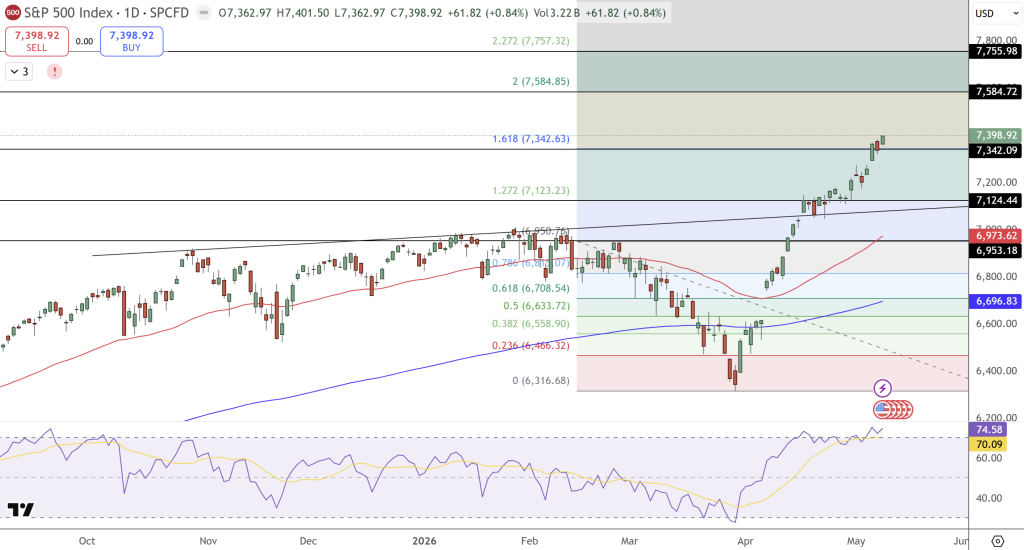
Below, the 7,342 breakout level provides the first line of defense before the ascending trendline at 7,124. The RSI currently sits around 74, indicating a high but not yet overbought condition. The preferred trade setup involves going long on a dip to 7,342, aiming for 7,584, with a stop-loss placed below 7,124.
Nasdaq 100: Closed at 29,234, well clear of the 2.0 Fibonacci at 27,844. Resistance sits at the 30,335 3.0 Fibonacci extension, the main target for bulls, with support found between 28,501 and 27,855. The RSI has pushed past 82, a level that warrants caution.
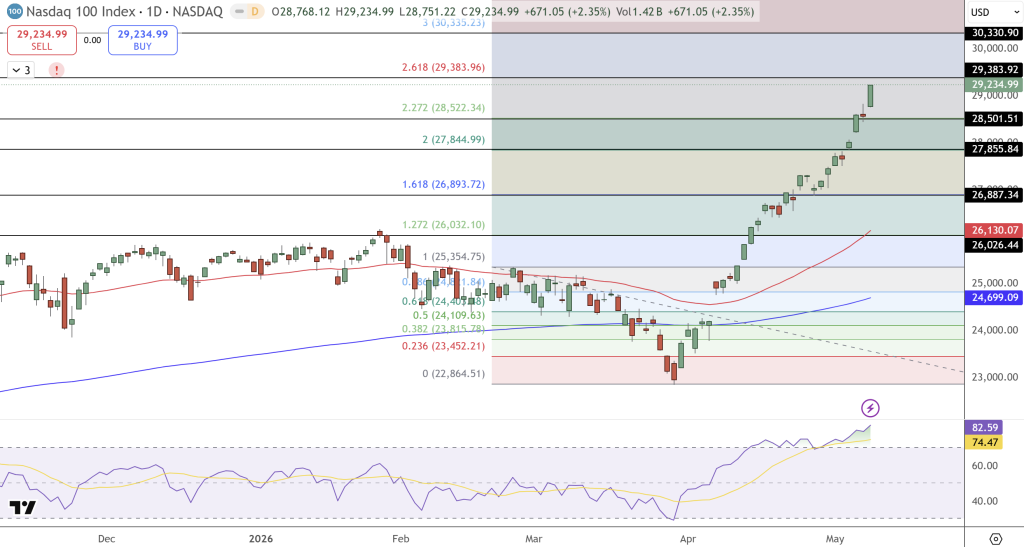
If the index climbs further ahead of Nvidia’s May 20 earnings, we may see the “sell the news” scenario analysts at Schwab have been anticipating. If tech rallies persist into that earnings release, a pullback is possible once the event concludes.
The trade plan: buy above 29,300 with a target of 30,335 and a stop below 28,501.
Weekly Outlook FAQs: Warsh Transition, Nvidia Event Risk, & CPI Headwind
Why is the April CPI so critical for equities compared to the NFP report this week?
The April NFP came in at +115,000, a figure the market has already priced in. That was the Goldilocks print, confirming a resilient economy without completely erasing hopes for Fed rate cuts next year. Today, the April CPI prints are the game changers.
Equity markets are still vulnerable to surprises in inflation data. A hot inflation number would trigger a market sell-off, especially in rate-sensitive technology and growth names as the prospect of “rates for longer” erodes valuations. A 3.0% April CPI vs 3.5% CPI means the difference between a 15% rate-cut probability in June vs 0.0% which directly feeds into the forward P/E of the Nasdaq.
What does a Warsh Fed transition mean for the stock market?
Warsh’s background in policy making and his time at the Fed lends support to central bank independence and financial system stability, containing the surge in inflation expectations associated with the energy shock. The view of productivity-enhancing growth that Warsh seems to favor is also positively impacting tech multiple valuation in an incremental sense.
The near term risk is not so much the content of his policy, but the process of institutional transition: the first few weeks of any new Fed Chair can create uncertainty that is likely to dampen risk appetite.
What’s the S&P 500 & Nasdaq 100 Outlook for Week of May 11-16?
Earnings support remains strong, as 82% of the S&P 500 beat on a year-over-year EPS basis and EPS growth for the first quarter is tracking at 25.28%. Year-end targets are currently clustered around 7,500 to 7,700 for the S&P.
The rest of this week’s equity direction is 100% on the April CPI prints: a soft CPI print enables a move up toward 7,584 for the S&P 500 & 30,335 for the Nasdaq 100, while a hard print would push for a move towards 7,342 for the S&P 500 and 28,501 for the Nasdaq 100.
The wild card could be the Trump-Xi meeting on Thursday, a potentially game changing event capable of upending the entire macro picture.
- Check out our free forex signals
- Follow the top economic events on FX Leaders economic calendar
- Trade better, discover more Forex Trading Strategies
- Open a FREE Trading Account
- Read our latest reviews on: Avatrade, Exness, HFM and XM

Related Articles

Sidebar rates

Related Posts
 Save
Save