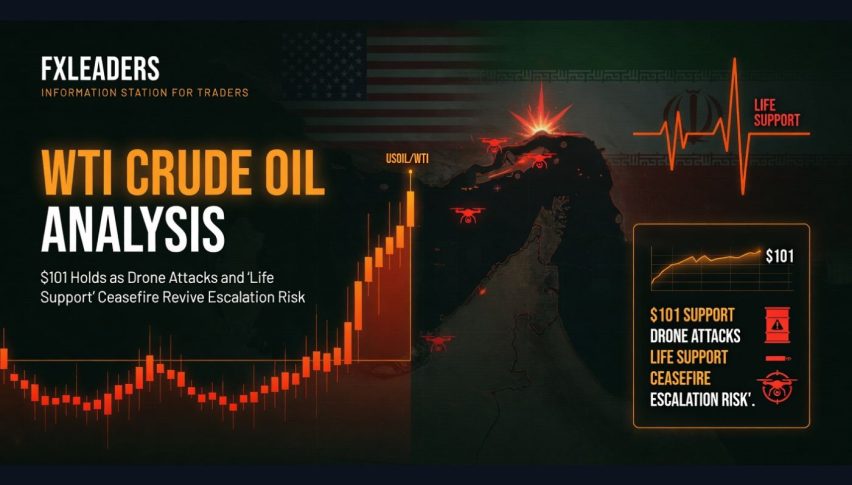
WTI Crude Oil Analysis: $101 Holds as Drone Attacks and “Life Support” Ceasefire Revive Escalation Risk
WTI stands at $101.35 as of May 12, 2026, maintaining footing above the critical $100 threshold. This stability comes despite Monday’s...
Quick overview
- WTI crude oil is currently priced at $101.35, remaining above the critical $100 mark despite geopolitical tensions and a fragile truce.
- Former President Trump criticized the peace agreement with Iran as weak, while drone attacks near Qatar highlight ongoing security concerns affecting oil transit.
- Goldman Sachs warned of rapidly depleting inventories of petroleum products, particularly in the chemical sector, raising concerns about potential shortages.
- The upcoming U.S. CPI report could influence WTI prices, with higher inflation potentially supporting crude prices while lower numbers might reduce the inflation premium.
WTI stands at $101.35 as of May 12, 2026, maintaining footing above the critical $100 threshold. This stability comes despite Monday’s sharp 3% rally that erased last week’s decline following the announcement of a deal (MOU). Former President Trump characterized the current truce as “unbelievably weak” and operating “on massive life support,” following his dismissal of an Iranian counterproposal for a nuclear deal. Simultaneously, geopolitical tensions escalated overnight when unmanned aircraft targeted a cargo ship in the waters off Qatar, while the United Arab Emirates and Kuwait successfully intercepted incoming drones. The International Energy Agency (IEA) recently termed the disruption the largest supply shock in recorded history, and this assessment is current, not retrospective.
The Truce Remains Fragile as Markets Adjust Expectations
The headline narrative suggesting a fragile truce that allows “a gradual return of tanker traffic” glosses over the turbulent events of Monday and Tuesday. WTI jumped 3% to retest its range on Monday, buoyed by Trump’s scathing “life support” description of the peace agreement, and his declaration that Tehran’s counteroffer was “totally unacceptable.” Furthermore, hostile drones targeted a merchant vessel off Qatar’s coast, and similar munitions were shot down in both the UAE and Kuwait, highlighting security realities that have kept vessel transits well below pre-conflict volumes, even as hostilities have officially paused.
While some oil tankers from the UAE, Saudi Arabia, and Qatar have been able to resume passage, volumes remain far below pre-war averages. The prolonged closure of the strategic Hormuz Strait has upended global flows of crude oil, LNG, and refined petroleum products, the crisis that the IEA labelled the most significant supply shock in modern history.
Now, the looming danger of a refined products squeeze appears to be a blind spot for many market watchers. Goldman Sachs sounded a warning alarm Monday that inventories of readily available petroleum products are draining at a rapid pace. Shortages are most acute in the chemical sector with naphtha and LPG, alongside an emerging tightness in aviation gasoline. Mike Wirth, CEO of Chevron, confirmed Monday that fuel scarcity was already becoming a worry in parts of the world. Betting on a price spike has become a reasonable calculation: Polymarket now lists 46.5% odds that May 2026 WTI will breach $110.
The Iraqis are willing to offer term buyers steep discounts, but only if shippers agree to route their ships through the Hormuz Strait. The discount itself is telling; the market perceives a tangible risk premium, and buyers are demanding an incentive to transit the choke point. Benjamin Netanyahu has stated that the war with Iran is not finished.
Today, the U.S. will release its CPI report, providing macroeconomic context. Higher-than-expected CPI numbers would indicate oil-driven inflation is trickling through to everyday products. That would increase political pressure on Trump to settle with Tehran, but at the same time it could help support crude prices by forcing the market to price in higher inflation. Conversely, if the CPI print comes in lower, it would reduce the inflation premium that is currently propping up crude prices, though the underlying physical supply disruption would remain unchanged.
WTI Technicals: $102.86 Opens the Door to $106
Looking at the WTI hourly chart, there is a bullish flag pattern forming after that aggressive rally from $96. The price is holding above the blue moving average at $100.33, with a clear series of higher lows remaining intact.
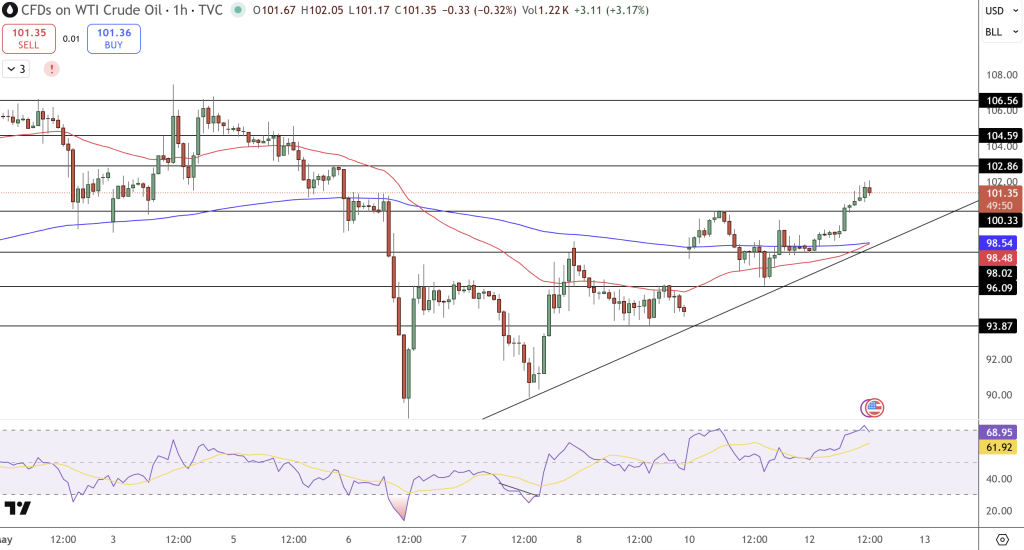
Resistance: $102.86 (red MA) to $104.59 to $106.56 (upper channel). Support: $100.33 (blue MA) to $98.54 to $96 (channel base).
The RSI indicator at 62 reflects positive divergence, suggesting the market is simply taking a breather before continuing to the upside.
Trade strategy: Consider long positions above $101.80 with targets between $102.86 and $104.59, and a stop loss below $100.33.
Analysts at LiteFinance have forecast a massive WTI volatility range in May, from a low of $74.51 to a high of $138.97, making this the widest range on the commodities table. In a sense, the risk is binary. The deal collapses, the crisis continues and WTI surges. If the deal holds, and the Strait reopens, then WTI could fall back towards pre-crisis levels. The Trump-Xi summit on May 14 to 15 in Beijing is the week’s geopolitical wildcard, a confirmed deal reducing Chinese purchases of Iranian oil would directly alter the supply calculus.
Frequently Asked Questions: WTI Crude
Why does WTI remain above $100 even though the ceasefire is not formally over?
A number of drone strikes occurred near Qatar last night, and some drones were successfully intercepted in the UAE and Kuwait overnight. Plus Trump called the ceasefire ‘on massive life support’. This suggests that the ceasefire is merely paper-thin, and there is still active combat taking place. Ship transits remain far below pre-war levels. The price floor above $100 reflects market expectation that any reopening of the Hormuz Strait and return of flows to their pre-war levels is still many months away. And that’s true regardless of whether a formal peace deal is ever announced.
What was the latest warning from the Goldman Sachs report?
Goldman Sachs has recently warned that inventories of readily accessible products are now being drawn down rapidly. The products most affected are the inputs to the petrochemicals industries, naphtha and LPG, as well as aviation gasoline. Jet fuel shortages will result in higher costs and delays for airlines. Shortages of naphtha and LPG in Asia and Europe will hurt the profitability of the chemical producers and refiners. Even if crude oil supply is restored to the market after the Hormuz Strait reopens, this shortage of products may keep prices high, especially if the refinery utilization is high.
Does today’s CPI report affect the WTI price?
Yes. A hot CPI number above 3.7% will confirm that the oil crisis is feeding through to consumer prices, putting more political pressure on Trump to end the crisis, but also likely helping the price of WTI hold above $100. But, a cool CPI number below 3.3% would help alleviate that pressure. That may lead traders to reduce their bets on inflation, and could pull the price back to $98 or $100. However, this won’t affect physical flows and supply. It only helps or hinders the price if the market is still trading the price impact of the current crisis in the future, rather than just the current supply disruption.
- Check out our free forex signals
- Follow the top economic events on FX Leaders economic calendar
- Trade better, discover more Forex Trading Strategies
- Open a FREE Trading Account
- Read our latest reviews on: Avatrade, Exness, HFM and XM

Related Articles
Sidebar rates

Related Posts
 Save
Save