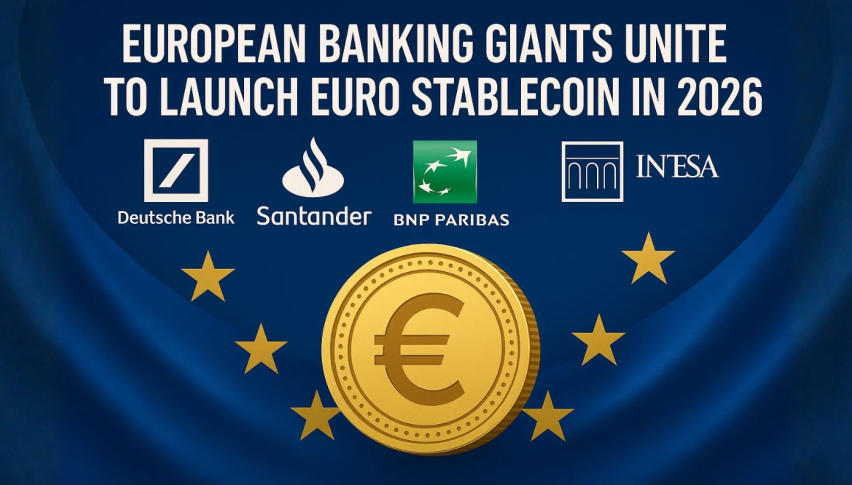
European Banking Giants Unite to Launch Euro Stablecoin in 2026
A group of ten European banks, including ING (INGA.AS), UniCredit (CRDI.MI), and BNP Paribas (BNPP.PA), has launched a business...
Quick overview
- A consortium of ten European banks, including ING and BNP Paribas, plans to launch a euro-pegged stablecoin by late 2026 to enhance digital payment capabilities in Europe.
- The stablecoin will comply with the EU's Markets in Crypto-Assets framework and aims to provide low-cost, near-instant payments, initially focusing on cryptocurrency trading.
- Qivalis, the Amsterdam-based subsidiary leading the project, is headed by Jan-Oliver Sell, a former CEO of Coinbase's German operation.
- Despite the initiative, interest in euro-pegged stablecoins remains low, with existing offerings having minimal market capitalization compared to global standards.
A group of ten European banks, including ING (INGA.AS), UniCredit (CRDI.MI), and BNP Paribas (BNPP.PA), has launched a business to introduce a euro-pegged stablecoin in the latter half of 2026, hoping to fight US supremacy in digital payments.
Qivalis, the banks’ Amsterdam-based subsidiary, plans to establish a stablecoin complying with the region’s Markets in Crypto-Assets (MiCA) framework, requiring regulatory permission.
Jan-Oliver Sell, the former CEO of crypto exchange Coinbase’s German operation and a former Binance employee, will lead Qivalis. Howard Davies, a former NatWest chair, will serve as chairman, the group announced at a news conference in Amsterdam on Tuesday.
A native euro stablecoin is more than simply convenience; it represents monetary liberty in the digital era, according to Qivalis CEO Jan-Oliver Sell. Providing new opportunities for European businesses and consumers to participate with blockchain payments and virtual asset markets in their native currency, he added.
Banks are battling with the rapidly expanding stablecoin market and the broader expansion of cryptocurrencies, which some lenders regard as possible direct competitors.
This rise has put traditional lenders under pressure to develop use for blockchain technology in their own businesses.
The development of a major euro-pegged stablecoin arrives as US regulators prepare to implement legislation creating a framework for payment stablecoins in the country. The bill, known as the GENIUS Act, was signed into law by President Donald Trump in July.
NEW: GROUP OF 10 EUROPEAN BANKS, INCLUDING ING, UNICREDIT, AND BNP PARIBAS, HAVE FORMED A COMPANY TO LAUNCH A EURO-PEGGED STABLECOIN IN THE SECOND HALF OF 2026, IN A MOVE THEY HOPE WILL COUNTER U.S. DOMINANCE IN DIGITAL PAYMENTS – VIA REUTERS
SOURCE: https://t.co/jyTpThlhD5 pic.twitter.com/vthFQB5Cri
— DEGEN NEWS (@DegenerateNews) December 2, 2025
There are little signs of interest for euro-pegged stablecoins. Societe Generale’s crypto arm, SG-FORGE, which is not part of Qivalis, debuted a euro-pegged stablecoin in 2023, but just 64 million euros ($74.27 million) of tokens are in circulation.
According to Qivalis, the token would allow “near-instant, low-cost payments and settlements,” although Davies stated that the initial use-case will be in cryptocurrency trading.
Regulatory concerns:
Among the EU banks’ efforts, Dutch Central Bank Governor Olaf Sleijpen reportedly worried of the potential harm to monetary policy if the stablecoin market expands. The European Central Bank (ECB) issued a paper in November stating that the dangers linked with stablecoins were likely modest, but the justifies close monitoring.
According to ECB consultant Jürgen Schaafhe, euro-denominated stablecoins held a market capitalization of less than 350 million euros, or roughly $407 million, at the time of publication. This accounted for less than 1% of the global market in July.
Floris Lugt, ING’s digital assets lead who will become Qivalis’ CFO, said the group had spoken with the ECB, which was “very supportive” of the proposal.
Our impression of them is that they are very supportive, which is because one important policy goal is to attain strategic autonomy in European payments, and they are very concerned about stablecoins, particularly US dollar fintech-issued stablecoins, and they prefer to have – in our opinion – European champions to support.
The banks involved in the project, which was first announced in September, were initially ING, UniCredit, Danske Bank (DANSKE.CO), Banca Sella (BSEL.HT), KBC (KBC.BR), Caixabank (CABK.MC), DekaBank,SEB (SEBa.ST), and Raiffeisen Bank International (RBIV.VI). BNP Paribas has since joined the consortium, Lugt stated on Tuesday.
A different group of ten institutions, including Bank of America (BAC.N), Deutsche Bank (DBKGn.DE), Goldman Sachs (GS.N), and UBS (UBSG.S), have also announced that they are jointly studying the issuance of a stablecoin. BNP Paribas is member of both groups.
- Check out our free forex signals
- Follow the top economic events on FX Leaders economic calendar
- Trade better, discover more Forex Trading Strategies
- Open a FREE Trading Account
- Read our latest reviews on: Avatrade, Exness, HFM and XM

Related Articles


Sidebar rates

Related Posts
 Save
Save