CoreWeave Stock Plunges 8% as AI Infrastructure Selloff Intensifies
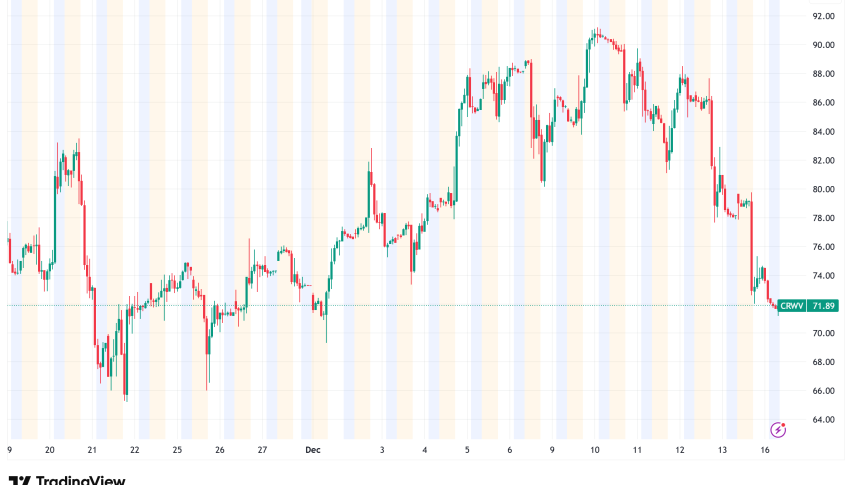
Monday's sharp plunge in CoreWeave Inc. (NASDAQ: CRWV) saw the firm drop around 8% to $72.36 per share, continuing a vicious selloff that
Quick overview
- CoreWeave Inc. experienced an 8% drop in stock price, continuing a decline of over 60% since its June peak.
- Investor concerns are rising due to the company's high debt-to-equity ratio and substantial capital expenditures, which have outpaced revenue growth.
- Despite these challenges, CoreWeave has a significant revenue backlog of $55.6 billion, with 40% expected to be realized in the next two years.
- Analysts are divided on the company's future, with price targets ranging from $50 to $150, as investors await updates on profitability and data center developments.
Monday’s sharp plunge in CoreWeave Inc. (NASDAQ: CRWV) saw the firm drop around 8% to $72.36 per share, continuing a vicious selloff that has wiped off over 60% of the company’s value since its June peak. After going public at $40 a share in March, the AI infrastructure specialist is currently at the forefront of a larger market reevaluation of AI investments and returns.
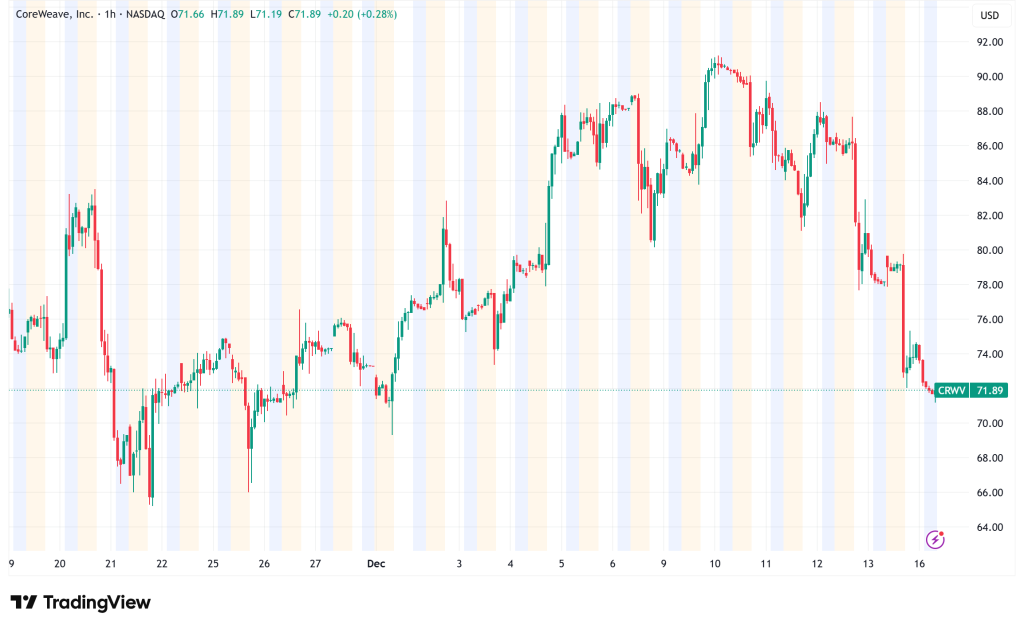
The most recent decline in the stock coincides with a broader trend in AI infrastructure names. As investors become more concerned about whether the AI industry’s enormous capital expenditures will result in long-term profits, shares of Broadcom, CoreWeave, and Oracle all fell Monday, continuing the losses from the previous week.
Growing doubts about CoreWeave’s capital-intensive business model are reflected in the company’s sharp decline from a June peak of $187 to current levels below $73. In order to run its business, the AI cloud provider buys cutting-edge graphics processing units from Nvidia and rents computing power to well-known customers like OpenAI, Microsoft, and Meta Platforms. Although the company’s revenue has increased dramatically as a result of this strategy, it has also left it with substantial financial responsibilities.
The Debt Question
The aggressive fundraising strategy of CoreWeave is the main source of investor concerns. Concerns over leverage and possible dilution were raised by the company’s recent completion of an enlarged $2.587 billion convertible notes issuance. Venture capitalist Tomasz Tunguz of Theory Ventures claims that CoreWeave has a debt-to-equity ratio of over 120%, which is far higher than that of its competitors in the cloud computing space, such as Amazon, Microsoft, and Google, which have ratios ranging from 7% to 23%.
The company’s capital expenditure needs are still very high. After spending $2.9 billion in Q2 and $1.9 billion in Q1, CoreWeave spent $1.9 billion on capital expenditures in just the third quarter. However, Q3 revenue was only $1.4 billion, indicating that the corporation spent more than twice as much on infrastructure buildout as it did in the previous year. Over the past twelve months, CoreWeave has burned up more than $8 billion in free cash flow due to this expenditure pattern.
A Massive Backlog Offers Hope
CoreWeave still has a potentially revolutionary revenue funnel in spite of the losses. As of September 30, 2025, the firm reported a $55.6 billion revenue backlog, of which 40% is anticipated to be realized in the upcoming 24 months. A $14.2 billion commitment from Meta Platforms through 2031 and a five-year arrangement with OpenAI for up to $11.9 billion are two significant contracts.
During a CNBC appearance, Wellington Management’s head of late-stage development, Matt Witheiler, expressed a measured opinion: “It definitely requires the ROI to be there to keep funding this AI investment.” Based on our current observations, there is a return on investment. He pointed out that in order to make more money, AI companies constantly request greater processing power.
The Profitability Puzzle
According to CoreWeave’s third-quarter figures, the company’s revenue increased by triple digits year over year to almost $1.36 billion. For the first time, the business’s adjusted operating income was positive. However, CoreWeave continues to be extremely unprofitable on a GAAP basis because of high interest and depreciation charges.
There are structural obstacles in the way of long-term profitability. GPUs that execute AI workloads are subjected to extreme stress and usually last three years, while some break down in as little as a year. Furthermore, cutting-edge hardware quickly becomes outdated due to Nvidia’s short release cycles. Since CoreWeave places a strong emphasis on providing top-notch equipment, the business must constantly make capital expenditures.
Citing delays at a third-party data center partner, CoreWeave reduced its 2025 revenue projection from a previous estimate of $5.15 billion to $5.35 billion to a range of $5.05 billion to $5.15 billion, adding to short-term worries. The market became more sensitive to execution concerns as a result of the change.
Wall Street Divided
Due to the high beta of the company, analyst opinions on CoreWeave differ greatly. Current price targets are between $110 and $150, and some pessimistic analysts predict that if attitude against AI infrastructure continues to deteriorate, the stock may drop as low as $50. In November, JPMorgan lowered CoreWeave to Neutral with a $110 target, citing building delays and supply chain challenges.
Momentum-focused investors’ concerns have been heightened by the convertible debt offering and insider selling, including a recent disposition by CFO Nitin Agrawal. The stock fell over 20% between December 9 and December 15, highlighting its susceptibility to changing mood.
Looking Ahead
CoreWeave’s future depends on a number of important aspects, including its capacity to turn its enormous backlog into lucrative income, the timely and successful completion of its data center buildout, and the willingness of the general market to finance capital-intensive AI infrastructure bets. To further solidify its position in the AI ecosystem, the company also declared its involvement in a $20 million investment fund connected to New Jersey’s AI Hub Strategic Innovation Center.
CoreWeave is still a high-stakes wager on the development of artificial intelligence. Investors have to balance significant balance sheet concerns, an unclear time to profitability, and great growth potential. According to one analyst, the question is whether CoreWeave can scale financially before its finance costs and capital requirements surpass revenue growth, rather than if AI demand exists.
Investors will be keenly monitoring CoreWeave’s upcoming earnings release and any updates on data center timing as U.S. markets continue to reevaluate AI infrastructure values. They are trying to ascertain whether the stock’s 50% drop from its top is a warning sign or a buying opportunity.
- Check out our free forex signals
- Follow the top economic events on FX Leaders economic calendar
- Trade better, discover more Forex Trading Strategies
- Open a FREE Trading Account
- Read our latest reviews on: Avatrade, Exness, HFM and XM

Related Articles

Sidebar rates

Related Posts
 Save
Save