Crypto Ownership in Europe Hits 9% as 2024 Rules Transform Market
Crypto ownership across Europe certainly took a wild ride in 2025, but then came a major turning point with regulatory clarity.
Quick overview
- In 2025, regulatory clarity significantly boosted crypto ownership in Europe, with 90% of adults in major economies recognizing it as a legitimate asset class.
- Crypto ownership in the eurozone more than doubled from 4% in 2022 to 9% in 2024, with notable increases in countries like Greece and Lithuania.
- Investment remains the primary use of crypto among Europeans, with a high concentration of holders using it solely for investment purposes rather than daily transactions.
- Despite growing institutional adoption, crypto still faces challenges in becoming a functional payment tool within the European financial infrastructure.
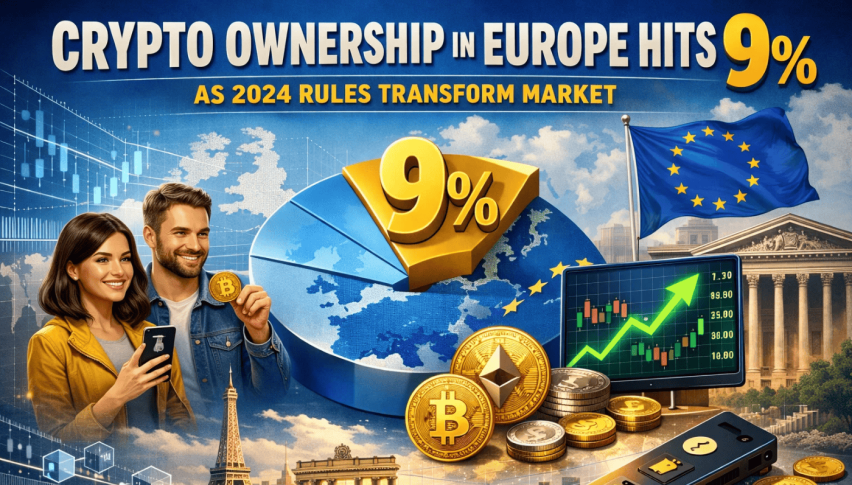
Crypto ownership across Europe certainly took a wild ride in 2025, but then came a major turning point with regulatory clarity. Finally, awareness is no longer the biggest obstacle. A whopping 90% of the 18-plus crowd in the major economies now see cryptocurrencies as a bona fide financial asset class. And a survey by the European Central Bank found that 9% of adults in the eurozone had invested in crypto by 2024, indicating that this market has long since moved beyond a niche cult following.
The ownership levels are consistent across all the countries involved. Some places have a lower rate, like Germany and the Netherlands, where it’s around 6%; while other places have a much higher rate, like Slovenia at 15%, which is a pretty good example of how modest variation can be achieved despite some pretty big differences in the economies of each country. This suggests that regulation is increasingly the driving force behind adoption, rather than national income or demographics.
Ownership up by more than 100% since 2022
Ownership of crypto has more than doubled across most eurozone countries since 2022, rising from 4% to 9% in 2024. The Netherlands was the one place where things didn’t change much, and there wasn’t enough data to go on for Croatia in 2022.
Some countries recorded some pretty sharp increases in ownership, which is a good sign for renewed confidence among investors:
- Greece and Lithuania both saw a 10-point leap
- Cyprus, Belgium, Ireland, Austria, Slovakia, Portugal, and Italy each rose by 7 points
- And all of that growth, you can bet, is aligned closely with the broader global market recovery
This whole expansion coincided with the launch of Europe’s Markets in Crypto Assets framework, which, among other things, strengthened consumer protection and standardized oversight across member states. For a lot of retail participants, regulatory safeguards reduced the perceived risk and legitimized crypto as something you could invest in.
Investment accounts for the bulk – payments are a far cry behind
Even though ownership is on the rise, the way Europeans are using crypto remains largely driven by investment. The Netherlands and Germany – both of which have pretty low ownership rates – show the highest investment concentration, with 90% and 82% of holders using crypto just for investment purposes. France is an exception here, with 25% of users reporting crypto use for payment-related purposes.
Some key takeaways from all this are:
- Crypto is hardly ever used for daily transactions
- The retail adoption is still pretty speculative in nature
- Utility is going to depend on how well it gets integrated with the payment systems
While the institutional adoption is expanding, how consumers behave tells us that crypto’s still a long, long way from being a functional payment tool. Long-term utility will depend on how regulators execute on this and how well it is integrated into the European financial infrastructure.
Crypto in Europe is no longer some high-risk novelty. It’s indeed becoming more institutional, more regulated, and more measured – but still searching for that everyday relevance.
- Check out our free forex signals
- Follow the top economic events on FX Leaders economic calendar
- Trade better, discover more Forex Trading Strategies
- Open a FREE Trading Account
- Read our latest reviews on: Avatrade, Exness, HFM and XM

Related Articles

Sidebar rates

Related Posts
 Save
Save