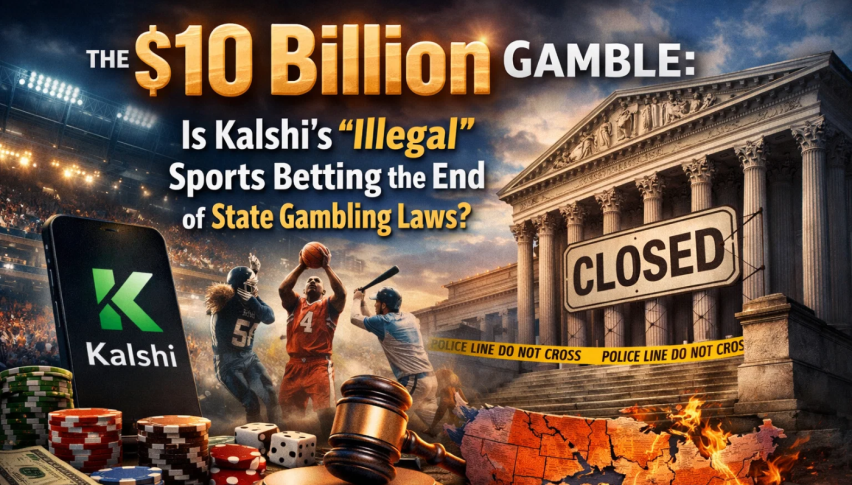
The $10 Billion Gamble: Is Kalshi’s “Illegal” Sports Betting the End of State Gambling Laws?
A huge legal mess is shaking up the foundations of America's betting industry. Kalshi , the ultra trendy Silicon Valley company...
Quick overview
- Kalshi, a Silicon Valley company, is facing over twenty lawsuits that challenge its legitimacy as a betting platform, labeling it an 'illegal gambling operation.'
- The latest class action lawsuit in Oregon seeks double damages under a unique statute aimed at shutting down illegal sportsbooks, claiming Kalshi operates more like a sportsbook than a financial exchange.
- Plaintiffs allege that users are betting against Kalshi's own subsidiaries, undermining the company's claim of being a peer-to-peer exchange.
- The outcome of these legal battles could significantly impact casual traders' ability to engage in event contracts, potentially restricting access to markets based on state laws.
A huge legal mess is shaking up the foundations of America’s betting industry. Kalshi , the ultra trendy Silicon Valley company that promised to take global events and turn them into a tradable asset class, is now getting smashed by a “tsunami” of lawsuits that could take apart the way Americans gamble on everything from the Superbowl to the weather in their own backyards.
With over twenty active lawsuits scattered across the country , the battle has gone from high-stakes boardroom debates to a super high-stakes showdown in Oregon, where a brand new class action lawsuit is gunning for double damages because it calls Kalshi an “illegal gambling operation”.
The Oregon Showdown: A Legal Time Bomb for Prediction Markets?
The latest filing in Oregon is more than just another legal headache, its a financial minefield. Plaintiffs are using Oregon’s unique loss-recovery statute – a little known tool designed to put operators of illegal sportsbooks out of business by making them pay back double what people lost – in an attempt to bankrupt Kalshi.
The crux of their argument? Kalshi isn’t a “financial exchange” – it’s a sportsbook in a fancy dress.
“By operating unlicensed sports betting, Kalshi is breaking gambling laws and has unfairly made a profit off tens of thousands of consumers,” the lawsuit claims.
While Kalshi claims its “event contracts” are special sorts of federal derivatives, state regulators in Oregon & Nevada reckon they are basically indistinguishable from the “prop bets” you can find on platforms like FanDuel or DraftKings.
The $2 billion Ghost Market: Who Are You Really Betting Against?
One of the most explosive claims in the lawsuit is the “Market maker” controversy. While Kalshi pitches itself as a peer-to-peer (P2P) exchange where you bet against other users, the lawsuits claim the reality is far from it:
NEW: Kalshi has been hit with a federal class action lawsuit in Oregon for operating an "illegal online gambling enterprise" in violation of Oregon law, which bans all non-state-run gambling-related activities within its borders. Seeks 2x damages under OR's loss recovery statute. pic.twitter.com/cUCgnSVHGY
— Daniel Wallach (@WALLACHLEGAL) February 21, 2026
- The “house” is back: Plaintiffs claim users often bet against Kalshi’s own subsidiaries or massive hedge funds like Susquehanna International Group (SIG).
- The Edge in odds: The suit alleges these market-making entities get involved when bets start to diverge from Kalshi’s internal projections, essentially acting as “the house”.
- Massive volume: In September (2025 ?, we’re not told why the year is only mentioned for this one fact alone) sports contracts accounted for a whoppng 90% of Kalshi’s volume, to the tune of nearly $2 billion.
The CFTC & Kalshi
These are “financial derivatives” that get used for hedging risk, protected by federal law. Federal Preemption (Commodity Exchange Act) – this is the law that’s supposed to give prediction markets a federal shield.
The new CFTC Chairman, Michael Selig, has taken a “big stick” approach to defending the industry, recently filing a friend of the court brief to protect prediction markets from “overzealous state governments”.
Supreme Court Bound: The “Major Questions” Doctrine
Legal analysts, like Bloomberg’s Elliott Stein, think this fragmentation is the “perfect way for the Supreme Court to get involved”.
The Court’s recent trend of reining in the power of agencies (the Major Questions Doctrine) could be Kalshi’s weakness. If the Justices decide Congress never gave the CFTC the power to regulate nationwide sports betting, the “federal shield” will disappear and leave Kalshi at the mercy of 50 different state laws.
What This Means For You
For casual traders, the outcome will determine if you can still be trading on NFL “event contracts” on your phone at 18, or if those markets will only be available in states with licensed, legal sportsbooks.
Are you currently trading on Kalshi or Polymarket?
The Risk: Your money could get tied up on platforms that are facing cease and desist orders.
The Reward: Prediction markets often have “better odds” because they operate as exchanges rather than traditional sportsbooks.
- Check out our free forex signals
- Follow the top economic events on FX Leaders economic calendar
- Trade better, discover more Forex Trading Strategies
- Open a FREE Trading Account
- Read our latest reviews on: Avatrade, Exness, HFM and XM

Related Articles
Sidebar rates

Related Posts
 Save
Save