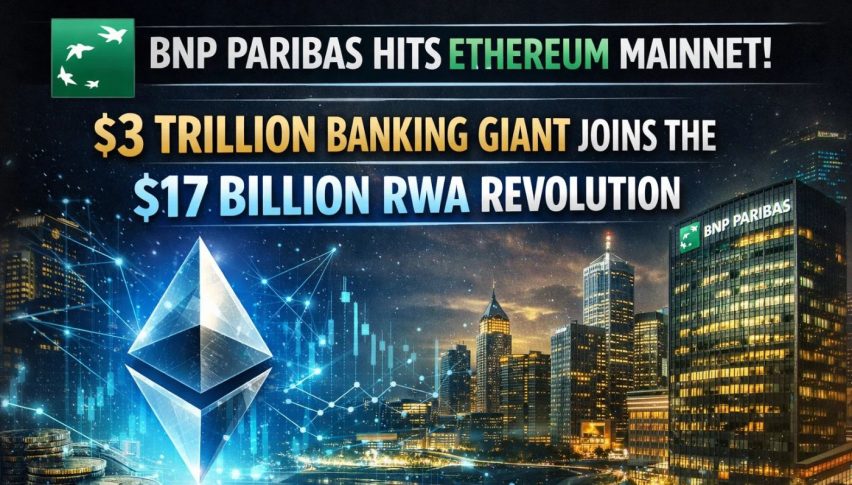
BNP Paribas Hits Ethereum Mainnet: $3 Trillion Banking Giant Joins the $17 Billion RWA Revolution
Traditional finance has made a big move into the public eye. BNP Paribas, Europe’s largest bank with more than $3 trillion in assets...
Quick overview
- BNP Paribas has launched a tokenized share class of its French money market fund on the public Ethereum blockchain, marking a significant shift in institutional finance.
- The pilot project utilizes the bank's AssetFoundry platform, allowing for instant trading and strict identity verification for participants.
- Tokenized money market funds are emerging as a high-yield alternative for large firms, enhancing collateral efficiency and enabling real-time transactions.
- BNP Paribas' decision to use Ethereum signals a move away from private blockchains, potentially leading to greater interoperability among institutional assets.
Traditional finance has made a big move into the public eye. BNP Paribas, Europe’s largest bank with more than $3 trillion in assets, has launched a tokenized share class of its French money market fund on the public Ethereum blockchain.
This is more than a typical pilot project. By moving from private ledgers to Ethereum, BNP Paribas is showing that the future of institutional liquidity is on-chain, not hidden behind firewalls. This step comes as the Ethereum real-world asset market cap has grown past $17 billion, up 315% from last year.
The “AssetFoundry” Breakthrough: Public Tech, Private Control
The pilot used the bank’s AssetFoundry platform, which manages the connection between regulated fund accounting and blockchain technology. Although the fund operates on the public Ethereum mainnet, it uses a permissioned access system.
How it Works:
- Identity Verification: Only participants who pass strict KYC and AML checks can hold these tokens.
- Atomic Settlement: Unlike traditional funds that settle in 24 to 48 hours, these tokenized shares can be traded instantly, with the asset and payment exchanged at the same time.
- Intra-Group Testing: This first phase was a one-time experiment involving BNP Paribas Asset Management, its CIB division, and Securities Services to make sure the system works reliably.
Why Money Market Funds (MMFs) are the Perfect “Digital Fuel”
Money market funds are now a leading use case for institutional tokenization. For large firms like BNP Paribas, BlackRock, and Fidelity, tokenizing these funds provides a high-yield, regulated alternative to stablecoins.
The Institutional Advantage:
- Yield on Idle Cash: Corporate treasurers can use tokenized money market funds as collateral, earning institutional yields while keeping the liquidity of a digital token.
- Collateral Efficiency: In derivatives trading, posting tokenized shares as collateral at any time, instead of waiting for bank hours, could save millions by improving capital efficiency.
- Real-Time NAV: Tokenization enables on-demand transactions based on real-time Net Asset Value, moving away from batch processing.
Stablecoins can move billions across the world in seconds. No forms. No waiting. No “please verify again.” The money just moves.
But the moment a user switches to a new app? They’re starting from zero.
KYC again. Wallet connect again. Prove your reputation again. Build trust… pic.twitter.com/Z8ylM94Jep
— Rasta (@sodeindemueez) February 22, 2026
Ethereum Consolidates its Lead in RWA Dominance
BNP Paribas’ choice to use Ethereum is a setback for private blockchain competitors. Recent data from The Block and RWA.xyz shows that Ethereum has established itself as the main global settlement layer for institutional assets.
| Blockchain | Tokenized RWA Value (Feb 2026) | Annual Growth |
| Ethereum | $17.1 Billion | +315% |
| Solana | $1.8 Billion | +140% |
| XRP Ledger | $1.5 Billion | +267% |
| Stellar | $0.9 Billion | +12% |
Professional Analysis: The End of “Blockchain Isolation”
With ten years of experience in both forex and crypto, my main takeaway is that the era of private-only banking blockchains is ending. Two years ago, banks were wary of the public Ethereum network. Now, they are building permissioned layers on top of it. By choosing Ethereum, BNP Paribas gains interoperability. Their fund could eventually interact with other tokenized assets from BlackRock or JPMorgan, helping to create a large, unified pool of global institutional liquidity.
“This pilot allows us to explore new end-to-end processes in a controlled, regulated environment while benefiting from the strength and broad adoption of public infrastructure,” said Edouard Legrand, Chief Digital Officer at BNP Paribas Asset Management.
The Week Ahead: What to Watch
With the CLARITY Act close to a vote in Washington and the GENIUS Act encouraging adoption in Europe, institutional tokenization is shifting from experiment to enterprise.
Watch for other major European banks, such as SocGen or Deutsche Bank, possibly following BNP’s example and moving onto Ethereum.
Stablecoin Competition: Monitor whether tokenized money market funds start to reduce the market share of institutional stablecoins like USDC or PYUSD.
- Check out our free forex signals
- Follow the top economic events on FX Leaders economic calendar
- Trade better, discover more Forex Trading Strategies
- Open a FREE Trading Account
- Read our latest reviews on: Avatrade, Exness, HFM and XM

Related Articles



Sidebar rates

Related Posts
 Save
Save