ExxonMobil Surges 3.3% Amid Middle East Tensions and Strong Institutional Confidence
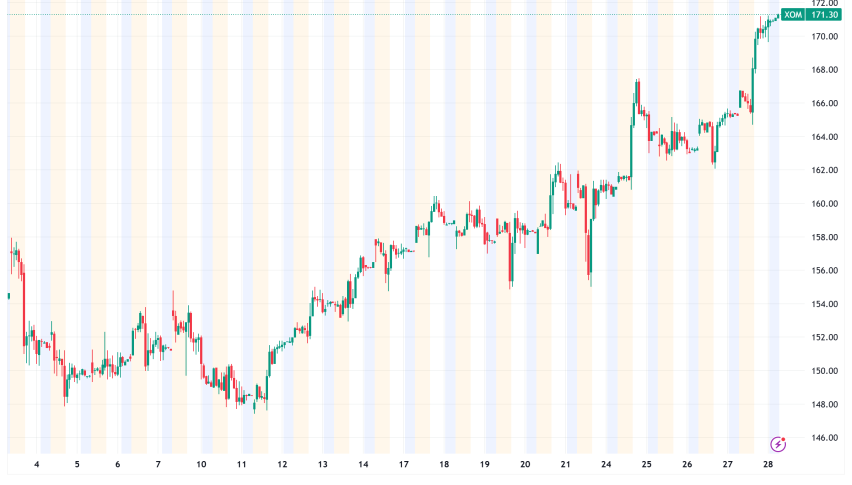
ExxonMobil's (NYSE: XOM) shares closed at $170.99 on Friday, close to its 52-week high of $171.23, capping a successful week. Investors rush
Quick overview
- ExxonMobil's shares closed at $170.99, nearing its 52-week high, as investors flocked to energy stocks amid Middle East tensions.
- Geopolitical volatility has driven crude oil prices above $91, raising concerns about supply shortages due to actions in the Strait of Hormuz.
- ExxonMobil's stock has gained 50.2% over the past year, with analysts suggesting it remains undervalued and projecting further growth.
- The company continues to pay a quarterly dividend, making it an attractive option for income-focused investors amid ongoing geopolitical risks.
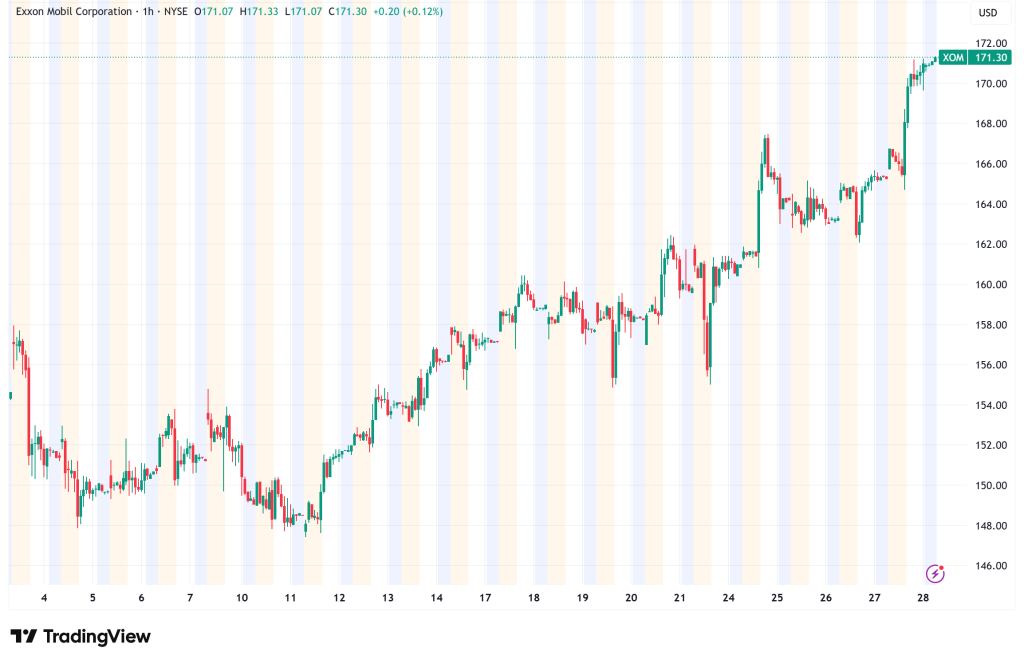
ExxonMobil’s (NYSE: XOM) shares closed at $170.99 on Friday, close to its 52-week high of $171.23, capping a successful week. Investors rushed into energy companies because they were perceived as safe havens during supply shocks due to the growing tensions in the Middle East.
Geopolitical Volatility Drives Crude Above $91
It was a quick and important catalyst. Iran took action to prevent commercial shipping via the Strait of Hormuz after Israeli and American military operations. About 20% of the world’s supplies of oil and liquefied natural gas pass through the strait, and its effective closure has raised grave concerns about supply shortages in the world’s energy markets. Since the strikes started in late February, oil and gas prices have increased significantly, and economists caution that if tensions worsen, they may rise even more.
Although the Trump Administration has declared that it is actively seeking a diplomatic resolution to the problem, there have been rumors that Washington is also considering conducting ground operations inside Iran. This would represent a significant escalation and may extend the crisis for months.
There were other companies who profited from the unrest than ExxonMobil. Oilfield services behemoth SLB had a 15% increase throughout the week, while offshore driller Transocean saw an 11% increase. Nevertheless, considering the size of the business, ExxonMobil’s action was noteworthy. The energy major, whose market capitalization is close to $713 billion, saw a significant change in investor attitude with its 7% weekly rise.
Institutional Confidence and Financial Strength
The increase completes the stock’s already incredible run. With a 50.2% gain over the last 12 months and a 39.4% year-to-date increase, shares have generated both praise and concerns about whether more upside is possible.
It seems that valuation analysts believe it does. Based on trailing twelve-month free cash flow of about $27.8 billion and projected free cash flow of $40.7 billion by 2030, Simply Wall St.’s discounted cash flow analysis places ExxonMobil’s intrinsic value at about $248.93 per share, suggesting the stock is still about 31% undervalued at current prices. Again indicating space to grow, the company’s price-to-earnings ratio is 24.7x compared to a calculated fair ratio of 28.55x.
It seems that institutional investors concur. In the fourth quarter, Dakota Wealth Management raised its ownership to 336,114 shares, worth around $40.45 million, a 28.4% gain. Additionally, BWM Planning LLC increased its stake, indicating that more funds have faith in the fundamentals of the energy behemoth.
In most of Wall Street, analyst price expectations are likewise optimistic. Bernstein set a $195 goal with an Outperform call, while Morgan Stanley just increased its target to $172 while keeping its Overweight rating. At $171, UBS reiterated its Buy recommendation. BNP Paribas Exane issued a warning, downgrading the stock to Underperform with a $125 target due to worries about the long-term energy shift.
The company’s 45% ownership in the Guyana Stabroek block, as well as ongoing Permian Basin expansion and increasing LNG exposure, are key components of ExxonMobil’s longer-term investment rationale. In comparison to 2024 levels, the corporation anticipates $25 billion in increased yearly earnings and $35 billion in additional cash flow by 2030. At $65 Brent pricing, the total excess cash could reach $145 billion.
Is Exxon (XOM) a Good Investment?
ExxonMobil continues to pay a quarterly dividend of $1.03 per share to income-focused investors, which annualizes to $4.12 for a yield of roughly 2.4%.
ExxonMobil appears destined to stay at the center of energy investors’ portfolios for the foreseeable future because geopolitical risk does not appear to be abating anytime soon and the company’s integrated model, which includes exploration, production, refining, and petrochemicals, provides a natural buffer against commodity volatility.
- Check out our free forex signals
- Follow the top economic events on FX Leaders economic calendar
- Trade better, discover more Forex Trading Strategies
- Open a FREE Trading Account
- Read our latest reviews on: Avatrade, Exness, HFM and XM

Related Articles
Sidebar rates

Related Posts
 Save
Save