Gold Keeps Shining: Markets Bet on Bigger Gains in 2026
In this context, the World Gold Council’s projection of a 5–15% rise looks fairly conservative, U.S. data remain mixed.

Quick overview
- Gold has achieved remarkable success in 2025, breaking over 50 records and trading above $4,200 per troy ounce with a 60% year-to-date return.
- Major investment banks forecast continued growth for gold, with projections ranging from $4,500 to as high as $20,000 per ounce by the end of the decade.
- Strong demand from ETFs, retail investors, and central banks worldwide is driving gold's appeal as a safe-haven asset amid economic uncertainty.
- Looking ahead to 2026, geopolitical tensions and mixed economic data suggest that gold may continue to benefit from increased investor caution.
The yellow metal has spent the year smashing records. It has outperformed nearly every other asset in 2025, and while it’s true that trees don’t grow to the sky, forecasts suggest gold still has room to climb.
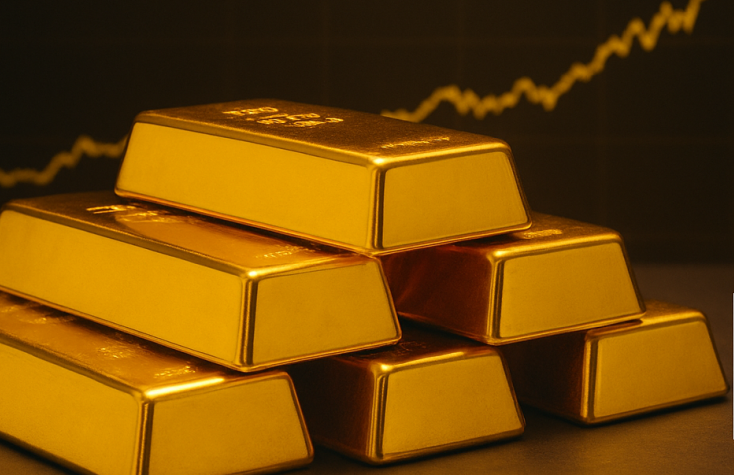
As the year draws to a close, gold has already broken more than 50 records on global markets. The troy ounce is trading above $4,200 on New York’s Comex, delivering a 60% year-to-date return and becoming the most profitable asset of the year. Major investment banks—Goldman Sachs, J.P. Morgan, Deutsche Bank, and others—whether by momentum, FOMO, or simple herd behavior, continue to project fresh highs for gold in 2026 and beyond.
Forecasts range from a modest $4,500 to more than $6,000 per ounce, and some even imagine levels as high as $20,000 by the end of the decade, tied to a potential collapse of fiat currencies as we know them. While many variables could influence gold’s path, experts across the global metals market agree: the rally isn’t over.
Demand remains strong—not only from ETFs and retail investors, but also from central banks, which keep announcing new gold-reserve purchase programs across every continent. China has long led the push, but now countries across Europe, Asia, Latin America, and Africa are joining in. No one wants to miss the wave, even with prices at levels that might typically deter new buying. In this context, the World Gold Council’s projection of a 5–15% rise looks fairly conservative.
A remarkable year for gold
Gold’s performance in 2025 has been extraordinary, marking what could become the metal’s fourth-best annual return since 1971. The surge was driven by geopolitical and economic uncertainty, a weaker dollar, and strong price momentum. This environment boosted portfolio diversification as bonds delivered lackluster returns and investors grew uneasy about overheated stock markets.
Both private investors and central banks increased their exposure to gold as a source of stability—across every region, from West to East.
What to expect in 2026
Looking ahead, markets largely expect the status quo to hold, but diverging macroeconomic data—complicated by geopolitical tension—means uncertainty will remain elevated. Concerns are rising over a cooling U.S. labor market, and debates continue over whether inflation will remain sticky or face renewed upward pressure. Meanwhile, geopolitical frictions remain unresolved.
What does this mean for gold? As in 2025, unexpected “tail-risk” events are impossible to forecast, yet their frequency is rising—adding fuel to gold’s safe-haven appeal.
The consensus view: steady support with room to rise
Gold’s current price already reflects the broad macroeconomic consensus on growth, inflation, and monetary policy.
That consensus includes:
- Global GDP growth stable and near trend (2.7%–2.8% real)
- Another 75 bps of Fed rate cuts expected
- Inflation falling 40–60 bps by year-end
A slightly stronger dollar and relatively stable bond yields
U.S. data remain mixed, but market participants fear the momentum is slowing. As risk appetite wanes, investors shift toward defensive assets. A potential reset in AI-driven market expectations could further weigh on equities—especially given AI stocks’ heavy influence on major indexes—amplifying volatility and encouraging de-risking.
This could weaken the U.S. labor market as record-high profit margins compress, dragging down consumer activity and contributing to slower global growth. In this scenario, the Fed may be forced to cut interest rates more aggressively than currently projected, easing monetary policy in response to heightened uncertainty and softening inflation expectations.
Gold, once again, could be a primary beneficiary.
- Check out our free forex signals
- Follow the top economic events on FX Leaders economic calendar
- Trade better, discover more Forex Trading Strategies
- Open a FREE Trading Account
- Read our latest reviews on: Avatrade, Exness, HFM and XM

Related Articles

 Save
Save