Twenty One Capital (XXI) Tumbles 20% in Rocky Market Debut
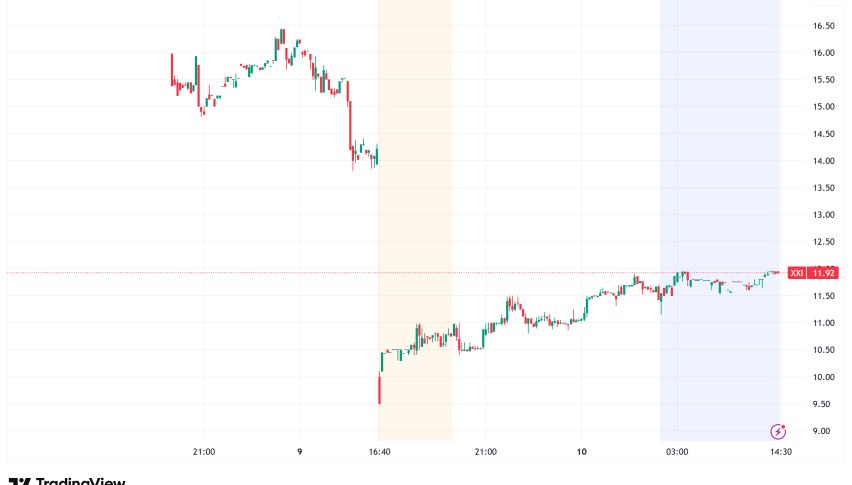
Twenty One Capital, one of the most talked-about cryptocurrency public debuts of the year, had a rough start on Tuesday. Its shares fell by
Quick overview
- Twenty One Capital experienced a challenging debut on the NYSE, with shares dropping nearly 20% after merging with Cantor Equity Partners.
- Despite starting at $10.74, the stock closed at $11.42, reflecting investor concerns over the company's unclear business strategy.
- The company holds over 43,500 Bitcoin, making it the third-largest corporate holder of the cryptocurrency, but aims to differentiate itself from typical treasury companies.
- CEO Jack Mallers emphasized the company's focus on offering Bitcoin-related products and services, although details remain vague.
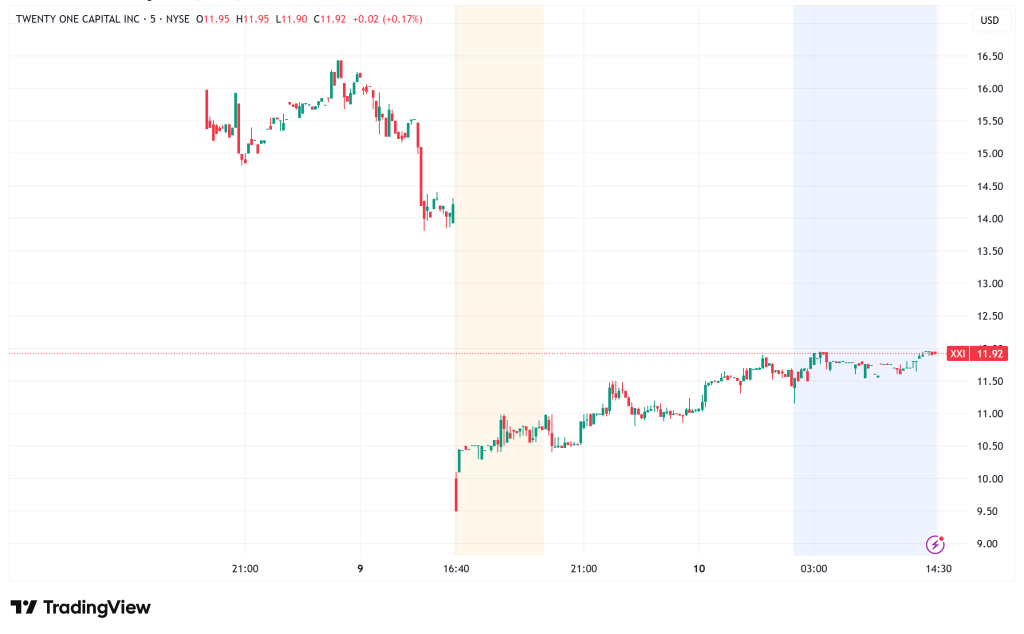
Twenty One Capital, one of the most talked-about cryptocurrency public debuts of the year, had a rough start on Tuesday. Its shares fell by about 20% on its first day of trading after it merged with blank-check provider Cantor Equity Partners.
Debut Dive: Stock Price Under Pressure
The new Bitcoin-focused business, which trades on the New York Stock Exchange under the ticker symbol “XXI,” started at $10.74 and closed Wednesday at $11.42. This is a 19.97% drop from Cantor’s closing price of $14.27 on Monday. The shares went up a little bit in after-hours trading, adding 2.2% to $11.67. This gave the company a market value of about $4 billion.
Major participants in the crypto business, like Tether (the largest stablecoin) and Bitfinex (a crypto exchange), control most of Twenty One Capital. Japan’s SoftBank Group owns a smaller interest. Jack Mallers, who started the Bitcoin platform Strike and is now the CEO of Twenty One, is in charge of the company.
The ‘Not a Treasury’ Conundrum
According to BitcoinTreasuries.NET and The Block, the company went public with more than 43,500 Bitcoin worth more than $4 billion. This made it the third-largest corporate holder of the cryptocurrency in the world, after Bitcoin miner MARA Holdings.
Even though the company has a lot of good credentials, investors seem to be worried about how unclear it is about how it does business. Mallers made it clear in a CNBC interview on Tuesday that Twenty One is “not a treasury company.” This sets the company apart from other so-called digital asset treasury companies that just acquire and keep cryptocurrencies.
“We don’t want the market to see us as just a treasury asset and set our prices accordingly,” Mallers said. “We have a lot of Bitcoin, but we’re also starting a business.” He said that the company wants to offer products and services related to Bitcoin, and he mentioned possible chances in financing, credit, brokerage, and exchange. But when asked for more information, Mallers was still evasive, indicating only that facts would come out “sooner rather than later.”
The weak start comes at a time when cryptocurrency markets are under a lot of pressure. Bitcoin has dropped more than 28% from its all-time high of almost $126,000 in October. This larger market collapse has hit digital asset treasury businesses hard, leading to doubts about their capacity to keep high valuations compared to their crypto holdings.
“It’s getting harder for DATs to get money, and right now they need to show real differences to get the mNAV multiples they were trading at earlier in 2025,” said John Todaro, a senior research analyst at Needham. The mNAV metric compares a company’s enterprise value to its cryptocurrency holdings.
Twenty One went public by merging with Cantor Equity Partners, a special purpose acquisition company sponsored by Cantor Fitzgerald and led by Brandon Lutnick, the son of U.S. Secretary of Commerce Howard Lutnick. Earlier in April, Cantor Equity shares rose as much as 380%, but they have since dropped to a small 3.9% gain for the year.
Michael Saylor’s Strategy and President Donald Trump’s pro-crypto policy attitude have led the company to join a large group of publicly traded companies that have implemented bitcoin investment methods. However, Twenty One’s first performance implies that investors may be getting pickier and want more than just exposure to Bitcoin; they want real business strategies.
Mallers is nevertheless hopeful about the company’s future. He told CNBC, “We see Bitcoin as the forest through the trees.” It is the chance, but it seems that no one is paying attention to it. The goal of this equity is to only focus on Bitcoin and give shareholders value mostly through Bitcoin.
- Check out our free forex signals
- Follow the top economic events on FX Leaders economic calendar
- Trade better, discover more Forex Trading Strategies
- Open a FREE Trading Account
- Read our latest reviews on: Avatrade, Exness, HFM and XM



 Save
Save