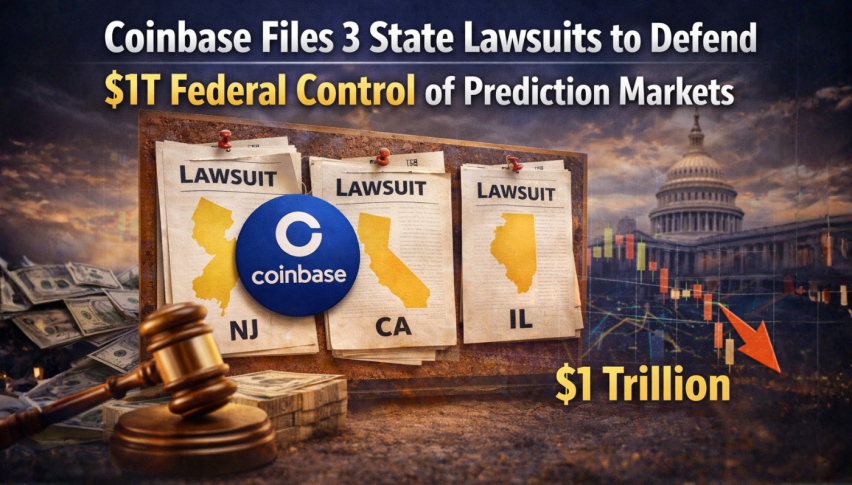
Coinbase Files 3 State Lawsuits to Defend $1T Federal Control of Prediction Markets
Coinbase has taken the gloves off in a fight with state regulators over the future of prediction markets - and is now taking on officials...
Quick overview
- Coinbase is challenging state regulators in Michigan, Illinois, and Connecticut over the classification of prediction markets as gambling.
- The exchange argues that these event-based contracts are financial derivatives under federal oversight, not state gambling laws.
- The outcome of these court cases could significantly impact how prediction markets are regulated in the US, affecting innovation and consumer protection.
- A ruling in favor of Coinbase may reinforce federal jurisdiction, while a ruling for the states could lead to inconsistent regulations across the country.
Coinbase has taken the gloves off in a fight with state regulators over the future of prediction markets – and is now taking on officials in Michigan, Illinois, and Connecticut in court. The exchange is challenging state-level efforts to restrict these markets, arguing forcefully that they fall well within federal oversight, not state gambling laws.
At the centre of the dispute are event-based contracts which let users bet on the outcome of real-world events – think inflation data releases or election results. State regulators are saying that these contracts are little more than a thinly veiled form of gambling – and that they pose a risk to consumers who don’t know what they’re getting themselves into. But Coinbase is countering that these contracts are actually financial derivatives, designed for hedging and to determine likely prices, rather than games of chance.
These court battles are just the latest chapter in a much bigger struggle over who gets to set the rules as cryptocurrency platforms start offering products that sound a lot like traditional financial products. When you consider that US derivatives markets are now worth over $1 trillion, the implications of how prediction markets get classified are massive.
MAKE THAT 3 LAWSUITS!
Coinbase also sued the Connecticut Attorney General and the Michigan Attorney General over their efforts to rein in prediction markets. 10 states are now in litigation with prediction market platforms. IL and MI are the latest entrants. https://t.co/xLfhx1z6XO pic.twitter.com/2EiE94tJrl
— Daniel Wallach (@WALLACHLEGAL) December 19, 2025
Why Coinbase Says States Lack Jurisdiction
In its court papers, Coinbase argues that prediction markets fall squarely within the Commodity Futures Trading Commission’s purview. The company is pointing to the fact that its partner platforms have already been cleared by the Commission to offer similar contracts as proof that these products are already in line with US law.
The exchange is also warning that if states are allowed to impose their own rules on top of federal regulations, it’ll be chaos – and it could actually discourage innovations and push activity offshore where it can’t be properly regulated. That would only reduce transparency and investor protection for all of us.
Key points that Coinbase is making in these court cases include:
- Prediction markets do basically the same job as futures and options do
- Event-based derivatives have been subject to federal oversight for years
- Imposing state-by-state rules will create huge compliance costs and uncertainty
Coinbase thinks that what’s needed here is a bit of consistency – federal regulation that covers all the states, particularly when we’re talking about digital platforms that are accessible across the country.
What the Outcome Could Mean for Markets
The outcome of these cases is being watched closely by exchanges, fintech firms, and investors – all of whom are waiting to see how prediction markets will be regulated in the US. If the courts rule in favour of the state authorities, it could mean that platforms face restrictions that vary from state to state, limiting retail access to these markets. On the other hand, if the courts rule in our favour, it could reinforce the idea that it’s the feds who ultimately set the rules, which could help prediction markets become part of the mainstream financial scene much faster.
Coinbase $COIN said it is suing the US states of Michigan, Illinois and Connecticut over their attempts to regulate prediction markets – Bloomberg pic.twitter.com/xwydXET4hR
— Evan (@StockMKTNewz) December 19, 2025
Beyond Coinbase, these court battles are a sign of the growing tension between states and the federal government over just who gets to set the rules in the world of digital finance. It could define how the US balances innovation with consumer protection in the next phase of market regulation.
As prediction markets start to take off, the outcomes of these cases could set a precedent that lasts for a long time and help determine who gets to decide what the rules are for betting on the outcomes of real-world events in an increasingly digital financial system.
- Check out our free forex signals
- Follow the top economic events on FX Leaders economic calendar
- Trade better, discover more Forex Trading Strategies
- Open a FREE Trading Account
- Read our latest reviews on: Avatrade, Exness, HFM and XM

Related Articles


Sidebar rates

Related Posts
 Save
Save
