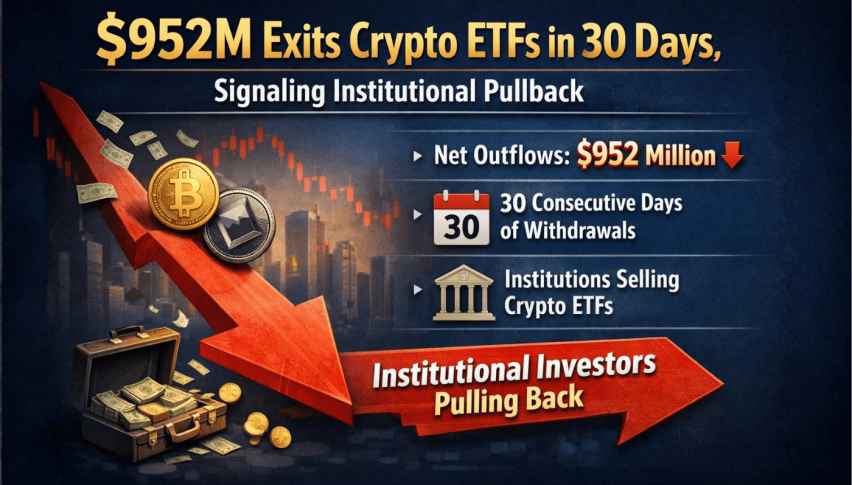
$952M Exits Crypto ETFs in 30 Days, Signaling Institutional Pullback
U.S.-listed Bitcoin & Ether exchange-traded funds are sending a clear warning signal. Since early November, the 30-day...
Quick overview
- U.S.-listed Bitcoin and Ether ETFs are experiencing significant net outflows, indicating a retreat by institutional investors amid deteriorating market conditions.
- Over the past week, crypto funds saw over $952 million in net outflows, with persistent selling pressure reflected in four consecutive days of negative Bitcoin ETF flows.
- Despite the overall downturn, BlackRock's iShares Bitcoin Trust has raised $62.5 billion in inflows, highlighting a concentration of capital in more established products.
- The mixed signals from ETF flows suggest that while institutions are becoming more cautious, interest in the crypto asset class remains, albeit focused on less risky investments.
U.S.-listed Bitcoin & Ether exchange-traded funds are sending a clear warning signal. Since early November, the 30-day simple moving average of net flows into these ETFs has turned decidedly negative, according to blockchain analysis firm Glassnode. This pattern suggests that the big institutional investors who drove a lot of the crypto price gains earlier this year are now backing off as market conditions deteriorate.
Glassnode described the situation as “a phase of rather subdued participation and a bit of a step back, and linked ETF outflows to a broader decrease in crypto market liquidity. Bitcoin and Ether prices have been going south since mid-October, and so far, ETF flows – which normally lag spot markets – are reflecting that downtrend. To many investors, ETFs serve as a proxy for institutional conviction, so it’s especially notable when these flows turn consistently negative.
Selling Pressure Moves Back In Across Crypto Funds
Data from Coinglass shows Glassnode’s assessment isn’t the only one bearing this out. Over the past four consecutive trading days, aggregate Bitcoin ETF flows have stayed in the red, showing persistent selling pressure. Many market commentators are saying this is a sign of caution, not panic, but the scale of the withdrawals is definitely getting attention.
Investment products (ETFs) tied to cryptocurrencies like Bitcoin (BTC) and Ethereum (ETH) registered an outflow of $952 million last week. pic.twitter.com/EYw0JTaRAH
— EricF (@EricCLFung) December 23, 2025
Some of the key names powering this story include:
- Over $952 million in net outflows from crypto funds last week
- Six out of the past ten weeks have shown investors taking their money back
- Four days in a row now of negative aggregate Bitcoin ETF flows
The Kobeissi Letter noted that “crypto ETF selling pressure is back,” and observed how quickly sentiment has shifted. Even while some funds are still taking in small amounts of cash, it’s not enough to offset the capital leaving the space.
BlackRock’s iShares Bitcoin Trust Stands Apart From the Rest
Despite the industry-wide pullback, BlackRock’s iShares Bitcoin Trust (IBIT) is holding out. Since launch, the fund has raised a whopping $62.5 billion in inflows, more than all other competing spot Bitcoin ETFs combined. Even during the recent slump, IBIT recorded decent inflows over the past week, which underscores its status as the go-to vehicle for big players.
Bloomberg ETF analyst Eric Balchunas had a bit to add to this story, too, pointing out that despite IBIT posting a negative return for the year, it still found itself in sixth place on Bloomberg’s “2025 Flow Leaderboard. And that’s really telling: IBIT still managed to pull in more cash than the SPDR Gold Shares ETF (GLD), even as gold went up 64% over the same period.
That suggests there’s more nuance at play here than some headlines might suggest. Institutions are just trimming their crypto exposure more broadly, but they’re not giving up on the asset class entirely. Instead, capital is just concentrating in the most liquid, most established products, while smaller or higher-risk funds are seeing a lot of their cash flow out.
For the wider crypto market, the message is mixed. The rise in ETF outflows suggests that institutions are becoming more cautious and less willing to take on risk. Yet at the same time, the fact that products like IBIT are still holding up suggests that institutional interest hasn’t vanished – just narrowed. And whether these flows level out or keep sliding will determine whether this is just a blip or a sign of a bigger, deeper reset in institutional crypto engagement.
- Check out our free forex signals
- Follow the top economic events on FX Leaders economic calendar
- Trade better, discover more Forex Trading Strategies
- Open a FREE Trading Account
- Read our latest reviews on: Avatrade, Exness, HFM and XM

Related Articles

Sidebar rates

Related Posts
 Save
Save
