Aave DAO Drama: 55% Say Nah to Control, Governance Gaps Exposed
A governance proposal aimed at transferring control of Aave’s brand and intellectual property from its founders to a decentralized...
Quick overview
- A governance proposal to transfer Aave's brand and intellectual property to a decentralized entity was rejected by 55.29% of voters, highlighting internal tensions within the DeFi platform.
- Supporters believed the move would enhance transparency, but many voters expressed skepticism about the plan's feasibility and rushed process.
- The failed vote raised broader concerns about governance token value capture and the challenges of decentralized decision-making.
- Controversy surrounding the proposal was exacerbated by Aave's founder purchasing a significant amount of AAVE tokens prior to the vote, raising questions about power dynamics.
A governance proposal aimed at transferring control of Aave’s brand and intellectual property from its founders to a decentralized entity has collapsed, exposing long-running tensions within one of DeFi’s biggest players.
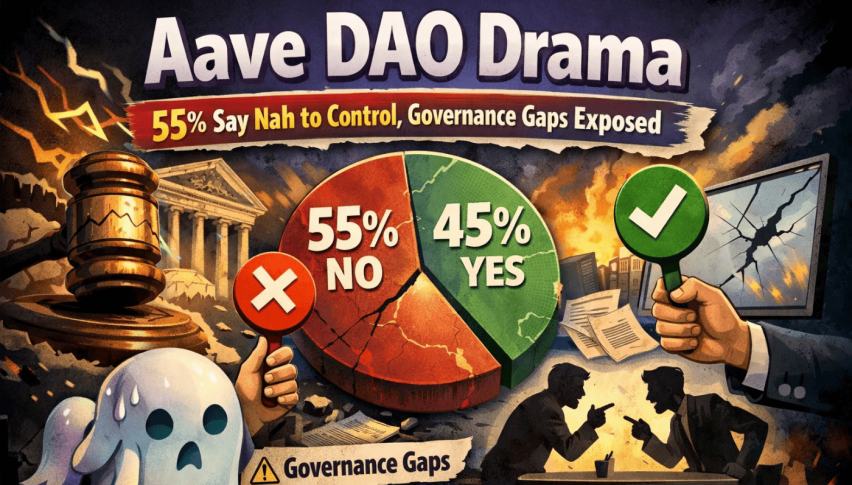
The Snapshot vote closed with 55.29% of voters rejecting the plan, 41.21% abstaining, and only 3.5% voting in favor. The outcome effectively killed the proposal—which sought to move Aave’s domains, trademarks, naming rights, and social media assets into a DAO-linked structure—leaving hopes of clarifying who truly controls Aave dashed.
Supporters argued that placing the brand under formal decentralized control would reinforce the platform’s ethos. Instead, the vote revealed deep skepticism within the community about how governance is functioning and when decisions about the future should be made.
Aave—whose token recently traded around $154—remains one of the most influential lending platforms in DeFi. Yet the vote underscored that even established protocols face governance challenges, raising awkward questions about ownership and decision-making authority.
Why the Governance Proposal Fell Flat
At its core, the proposal sought to transfer Aave’s intellectual property to a decentralized entity rather than leave it with the founders. Proponents claimed this would enhance transparency and align token holders with the platform’s public identity.
However, many voters saw the plan as premature or poorly conceived. With a large portion abstaining, the result left more uncertainty than clarity. Key concerns included:
Aave token holders have officially struck down the controversial "Brand Asset Ownership" proposal.
The Snapshot poll closed with 55.29% voting NAY, sending a clear message that the community isn't ready for the current plan. #Aave #DeFi pic.twitter.com/0lCsisrmta
— Conor Kenny (@conorfkenny) December 26, 2025
- Lack of clarity on how token holders would benefit
- Doubts about whether a decentralized entity could responsibly manage Aave’s IP
- Perceptions that the voting process was rushed and lacked proper discussion
- Fears that the plan might concentrate power during a transitional period
The failure reflects broader doubts about whether decentralized governance can realistically manage assets as valuable as branding and intellectual property.
Token Value and Structural Tensions
Beyond the proposal itself, the episode reignited debate over how governance tokens capture value for holders. Wintermute’s CEO noted his firm voted against the plan, emphasizing the need to examine how token holders can derive tangible benefits.
Gaevoy argued that solving the token value capture problem is critical not only for Aave but for the entire crypto ecosystem, since similar governance structures are widely used. Without clear benefits, he warned, the system risks collapse.
Hasu, a pseudonymous advisor at Lido, added that most token-equity hybrids are fundamentally flawed. In a public post, he argued these models create misaligned incentives and obscure accountability. Originally designed to navigate regulatory uncertainty, they were never intended as a permanent solution. Long-term investors now expect governance and economic rights to be clearly aligned.
Process Disputes and Community Friction
The vote was further clouded by controversy over its process. Some community members criticized the accelerated timeline, arguing that the vote occurred before discussions had concluded. This limited meaningful participation and weakened governance norms.
Tensions escalated when it emerged that Aave’s founder, Stani Kulechov, had purchased roughly $10 million worth of AAVE tokens ahead of the vote. While no rules appear to have been broken, the move amplified concerns about power concentration in token-based systems.
Conclusion
The failed proposal highlights the challenges of decentralized governance: balancing openness, fairness, and efficiency is no easy task. For Aave, the rejection may close one chapter, but deeper structural questions about ownership, authority, and token value remain unresolved.
- Check out our free forex signals
- Follow the top economic events on FX Leaders economic calendar
- Trade better, discover more Forex Trading Strategies
- Open a FREE Trading Account
- Read our latest reviews on: Avatrade, Exness, HFM and XM



 Save
Save