Intel Stock Surges 1.33% as Nvidia Finalizes $5B Strategic Stake to Close Out Blockbuster 2025
Intel Corporation said on Monday that Nvidia has finished its $5 billion equity investment. Regulatory filings show that the graphics chip
Quick overview
- Nvidia has completed a $5 billion equity investment in Intel, acquiring 214.8 million shares at $23.28 each.
- The investment gives Nvidia approximately 4.4% ownership in Intel and provides crucial funding for Intel's turnaround efforts under new CEO Lip-Bu Tan.
- Intel's stock has risen over 80% this year, although it remains 17% below its 52-week high, indicating potential for further growth.
- The partnership between Intel and Nvidia extends beyond financial investment, focusing on developing advanced data-center CPUs and PC processors.
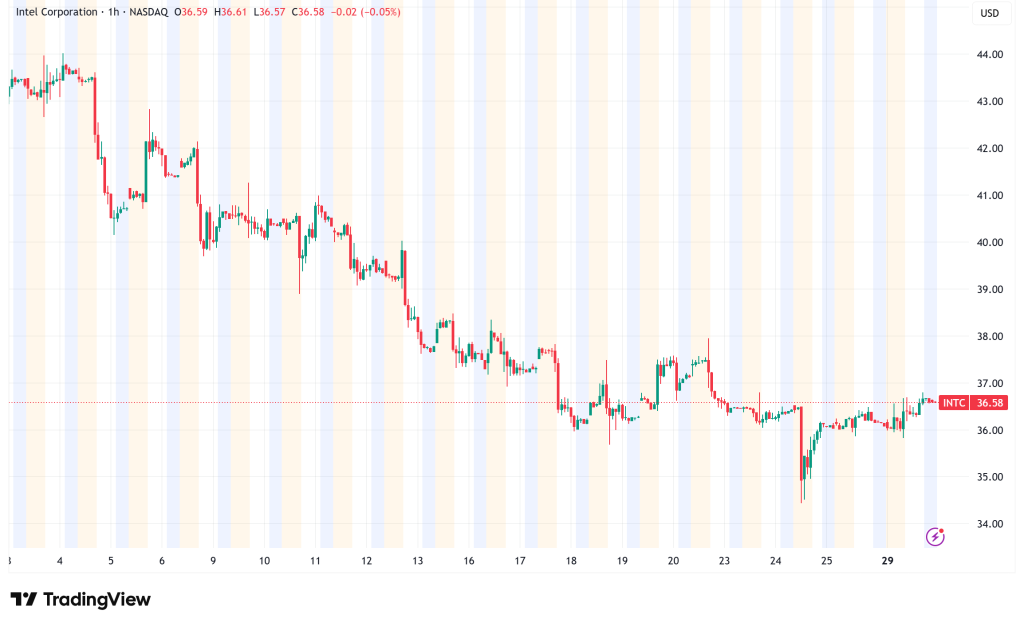
Intel Corporation said on Monday that Nvidia has finished its $5 billion equity investment. Regulatory filings show that the graphics chip giant bought 214.8 million freshly issued Intel shares for $23.28 each through a private placement. After the news came out, Intel’s stock jumped 1.33% to $36.68 in after-hours trade.
The deal, which was first announced in September, gives Nvidia about 4.4% of Intel and gives the ailing chipmaker important funding as it tries to turn around its manufacturing under new CEO Lip-Bu Tan. The Federal Trade Commission gave the merger the go-ahead on December 18 by ending the Hart-Scott-Rodino review waiting period early.
Intel (INTC) Stock Technical Picture Shows Strong Recovery
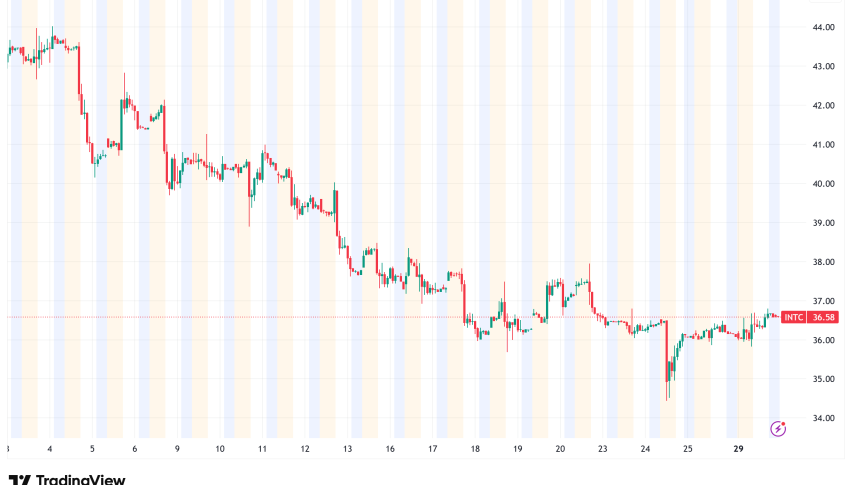
Intel’s chart has changed a lot in 2025 from a technical point of view. The stock has gone up more than 80% this year, which is a lot more than the Magnificent Seven tech stocks and AMD, its main competitor. Shares are still about 17% behind their 52-week high of $44.02, which means there is still possibility for more growth if momentum keeps up.
Intel’s stock is currently trading at roughly $23.28, which is about 37% less than what Nvidia paid for it in September. This shows how bad Intel’s previous selloff was and how big its recent recovery has been. The 36.3 million shares traded on Monday were much less than the 50-day average, which means that the move after the news happened with relatively few people involved.
The stock seems to have strong support above $35, even though the S&P 500 is down. The $44 level is a key barrier point because Intel hit that level earlier this year before falling back.
Intel-NVIDIA Strategic Partnership Beyond Financial Investment
The Nvidia agreement is far more than just a cash payment. The two companies plan to work together to make specialized data-center CPUs and PC processors that use NVLink, Nvidia’s high-speed interconnect technology that can send data at 1.8 terabits per second, which is more than ten times faster than the most recent PCIe 5.0 standard. When coupled with Nvidia’s powerful AI accelerators, this technical partnership might give Intel processors a big edge.
Intel will also make systems-on-chips for the consumer market that use chiplets from Nvidia’s desktop CPUs. But the cooperation doesn’t include Intel’s contract manufacturing company making Nvidia’s core processing chips at first, which raises questions about whether the two companies will work together more closely in the future.
Critical Juncture for Intel’s Foundry Ambitions
Intel’s manufacturing renaissance is yet unproven, even though good things happened in 2025, including the U.S. government investing $9 billion and SoftBank giving Intel $2 billion. Intel’s 18A process didn’t get any big outside customers, like Nvidia or Broadcom, so the company had to employ the technology mostly for its own Panther Lake and Clearwater Forest processors that are due out soon.
Analysts say that Intel’s next-generation 14A process is a turning point for the company. David O’Connor, an analyst at BNP Paribas, says that Intel has only 12 to 18 months to get a big outside customer for 14A. He calls this “the crux of Intel being successful on the foundry business or not, or potentially even exiting manufacturing long term.”
There are rumors that Apple would employ Intel’s 18A-P technology for lower-end CPUs, which has made many more hopeful, but nothing is certain. Intel has to compete hard even in the U.S. since TSMC is developing $165 billion worth of production capacity there.
Traders will look at Intel’s next earnings report, which is due around January 29, to see how margins, capital spending, and the company’s success in turning strategic expenditures into revenue are doing. The stock’s rise may be open to profit-taking near technical resistance levels until Intel can show that it can win and carry out big foundry contracts.
- Check out our free forex signals
- Follow the top economic events on FX Leaders economic calendar
- Trade better, discover more Forex Trading Strategies
- Open a FREE Trading Account
- Read our latest reviews on: Avatrade, Exness, HFM and XM





 Save
Save