Micron Stock Surges 3.4% on Rising DRAM Prices and Strong AI Demand Outlook
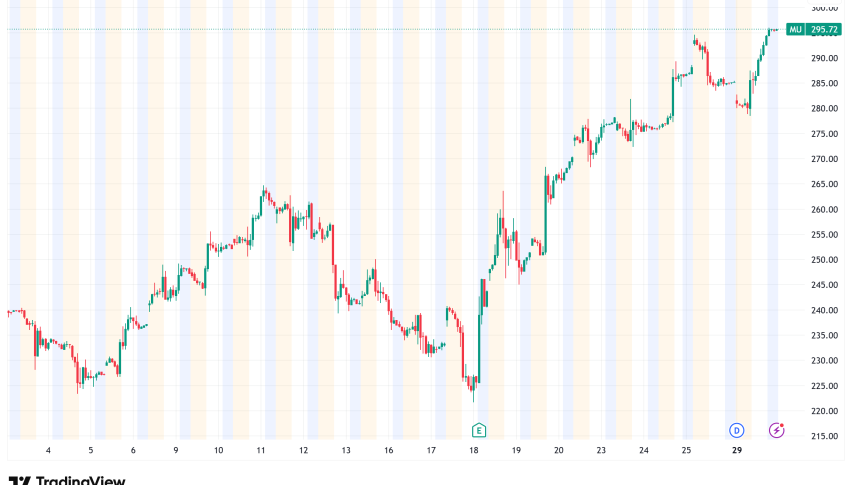
Micron Technology (NASDAQ: MU) ended Monday's session up 3.4% at $294.40, close to its session high after a strong turnaround that brought
Quick overview
- Micron Technology's stock rose 3.4% to $294.40, recovering from early losses and showing strong trading volume.
- Recent DRAM pricing data indicates rising prices for various memory products, suggesting a favorable supply-demand balance.
- Micron's earnings forecast significantly exceeded analyst expectations, driven by increased memory costs and limited supply.
- Analysts have raised their price targets for Micron, reflecting optimism about the company's growth potential in the AI-driven memory market.
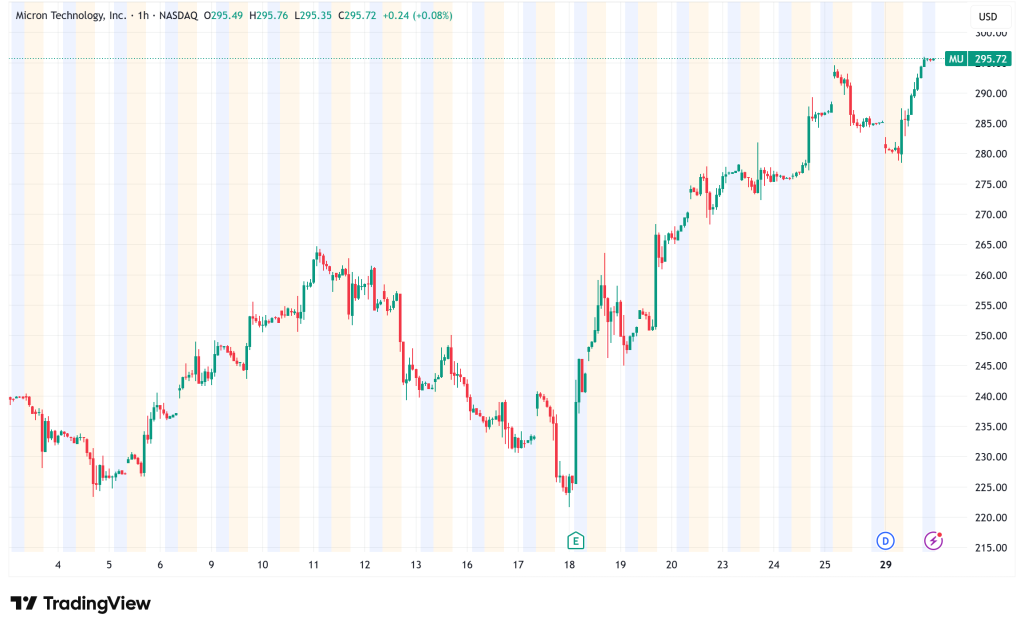
Micron Technology (NASDAQ: MU) ended Monday’s session up 3.4% at $294.40, close to its session high after a strong turnaround that brought the stock back from early weakness. The Boise-based memory maker’s stock fluctuated a lot, with over 25.6 million shares changing hands. It bounced between $278.51 and $294.45 during the day.
The SPDR S&P 500 ETF fell 0.4% and the Invesco QQQ Trust fell 0.5%, which was a sign of weakness in the broader market. Even in the semiconductor sector, other businesses had a hard time. Nvidia fell 1.2%, and the iShares Semiconductor ETF fell 0.2%, which made Micron’s performance stand out even more.
DRAM Pricing Shows Continued Strength
The most recent spot market data from DRAMeXchange, which shows that prices are still rising across several DRAM product lines, seems to be what caused Monday’s rise. On December 29, the spot prices for DDR5 16GB chips went up by about 1.4%. The prices for DDR4 16GB goods went up by 0.9%, while the prices for DDR4 8GB chips went up by 0.5%.
These daily increases may not seem like much, but they are quite important to Micron’s business strategy. The company works in a part of the semiconductor industry that is very sensitive to prices. Small changes in memory prices can quickly affect earnings. The fact that spot prices have been going up steadily implies that supply and demand are still in a good place, and that capacity limits are keeping prices in check.
There is more than just spot market data that shows tight supply conditions. Tom’s Hardware says that one U.S. seller is currently selling a 2-terabyte DDR5 server memory kit for about $39,000. This is because there is a general shortage of DRAM and prices have gone up sharply recently. This is a clear example of how the market is having trouble getting enough of these parts.
AI Infrastructure Drives Demand
Micron’s main idea is that there is a growing need for high-bandwidth memory (HBM), which is a type of stacked DRAM that is used with AI processors in data center servers. The market has been using the availability and price of HBM as a way to measure how quickly AI infrastructure spending is turning into real demand for components.
Micron’s earnings update on December 17th added to this trend by predicting adjusted earnings of about $8.42 per share in the second quarter, which was about double what analysts had expected at the time. Management said that the guidance beat was due to rising memory costs and limited supply. At the same time, they boosted its capital expenditure target for 2026 to $20 billion.
Several Wall Street corporations have reacted positively. Rosenblatt Securities raised its price objective to $500, and Cantor Fitzgerald raised its aim from $300 to $350. Raymond James raised its forecast from $190 to $310, and TD Cowen analysts said that Micron’s gross margins could approach 70% because of AI-supported DRAM demand.
Micron (MU) Stock Technical Picture and Near-Term Catalysts
From a technical point of view, Monday’s lesson was quite helpful. The fact that the stock was able to turn around early losses and close near session highs at $294.40 shows that there is renewed buying activity at the $280 area. The stock is now testing its 52-week high of $294.50, which is a huge improvement from its 52-week low of $61.54.
The key numbers from Micron’s fiscal Q1 results show that the company’s fundamentals are strong, which supports the technical picture. The company made $4.78 per share, which was more than the $3.94 that analysts had expected. Its $13.64 billion in sales were also more than the $12.88 billion that analysts had expected. Free cash flow hit $3.9 billion, while EBIT margins rose to 27.1% and gross margins rose to 39.8%.
Micron’s quarterly dividend of $0.115 per share will go to shareholders of record as of the close of business on Monday, and payment is set for January 14, 2026.
The Path Forward for Micron Technology
Investors need to think about sustainability above all else. Memory markets have always been cyclical, and as new capacity comes on the market, margins tend to change quickly. Micron’s problem is how to add more HBM and server memory without flooding traditional markets like PCs and smartphones.
Also, spot price strength must eventually show up in contract prices, which move more slowly through long-term deals with big consumers. Any signals from big buyers about delivery times and stock levels might quickly change people’s minds.
- Check out our free forex signals
- Follow the top economic events on FX Leaders economic calendar
- Trade better, discover more Forex Trading Strategies
- Open a FREE Trading Account
- Read our latest reviews on: Avatrade, Exness, HFM and XM

Related Articles



Sidebar rates

Related Posts
 Save
Save
