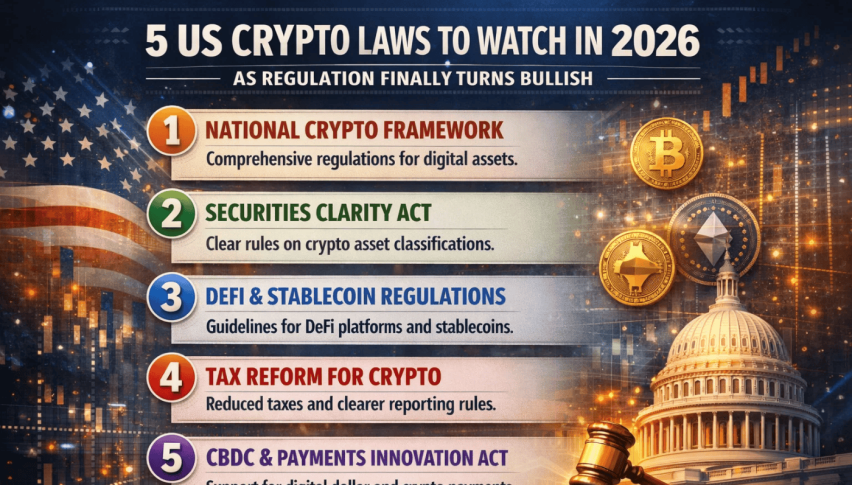
5 US Crypto Laws to Watch in 2026 as Regulation Finally Turns Bullish
The US crypto market is on the cusp of a pivotal moment in its history. After all the regulatory back-and-forth of past years...
Quick overview
- The US crypto market is approaching a significant turning point in 2026, with clearer regulatory frameworks emerging for digital assets.
- High-profile crypto cases are being dropped, and regulators are providing clearer guidance, signaling a shift towards mainstream acceptance of crypto in finance.
- Key legislative initiatives, including the CLARITY Act and the GENIUS Act, aim to establish a structured regulatory environment for stablecoins and digital assets.
- Both federal and state-level developments are expected to create a more predictable regulatory landscape, potentially easing uncertainty for investors and companies.
The US crypto market is on the cusp of a pivotal moment in its history. After all the regulatory back-and-forth of past years, 2026 looks like the year that finally provides some much-needed clarity. Politicians, regulators, and financial institutions are finally falling into line on a framework that outlines how digital assets should be created, bought, and held.
It’s been less than a year into Donald Trump’s second term, and already things have changed in Washington, with several high-profile cases involving crypto firms suddenly getting dropped, and regulators starting to issue clearer guidance to those banks willing to dip into digital asset custody. For most in the industry, the message is simple: crypto is being set up to be welcomed in mainstream finance, not pushed out of it.
Ruslan Lienkha – market chief at YouHodler – reckons that predictable rulemaking is what has driven crypto adoption in the past. And he thinks the US is now closing in on the regulatory setup that’s already in place in parts of Europe and Asia.
⚠️ REMINDER AS WE ENTER 2026 ⚠️
Back in July 2024, the BIS (the central bank of central banks) finalized the global framework for how banks are allowed to interact with crypto, with a formal implementation date of January 1, 2026, which is tomorrow.
In simple terms, this… pic.twitter.com/AJMleSTzDd
— Echo 𝕏 (@echodatruth) January 1, 2026
Key Senate Bills Lay Down the Law
At the heart of all this is the big question of who will regulate what in crypto. A law was introduced last year to clarify the SEC and CFTC’s roles, but it’s still got some way to go. Look for that to start moving again in January.
January 15th is going to be a big day (for crypto at least) when the Senate Banking Committee reviews the CLARITY Act, and everyone is hoping this will get the ball rolling on a full Senate debate later in the year.
Other initiatives that are already underway include
- Passage of the GENIUS Act in mid 2025, which has created a national framework for payment stablecoins
- Treasury-led consultations on rules for stablecoin implementation
- Finalised stablecoin regs are expected to drop in early 2026
- FDIC guidance for banks looking to issue stablecoins through their subsidiaries
- An SEC exemption that lets startups test out new products under a lighter touch
All of this is intended to reduce legal risk while keeping investors safe.
Bottlenecks at Both the State and Federal Levels
Regulatory momentum isn’t just about Congress, though. When Jerome Powell’s term as Federal Reserve Chair comes to an end in May 2026, Trump is expected to appoint a successor who is going to continue his pro-growth agenda – and that’s seen as potentially good news for riskier assets, including crypto.
And at the state level:
- California will be enforcing a Digital Financial Assets licensing law from July 1st
- Texas has given the green light to a state-managed Bitcoin reserve fund kicking off in 2026
- Arizona and New Hampshire are looking at doing something similar
- And new federal rules on crypto tax – covering things like staking, lending, and small transactions – are due by the end of August
Why 2026 Might be the Year of Change for Markets
All these developments point to a regulatory environment that’s becoming more structured, more predictable, and more a part of mainstream finance. And for investors and companies, that’s got to make life a lot easier, and a lot less uncertain. It’s not that regulation is getting lax; it’s just that it’s getting a lot clearer. And that could make all the difference in 2026.
- Check out our free forex signals
- Follow the top economic events on FX Leaders economic calendar
- Trade better, discover more Forex Trading Strategies
- Open a FREE Trading Account
- Read our latest reviews on: Avatrade, Exness, HFM and XM

Related Articles
Sidebar rates

Related Posts
 Save
Save
