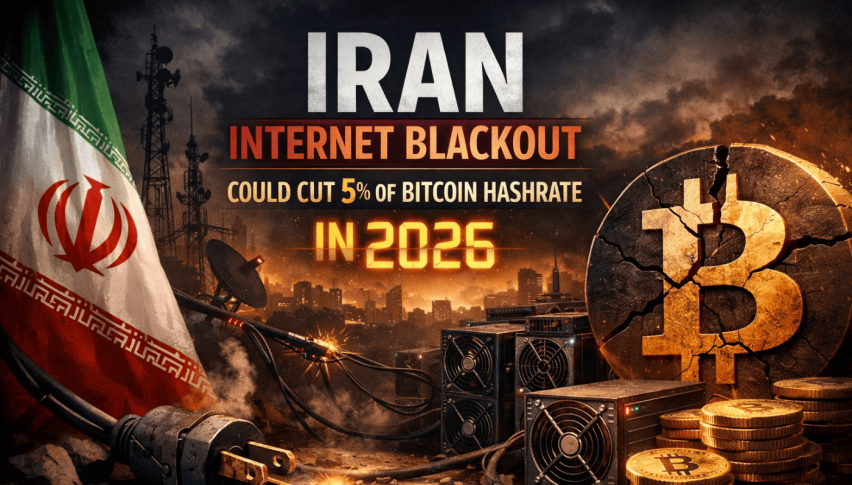
Iran’s Internet Blackout Could Cut 5% of Bitcoin Mining Hashrate in 2026
Iran's near-total shutdown of the internet in response to escalating anti-government protests has shone a spotlight on the nation's...
Quick overview
- Iran's internet shutdown amid protests has highlighted the country's cryptocurrency mining sector, which has seen a decline in global hashpower since 2021.
- While Iran's cheap electricity once made it a mining hotspot, sanctions and government crackdowns have pushed many miners underground.
- The current internet outages complicate operations for miners, but the overall impact on global Bitcoin hashpower is expected to be minimal.
- The situation emphasizes the mining industry's sensitivity to energy costs and the shift towards more stable jurisdictions for operations.
Iran’s near-total shutdown of the internet in response to escalating anti-government protests has shone a spotlight on the nation’s cryptocurrency industry – a sector that, although not vital to the global Bitcoin network, has still been quietly churning out a respectable chunk of global hashpower – albeit far less than the sizeable contribution Iran made way back in 2021
Its abundant supply of cheap, subsidised electricity had once made Iran a hotbed for cryptocurrency mining – but sanctions and a toughening of the government’s stance on the industry forced many miners to go underground. Today, some in the industry have adapted, operating in a shadowy mix of formal and semi-legitimate mining farms – but geopolitical instability is once again putting the brakes on consistent operations.
Monitoring groups have reported that mobile and fixed-line networks are largely out of action, which is not only a major inconvenience for the miners but is also likely to make life even tougher for them – and it’s not just a domestic issue either – the implications are being felt far beyond Iran’s borders.
Impact of Blackouts on Mining
Bitcoin mining doesn’t require a constant internet connection to keep going. Industrial-scale farms are actually pretty good at coping with patchy connectivity – because new blocks get added to the network roughly every ten minutes. But when outages drag on, things start to get a bit more tricky:
Iran cut off all mobile internet from the outside world
Cloudflare data shows Iranian IPv6 networks dropped to zero as protests enter day 12
Millions of Iranians now disconnected while regime fires on demonstrators
This is the 🅱️iggest digital blackout since the 2025 war pic.twitter.com/CbYvxg9KY7
— Boi Agent One (@boiagentone) January 8, 2026
- Coordinating with the rest of the mining pool becomes harder
- Firmware updates and payout transfers are delayed until the internet comes back on
- And for smaller or illicit miners, the risks of downtime are all the higher
Even if Iran were to go dark for good – which seems unlikely – the global hashpower would probably only drop by a small fraction – less than 5% – and the network would just compensate by adjusting the difficulty of the maths problems it’s asking miners to solve. We’ve seen this play out before – when China banned mining last year, it removed over 40% of global hashrate but Bitcoin didn’t even flinch
The unrest in Iran will probably also cause some of its miners to shut down and tighten up the global hashflow a bit – but in the grand scheme of things, the impact is likely to be minimal – and the key thing to note is that Bitcoin itself is more resilient than most people think – with very little actual structural impact
Geopolitics, Energy and Mining Trends
And this brings us to a much bigger point : all these regional swings in hashpower highlight just how sensitive the whole mining industry is to the cost of energy – and to which regions are willing to tolerate a bit of instability to get that energy. This creates what might be called a minefield of operational volatility on the edges of the network.
The situation also underscores a broader trend: the ongoing shift of mining from high-risk areas to more stable and well-regulated jurisdictions with an abundance of cheap energy. In reality, Iran’s share of the global hashpower is actually shrinking – not growing.
So, for investors the main takeaway should be this: the Iranian crisis might cause some short-term disruption to local miners – but ultimately it won’t have any significant impact on the stability of the Bitcoin network. In the long run, the biggest risks are going to be linked to energy policy, to how governments interact with the industry and to the adaptability of miners – not to any one country.
- Check out our free forex signals
- Follow the top economic events on FX Leaders economic calendar
- Trade better, discover more Forex Trading Strategies
- Open a FREE Trading Account
- Read our latest reviews on: Avatrade, Exness, HFM and XM



 Save
Save