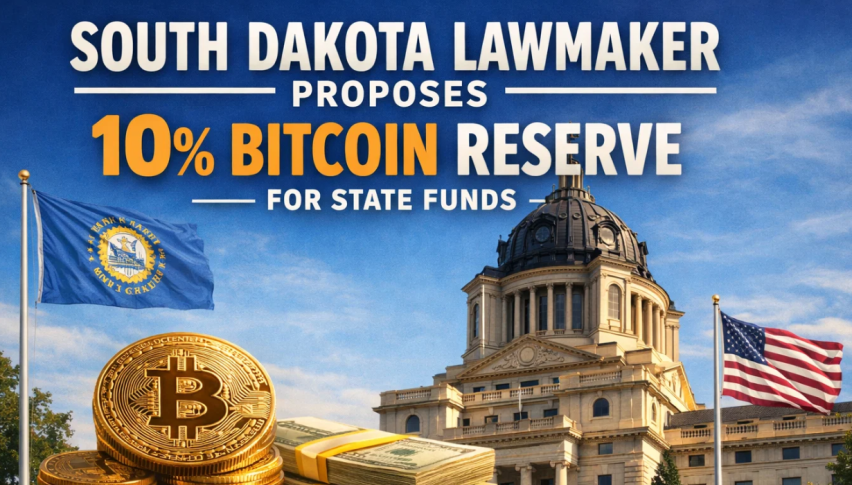
South Dakota Lawmaker Proposes 10% Bitcoin Reserve for State Funds
South Dakota is considering adding Bitcoin to its public investment strategy again, as more states across the US show interest...
Quick overview
- South Dakota is revisiting the idea of investing in Bitcoin, with House Bill 1155 allowing up to 10% of state revenues to be allocated to the cryptocurrency.
- The bill emphasizes Bitcoin as 'strong money' and aims to enhance the state's financial stability.
- HB 1155 includes stringent custody and security measures for Bitcoin holdings, making it one of the strictest state-level proposals in the US.
- Despite growing state interest in digital assets, federal regulations remain restrictive, limiting direct government investment in Bitcoin.
South Dakota is considering adding Bitcoin to its public investment strategy again, as more states across the US show interest in digital assets.
State Representative Logan Manhart has brought back House Bill 1155 (HB 1155), which would let the South Dakota State Investment Council put up to 10% of state revenues into Bitcoin. First introduced in 2025, the bill describes Bitcoin as “strong money” and suggests it could help support long-term financial stability.
Manhart announced the bill’s release in a public statement on January 27, 2026, saying it aims to strengthen the state’s financial foundation.
Custody and Security Standards Raise Expectations
A key part of HB 1155 is its detailed plan for managing and protecting Bitcoin holdings. The bill says any Bitcoin bought must be held either by the State Investment Council itself or by a qualified institutional custodian.
I am proud to say I have released my bill that would allow the State of South Dakota to invest in Bitcoin.
Strong money. Strong state.
— Logan Manhart (@ManhartLogan) January 27, 2026
Key security provisions include:
- Hardware-secured and encrypted private key storage
- Fully encrypted transaction channels
- Multi-location custody across at least two secure data centers
- Multi-party governance controls tracking all access and transactions
- Mandatory disaster recovery planning, code audits, and penetration testing
These rules make South Dakota’s proposal one of the strictest state-level Bitcoin custody plans in the US, showing a strong focus on operational and cybersecurity risks.
Broader State Momentum, Federal Constraints Remain
If the bill passes, South Dakota would join states like Texas, Arizona, and New Hampshire, which have passed or considered laws allowing public investment in Bitcoin or other digital assets. Other proposals, such as West Virginia’s Inflation Protection Act, have also looked at using crypto and hard assets in state treasuries, but strict rules still apply.
Progress at the federal level has been slower. Patrick Witt, Director of the White House Crypto Council, said that although a Strategic Bitcoin Reserve and Digital Asset Stockpile were ordered in March 2025, the executive order did not allow direct federal Bitcoin purchases. Legal and administrative rules still limit government adoption across the country.
South Dakota’s new effort shows that state governments are pushing the limits of digital asset use, even while federal policy stays cautious.
- Check out our free forex signals
- Follow the top economic events on FX Leaders economic calendar
- Trade better, discover more Forex Trading Strategies
- Open a FREE Trading Account
- Read our latest reviews on: Avatrade, Exness, HFM and XM


 Save
Save