Daily Crypto Signals: Bitcoin Battles $70K Resistance, Ethereum Eyes $2,100 Breakout
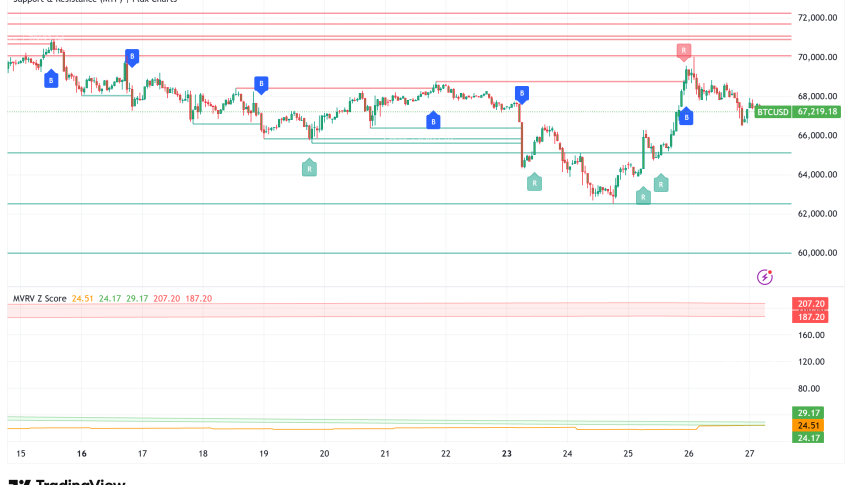
Bitcoin rebounded to $67,244 after touching a weekly low of $62,500, but derivatives markets signal persistent fear as futures premiums
Quick overview
- Bitcoin rebounded to $67,244 after hitting a weekly low of $62,500, but derivatives markets indicate ongoing fear with futures premiums below neutral levels.
- Ethereum reached a weekly high of $2,150 before retreating, with analysts focusing on a critical daily close above $2,100 for potential momentum.
- Institutional uncertainty and regulatory efforts are creating a cautious environment in the cryptocurrency market, highlighted by a proposal to restrict stablecoin issuers from providing returns.
- Vitalik Buterin introduced a four-year plan for Ethereum that includes significant technological upgrades aimed at improving transaction speeds and security.
Bitcoin BTC/USD rebounded to $67,244 after touching a weekly low of $62,500, but derivatives markets signal persistent fear as futures premiums remain well below neutral thresholds. Meanwhile, Ethereum ETH/USD climbed to a weekly high of $2,150 before retreating, with analysts watching a critical daily close above $2,100 as the key trigger for sustained momentum.
Crypto Market Developments
Institutional uncertainty, efforts to clarify regulations, and long-term technological advancements have created a cautious climate that the larger cryptocurrency market is navigating. A 376-page proposal to execute the GENIUS Act, which would forbid payment stablecoin issuers from giving holders any kind of return or interest, was released by the US Office of the Comptroller of the Currency. The action may pave the way for the more comprehensive Digital Asset Market Clarity Act of 2025 to proceed without the controversial yield clause. The public has sixty days to comment on the plan.
Separately, high-yield bond markets continue to draw substantial funding to the AI and data center expansion, which is partially driven by Bitcoin miners. Because of how lenders are pricing the higher risk profile of crypto-linked infrastructure, companies associated with this sector have raised about $33 billion in long-term senior notes over the past year, paying interest rates of 7% to 9%, which are significantly higher than the 4% to 5% typical of regulated utilities.
Regarding technology, Vitalik Buterin, a co-founder of Ethereum, presented a four-year plan known as the “Strawmap,” which calls for a shift to post-quantum cryptographic signatures and a reduction in transaction finality from about 16 minutes to 6 to 16 seconds. Buterin called the improvements a “very invasive set of changes,” and in order to minimize network disturbance, the most important upgrades would be bundled together.
Can Bitcoin Break $70,000 Resistance Soon?
After falling to $62,500 on Tuesday, Bitcoin bounced back to $67,244, helped along by $764 million in net inflows over two days into US-listed Bitcoin ETFs. The $1.2 billion in withdrawals over the previous eight trading sessions were somewhat offset by that amount, indicating that institutional purchasers are still active when prices fall below $65,000. The derivatives market is obviously reflecting this uneasiness, since the rally has not been sufficient to retake the $75,000 level that bulls are aiming for.
On Thursday, the annualized premium on two-month Bitcoin futures was only 2%, well below the 5% barrier that usually indicates neutral sentiment. Since January 31, Bitcoin has not significantly surpassed this level. On Deribit, Bitcoin put options were trading at a 14% premium over comparable call options. This was a significant decrease from Tuesday’s high 28% panic levels, but it was still well outside of the -6% to +6% range that is typical of a balanced market. Though none of the theories have been proven, they vary from Binance oracle pricing problems during last October’s crisis to concerns about quantum computing and the role of quantitative trading firm Jane Street in explaining Bitcoin’s 32% seven-week decline.
Ethereum Ready to Cross $2,100?
On Thursday, ether surged to a weekly high of $2,150 before reversing course. Analysts gave special weight to a consistent daily closing above $2,100. For wallets with 100,000 ETH or more, that level is equivalent to the realized price, which is the average cost base determined from the most recent on-chain movement. In the past, Ether has very infrequently dipped below the realized price of this whale cohort—most notably during the bear market of 2022—and has usually bounced back when that level was tested as support.
The technical outlook for the near future is conflicting. After a period of extremely negative readings, Ethereum’s funding rate on Binance has returned to positive territory at 0.23% after more than $220 million in short liquidations over the last two days cleared considerable overhead leverage. This change implies that late short sellers were forced out, but it also indicates that long posture has increased, increasing the possibility of a long squeeze around $1,800 in the event that momentum pauses.
Near that $1,800 level, analysts have identified a cluster of approximately $2.66 billion of cumulative long liquidation exposure, making it the primary downside level to keep an eye on. Before the market either regains its footing above the current range or reaches the April lows around $1,500, a sustained advance over $2,500 is deemed doubtful.
- Check out our free forex signals
- Follow the top economic events on FX Leaders economic calendar
- Trade better, discover more Forex Trading Strategies
- Open a FREE Trading Account
- Read our latest reviews on: Avatrade, Exness, HFM and XM




 Save
Save