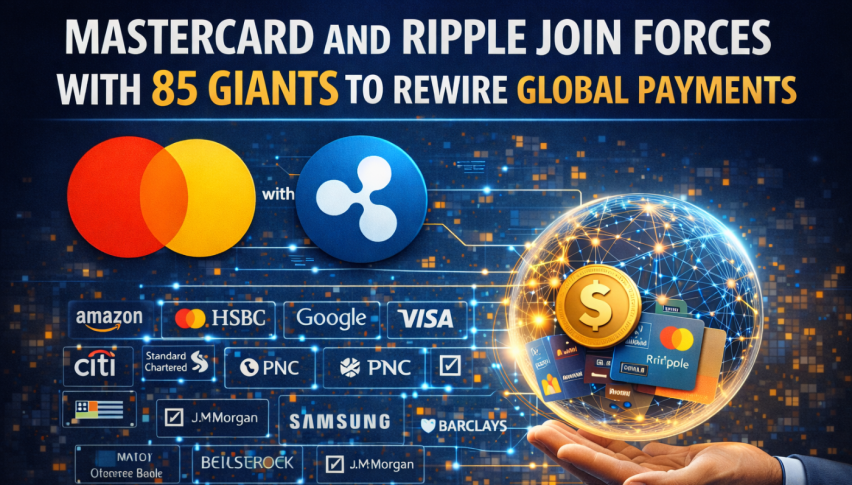
Mastercard and Ripple Join Forces With 85 Giants to Rewire Global Payments
Traditional finance and digital assets are coming together in a big way. Mastercard has launched its Crypto Partner Program...
Quick overview
- Mastercard has launched its Crypto Partner Program, uniting over 85 major companies to enhance the practicality of digital currencies.
- The program aims to streamline cross-border money transfers using blockchain technology, significantly reducing costs and delays.
- Ripple and Circle are providing infrastructure for stablecoins, while Binance and Coinbase facilitate seamless fiat-crypto conversions.
- This collaboration is expected to make cryptocurrency transactions as easy as credit card payments, benefiting both consumers and businesses.
Traditional finance and digital assets are coming together in a big way. Mastercard has launched its Crypto Partner Program, marking a shift from the “crypto winter” to a more practical era for digital currencies. This program brings together more than 85 major companies, such as Ripple, Binance, PayPal, Coinbase, and Circle.
The goal is to connect Mastercard’s global payment network, which operates in over 200 countries, with the fast and flexible features of blockchain. By combining these technologies, the program hopes to make cryptocurrency useful for everyday transactions instead of just speculation.
Experts think this partnership could be a turning point for digital finance, bringing it from a niche technology to something used by millions of merchants around the world.
A New Era of Instant Cross Border Settlements
The main reason for this partnership is to fix the long-standing problems with moving money across borders. Traditional banks often send funds through several other banks, which adds fees and delays. By using Ripple’s blockchain, Mastercard aims to make these transfers much faster and more efficient.
🚨MASTERCARD LAUNCHES CRYPTO PARTNER PROGRAM
Mastercard unveiled a new Crypto Partner Program with 85+ firms, including Binance, Circle, Ripple, Gemini, PayPal, and Paxos.
The initiative focuses on cross-border payments, B2B transfers, and global payouts using digital assets. pic.twitter.com/7Up130GJfe
— Coin Bureau (@coinbureau) March 11, 2026
With this system, transfers can happen almost instantly and cost much less. For example, a business in London can pay a supplier in Singapore and have the money arrive in seconds instead of days.
Ripple has already shown that this model can handle large volumes, processing over $100 billion in payments with stablecoins and its own liquidity tools. The aim is to let businesses use these benefits without changing how they already manage their finances. Mastercard helps by letting companies send digital assets, while recipients get paid in their local currency.
Why 85 Partners Are Betting on a Tokenized Future
Mastercard is working with 85 partners from across the financial and technology sectors. These include blockchain developers, fintech startups, and major banks. Together, they are creating shared standards for security and compliance worldwide.
- Ripple and Circle are providing the infrastructure for stablecoins like USDC and RLUSD, ensuring price stability during transfers.
- Binance and Coinbase serve as the primary on-ramps and off-ramps, allowing for seamless conversion between fiat and crypto.
- PayPal brings its massive consumer base and its own PYUSD stablecoin into the ecosystem.
- Financial Institutions are testing tokenized deposits to see how high-value B2B payments can be automated through smart contracts.
This teamwork leads to more companies joining, which increases liquidity, lowers costs, and builds trust in the system. The program also includes workshops and forums where the 85 firms share information about scalability and user experience to make sure the technology can support billions of users.
Ripple’s Strategic Expansion and the $750 Million Power Move
The partnership with Mastercard is a big step, but Ripple is also taking action on its own to strengthen its position. The company recently announced a $750 million share buyback, raising its private valuation to about $50 billion. This move shows strong confidence within the company and gives it the resources to invest in new technology.
In addition to the buyback, Ripple is growing internationally. By acquiring BC Payments, Ripple is working to get an Australian Financial Services License, which will help it operate in the important Asia-Pacific region. This area leads in crypto use and cross-border payments. With Mastercard’s global presence and Ripple’s new licenses and experience in processing over $100 billion in stablecoins, they are creating a financial network that is both regulated and innovative.
The Bottom Line for Consumers and Businesses
For most people, this could mean that paying with crypto online becomes as easy and reliable as using a credit card. For businesses, it offers a way to access money that used to be stuck in slow banking systems. The Mastercard Crypto Partner Program is working to make sure digital assets can move safely and efficiently across borders.
As these 85 companies keep testing new systems, their goal is to make the technology easy to use and almost unnoticeable. People will not need to understand how it works to benefit from it; they will just see that their money moves faster, costs less to send, and is more secure.
- Check out our free forex signals
- Follow the top economic events on FX Leaders economic calendar
- Trade better, discover more Forex Trading Strategies
- Open a FREE Trading Account
- Read our latest reviews on: Avatrade, Exness, HFM and XM

Related Articles

Sidebar rates

Related Posts
 Save
Save
