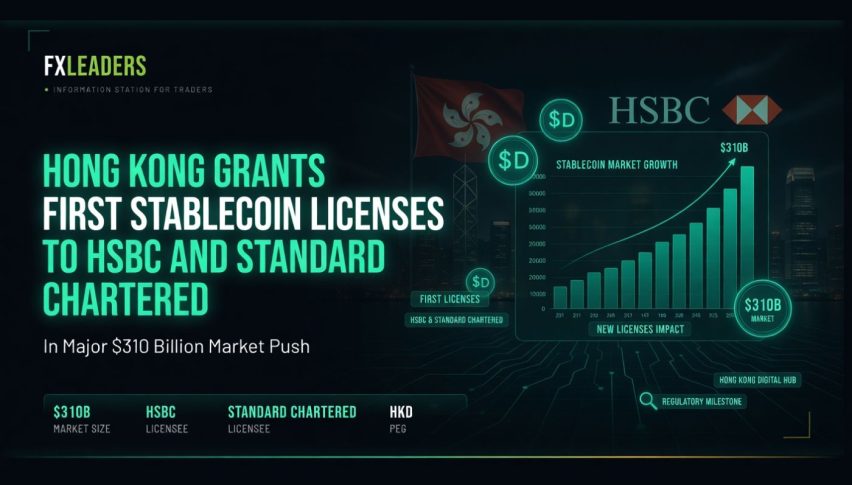
Hong Kong Grants First Stablecoin Licenses to HSBC and Standard Chartered in Major $310 Billion Market Push
Quick overview
- Hong Kong has issued its first regulated stablecoin issuer licences to HSBC and a consortium led by Standard Chartered, marking a significant milestone in its goal to become Asia's digital asset hub.
- The Hong Kong Monetary Authority (HKMA) aims to capture a share of the $310 billion global stablecoin market with bank-backed HKD stablecoins.
- The licences come with strict regulations, including requirements for cash reserves in high-quality liquid assets and compliance with anti-money laundering controls.
- Hong Kong's approach prioritizes established institutions over fintech innovation, as it seeks to establish a competitive presence in the digital currency landscape.
Hong Kong has taken a major step forward by issuing the first regulated stablecoin issuer licences to HSBC and Anchorpoint Financial (that’s a consortium put together by Standard Chartered & also featuring Animoca Brands and Hong Kong Telecommunications). The Hong Kong Monetary Authority (HKMA) has given the nod and this is a massive milestone in the city’s ambitions to become Asia’s leading digital asset hub.
The global stablecoin market is currently worth around $310 billion, and Hong Kong is looking to grab its own share of this market with bank-backed HKD stablecoins.
Why HSBC and Standard Chartered Got The Green Light First
The HKMA had 36 applications coming in under the Stablecoins Ordinance (which comes into effect in August 2025) and decided to start with a small group of high-cred lenders. Both HSBC and Standard Chartered are among the only three commercial banks which are allowed to issue physical Hong Kong dollar banknotes – a system that dates back to 1846.
Hong Kong has granted its inaugural stablecoin issuer licenses to HSBC and a joint venture of Standard Chartered, allowing the two lenders to be the first companies to issue cryptocurrencies pegged to the local currency https://t.co/hPcy0o5S4P
— Bloomberg (@business) April 10, 2026
HKMA Chief Eddie Yue when talking about this regime pointed out that just as banks used to back physical currency with silver, they will now back blockchain-tokens with top-grade liquid assets. Standard Chartered had actually tested out their stablecoin in the HKMA sandbox, whereas HSBC’s approval caught some people on the back foot – this was a bit unexpected since HSBC had opted out of the 2024 pilot.
The Strict Rules That Come With These Licences
The licences come with some quite tough rules:
- They have to keep their cash reserves in top quality liquid assets
- You can redeem them at face value within a working day (T+1) – not a second longer!
- Every client’s cash has to be kept in separate accounts
- Strict AML (anti-money laundering) controls and public reserve disclosures – they have to be as transparent as possible
- KYC (know your customer) verification needs to happen every time a wallet gets a transfer
- The travel rule kicks in on transfers above ~HK$8,000 ($1,000)
This is going to mean that HKD stablecoins embed compliance directly into smart contracts, so transfers will only go through to whitelisted wallets – they’re going to be quite different from freely tradable tokens like USDT or USDC.
JUST IN: HKMA grants first batch of stablecoin licenses, with HSBC and Standard Chartered among recipients. Could signal clearer on-ramp dynamics and growing institutional crypto access in Hong Kong. $BTC $ETH
— Bpay News (@bpaynews) April 10, 2026
A Long-Term Strategic Goal vs Dollar Dominance
Hong Kong wants to use regulated, bank-issued HKD stablecoins for tokenised commerce and regional trade settlement. Standard Chartered CEO Bill Winters has highlighted how this is all part of a new age of digital trade settlement.
The move also reflects the city’s regulatory approach: it’s prioritising the credibility of established institutions over rapid innovation from fintech start-ups. Even though the global market is still heavily dominated by the dollar, Hong Kong wants to carve out a meaningful role in Asia.
The licences have arrived as other financial centers are also accelerating their own regimes – the US has the GENIUS Act, the EU has MiCA, while Singapore, UAE, and Japan are also working on their own frameworks.
The big question now is whether tightly controlled HKD stablecoins will be able to compete with dollar incumbents on sheer network effects. However, one thing is clear: bank-issued, regulated digital currencies are now a reality in one of the world’s most important financial centres.
- Check out our free forex signals
- Follow the top economic events on FX Leaders economic calendar
- Trade better, discover more Forex Trading Strategies
- Open a FREE Trading Account
- Read our latest reviews on: Avatrade, Exness, HFM and XM

Related Articles
Sidebar rates

Related Posts
 Save
Save
