Amazon Stock Tests Investor Conviction As AMZN Stock Rebounds Off Key Support
Due to excessive spending, massive debt, and growing investor cynicism about the real benefits of the AI race, Amazon's stock has declined..

Quick overview
- Amazon's stock has declined approximately 17% from its early-November peak due to heavy spending and rising debt concerns.
- Investor skepticism has increased following a significant bond offering and a series of analyst downgrades questioning the profitability of AI investments.
- Despite recent challenges, Amazon's long-term trend remains positive, with potential for recovery if its AI investments yield profitable growth.
- The company's $50 billion investment in AI for government use highlights its commitment but also raises concerns about escalating costs and financial strain.
Live AMZN Chart
[[AMZN-graph]]
Due to excessive spending, massive debt, and growing investor cynicism about the real benefits of the AI race, Amazon’s stock has declined after a fantastic run.
Momentum Slows After Record Highs
Amazon entered November with one of its strongest stretches in months, fueled by enthusiasm around cloud services, artificial intelligence, and its expanding ecosystem. That momentum, however, began to fade as the month progressed. The stock retreated sharply from its early-November peak, falling roughly 17% and wiping out the gains made after its third-quarter earnings release. The pullback arrived at a time when investors across the market started reassessing sky-high expectations for AI-driven growth, particularly among the largest technology names.
Despite the decline, the broader long-term trend for Amazon still leans upward. The recent drop has so far paused near major technical levels, and the stock has managed to post several consecutive days of gains, suggesting that buyers are beginning to re-emerge—albeit cautiously.
Debt Issuance Triggers New Concerns
Investor unease intensified after Amazon announced a sizeable bond offering earlier this month, marking its first return to the debt market since 2022. The company indicated that the capital would support a mix of future investment, general purposes, and debt management. Yet the timing raised eyebrows. Markets are increasingly wary of the enormous sums being poured into AI infrastructure, and Amazon’s decision to take on additional borrowing reinforced fears that its ambitions may be stretching its balance sheet.
The underlying message many investors heard was simple: the cost of competing in AI is rising rapidly, and even companies as dominant as Amazon are feeling the financial strain. With interest rates still elevated compared to historical norms, any move that increases debt naturally draws heightened scrutiny.
Analyst Downgrades Deepen The Doubt
Skepticism around Amazon’s strategy hardened following a series of high-profile analyst downgrades. Analysts argued that the economics of generative AI may be far less attractive than initially believed. Unlike traditional cloud computing, which delivered strong margins and predictable revenue growth, AI appears to require far greater capital investment to generate each dollar of value.
Some suggested that generative AI could demand as much as six times the infrastructure spending to achieve comparable returns. Others highlighted that the pace of Amazon’s AI-related capital expenditure is accelerating at a speed that investors may no longer be willing to accept without clear evidence of strong, scalable profits. Similar downgrades to other major technology names signaled that this was not simply an Amazon issue, but part of a broader re-evaluation of the AI narrative.
The era of blank-check optimism toward AI appears to be fading, replaced by more demanding questions about efficiency, monetization, and long-term return on investment.
Technical Picture Offers Both Hope And Risk
From a technical perspective, the outlook is more balanced than the headlines suggest. While the retreat from all-time highs was sharp, the decline has, for now, found support near the 50-week moving average. Recent price action shows a tentative rebound from that level, coinciding with improved sentiment in the wider equity market.
AMZN Chart Daily – Will The 50 SMA Break?
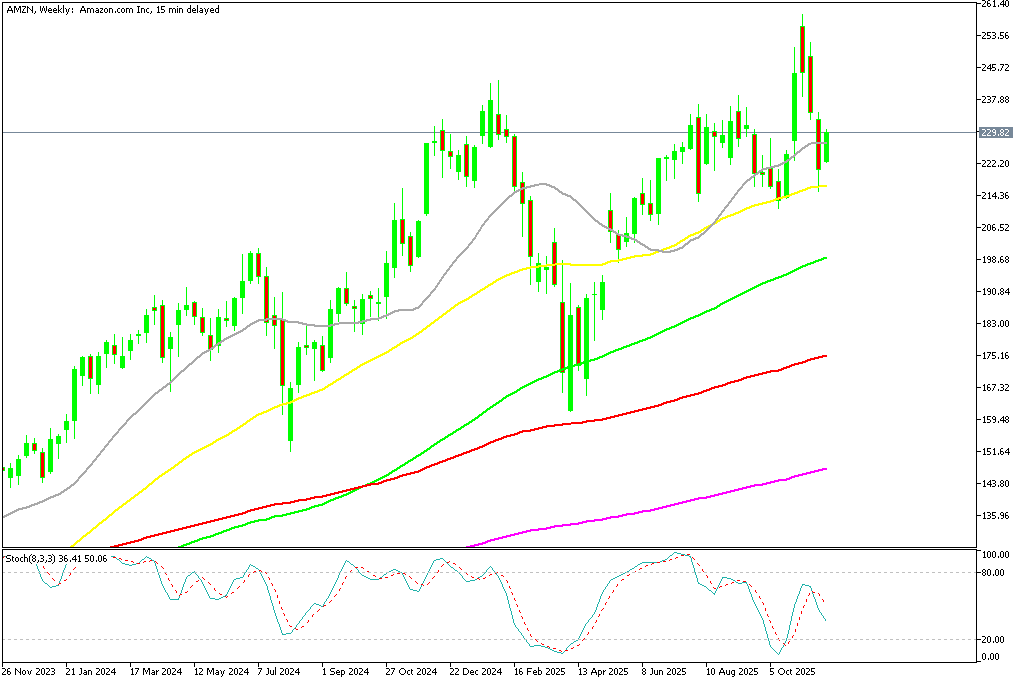
This zone is now critical. A sustained move higher could reinforce the idea that the pullback was merely a pause within a larger uptrend. On the other hand, a decisive break below this support could expose the stock to a deeper slide toward the 100-week moving average, currently sitting significantly lower and acting as the next meaningful level of interest.
A Fresh Bet On Government AI Infrastructure
In the midst of these concerns, Amazon has doubled down on its long-term vision. The company recently announced a massive new $50 billion investment aimed at expanding its artificial intelligence and supercomputing capabilities for U.S. government use. The initiative is designed to provide federal agencies with access to advanced AI tools, high-performance chips, and secure infrastructure to support missions ranging from cybersecurity to scientific development.
While the move positions Amazon as a major partner in building next-generation government technology, it also reinforces the very concern weighing on the stock: escalating costs. The planned expansion will add significant computing capacity to its cloud network over the coming years, but it will require enormous upfront spending before returns become visible.
Outlook Hinges On Execution
Amazon now stands at a defining moment. If its AI and infrastructure investments begin translating into durable, profitable growth, the recent pullback could be remembered as a buying opportunity. If not, investor patience may continue to thin. For now, the stock sits at a crossroads, supported by long-term optimism yet challenged by short-term reality.
- Check out our free forex signals
- Follow the top economic events on FX Leaders economic calendar
- Trade better, discover more Forex Trading Strategies
- Open a FREE Trading Account
- Read our latest reviews on: Avatrade, Exness, HFM and XM

Related Articles



Sidebar rates

Related Posts
 Save
Save