MU Stock Drops Again on Micron’s Consumer Memory Business Exit and Repricing
A wider divide in the market between growing concerns about sustainability and optimism is reflected in Micron's recent inconsistent...

Quick overview
- Micron Technology experienced a significant stock drop of over 23% in November, highlighting vulnerabilities in the AI-driven market.
- The company's brief rebound was halted by rumors of exiting its Crucial consumer business, leading to further declines.
- Despite strong financial results, investor sentiment has shifted towards skepticism, with a focus on sustainable returns amid growing competition.
- Geopolitical factors and increasing competition from companies like Samsung and SK Hynix add complexity to Micron's market position.
Live MU Chart
[[MU-graph]]
A wider divide in the market between growing concerns about sustainability and optimism is reflected in Micron’s recent inconsistent performance.
A Sudden Drop That Shook Market Confidence
Micron Technology entered November as one of the standout performers of the AI boom. Shares had climbed relentlessly throughout the year, reaching an all-time high of $261, powered by insatiable demand for high-bandwidth memory used in artificial intelligence systems. But by mid-November, the narrative shifted dramatically. A swift, unexpected pullback ripped through global markets, and Micron became one of the hardest-hit names.
The stock tumbled more than 23%, breaking below the psychologically important $200 level in a matter of days. For a company up over 160% year-to-date, the rapid reversal was a stark reminder that even the strongest AI beneficiaries are vulnerable when sentiment falters.
The decline exposed deeper investor worry: had the AI rally become too stretched, too crowded, and too dependent on flawless execution?
A Short-Lived Rebound Meets Fresh Resistance
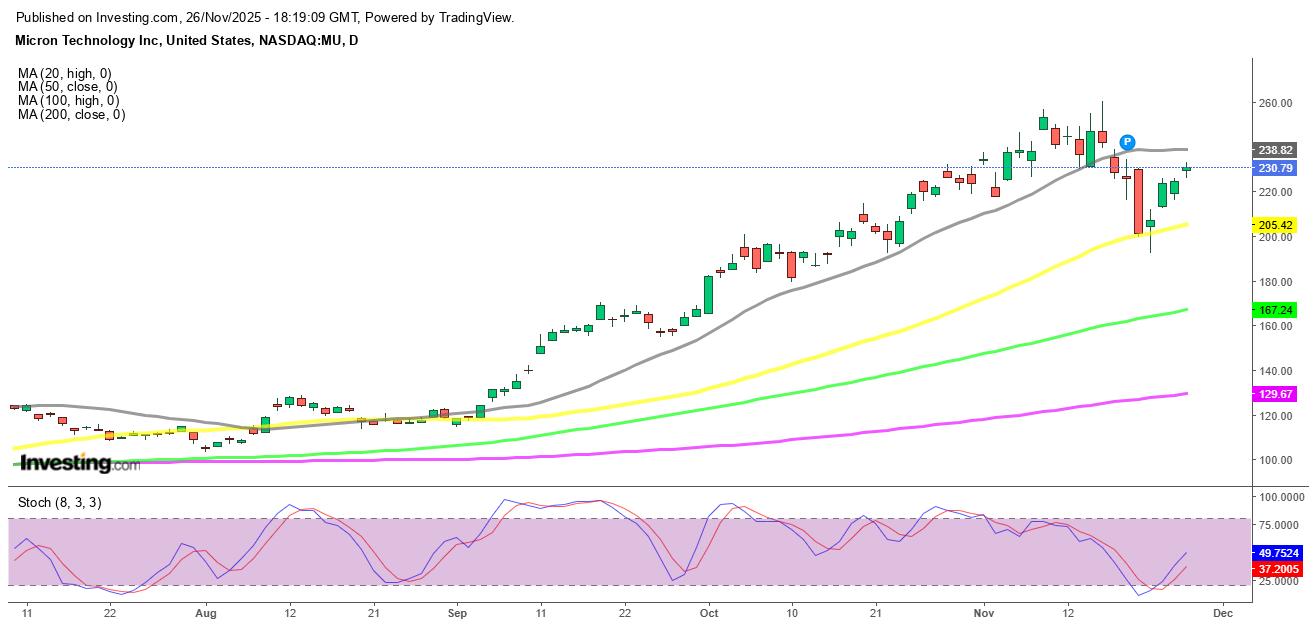
Following the sharp selloff, Micron briefly stabilized. Buyers stepped in near the 50-day simple moving average (yellow), a key technical level that had supported the stock throughout the year. From there, shares bounced back toward $245, offering a glimmer of relief and hinting at a potential resumption of the broader uptrend.
MU Stock Chart Daily – The 50 SMA Held As Support
Conumer Business Exit
But the rebound stalled almost immediately. The 20-day SMA (gray), once a consistent support line, flipped into resistance and rejected further gains. Trading turned choppy, and the stock slid again—this time accelerated by new rumours that Micron plans to exit its Crucial consumer business, including SSDs and DRAM modules sold at major retailers.
The shift marks a significant restructuring of Micron’s consumer strategy, with shipments expected to wind down by February 2026. The market reacted swiftly: shares fell more than 5% intraday and ultimately closed over 2% lower, slipping under $230.
What began as a technical correction has grown into a broader narrative shift surrounding Micron’s strategic direction.
Sector Downgrades Send Shockwaves Through the AI Trade
Micron’s decline did not occur in isolation. A series of cautious notes and downgrades from firms like Rothschild & Co. Redburn questioned whether the profitability of massive AI infrastructure spending can keep pace with soaring expectations.
Concerns that hyperscalers may trim capital expenditures or shift purchasing timelines hit the entire AI ecosystem. Big names including Microsoft, Amazon, and leading semiconductor stocks all faltered alongside Micron.
Investors began reassessing lofty valuations, adopting a more selective approach. The market is transitioning from “paying for potential” to prioritizing clear evidence of sustainable returns—a shift that leaves little tolerance for surprises, rumours, or strategic pivots.
Solid Fundamentals Offer Support—but Not Immunity
Ironically, Micron’s financial results remain exceptionally strong. Recent quarterly revenue reached $11.32 billion, up 46% year-over-year, while adjusted EPS of $3.03 easily surpassed expectations. Full-year revenue hit $37.38 billion, rising 49%, with net income jumping to $8.5 billion.
Data center demand is now responsible for more than half of the company’s revenue, underscoring Micron’s central role in the AI hardware supply chain.
Yet strong results alone are no longer a guarantee of stock stability. Many investors believe much of this strength is already priced in, especially as competitors rapidly ramp production and future supply conditions become less predictable.
Still, optimism remains among analysts. Morgan Stanley recently reiterated Micron as its top pick in the memory sector, citing worsening shortages in advanced memory technologies like DDR5 DRAM. In the firm’s view, pricing power could remain a tailwind into 2026, supporting elevated earnings.
Growing Competition and Geopolitics Add Complexity
While demand for advanced memory is booming, the competitive landscape is heating up. Samsung and SK Hynix are accelerating their push into next-generation HBM4 memory, while manufacturers in China and Taiwan expand capacity at a rapid pace. Analysts warn that today’s supply tightness could shift to oversupply by 2026.
Geopolitical pressures amplify these risks. With semiconductors central to national security, supply chains remain exposed to trade disputes, export restrictions, and potential disruptions in critical raw materials.
Conclusion: A Market Searching for Balance
Micron’s dramatic reversal encapsulates the market’s current dilemma—soaring optimism about AI’s long-term potential, tempered by questions about near-term sustainability, competition, and strategic execution. While the company’s fundamentals remain robust, sentiment has become more fragile, and investors are demanding clearer proof that the AI monetization cycle will continue delivering at scale.
- Check out our free forex signals
- Follow the top economic events on FX Leaders economic calendar
- Trade better, discover more Forex Trading Strategies
- Open a FREE Trading Account
- Read our latest reviews on: Avatrade, Exness, HFM and XM

Related Articles
Sidebar rates

Related Posts
 Save
Save