Intel Stock INTC Rebounds Right Back As Expected on Fundamental Catalysts
Intel’s rapid swing from a steep pullback to a sharp rebound has thrust the chipmaker back into market focus, stirring debate over whether..
Quick overview
- Intel has experienced a significant rebound, surging nearly 35% in two weeks, but faced a pullback of over 7% before stabilizing above $42.
- The company's resurgence is supported by favorable macroeconomic conditions and a renewed investor interest in the semiconductor sector.
- Speculation about a potential foundry partnership with Apple has added momentum to Intel's stock, potentially enhancing its manufacturing credibility.
- Intel's upcoming Panther Lake architecture aims to improve efficiency and performance, targeting premium markets while benefiting from favorable policy incentives.
Intel’s rapid swing from a steep pullback to a sharp rebound has thrust the chipmaker back into market focus, stirring debate over whether its latest momentum reflects a durable turnaround or another fleeting upswing.
Intel Rebuilds Momentum Amid a Volatile Market Shift
Intel’s recent weeks have marked one of its most dramatic reversals in 2025. After surging nearly 35% in just two weeks—powered by speculation, government incentives, and fresh optimism in the semiconductor sector—the company found itself once again commanding the market’s attention. The rally initially hinted at a genuine re-acceleration of Intel’s long-term recovery story. But by Thursday, enthusiasm cooled sharply, with shares sliding more than 7% from the recent high near $44. Yet today’s rebound above $42 signals that Intel’s momentum remains intact, and that buyers are not willing to let the latest pullback rewrite the broader narrative.
Intel’s resurgence comes on the heels of a destabilizing November drop, when shares tumbled under $33 and appeared at risk of breaking their broader recovery trend. That low proved to be a turning point. As macro fears faded and expectations for easier monetary policy strengthened, demand for cyclical tech—especially semiconductors—accelerated. Intel quickly became one of the sector’s top beneficiaries. The decisive reclaiming of the $40 level last week set off a wave of renewed interest, pushing the stock through several technical resistance zones and reinforcing the sense that Intel was entering a new phase of its comeback.
Technical Structure Reinforces the Recovery Narrative
The price action behind Intel’s rebound has been almost as important as the fundamental drivers. Once the stock reclaimed the mid-$30s, volume swelled and higher lows began to establish a fresh upward formation. The psychological break above $42.50 placed the stock directly against the 100-month simple moving average, a threshold that has acted as both support and resistance throughout the past decade.
INTC Chart Monthly – Buyers Couldn’t Hold the Price Above the 100 SMA
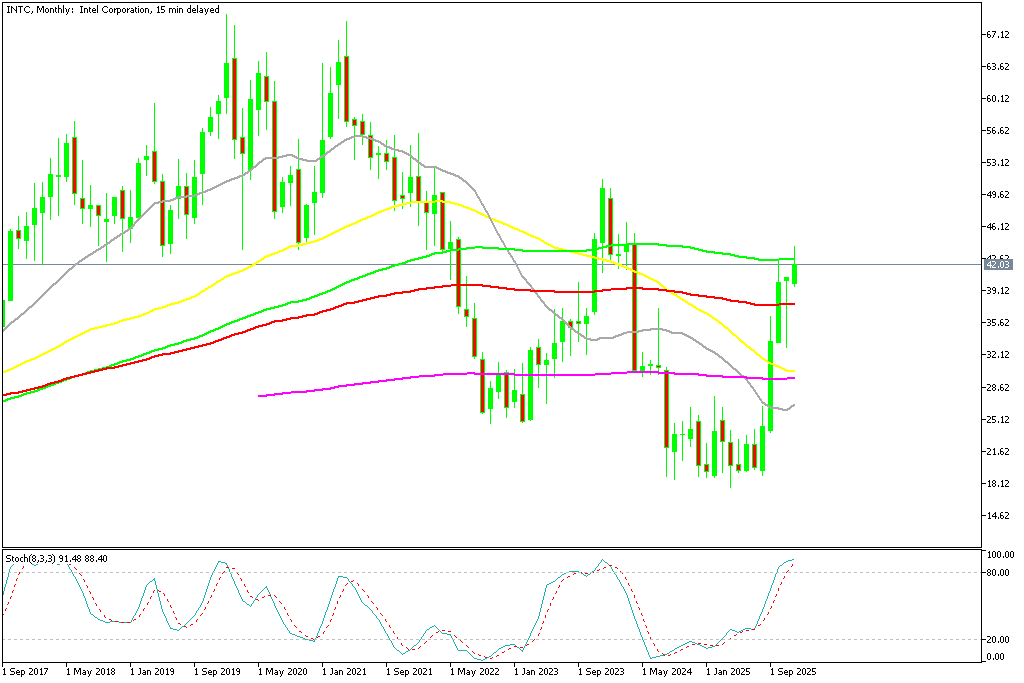
The attempted breakout above the 100 SMA energized traders, with some positioning for a potential retest of the 2024 highs above $51. However, the pullback that followed—combined with Thursday’s return beneath the 100 SMA—suggests that bullish conviction will need to strengthen before Intel can clear this major technical roadblock. Still, today’s rebound signals resilience and highlights that buyers continue to view dips as opportunities, not warning signs.
The broader backdrop remains constructive, especially as long-term charts show Intel stabilizing after years of structural challenges. Assuming shares hold support near the low $40s, the technical setup continues to favor upward continuation.
Macro Forces Have Become a Tailwind, Not a Headwind
Macro dynamics have played a crucial role in Intel’s renewed momentum. Federal Reserve officials adopted a more dovish tone as the year entered its final weeks, fueling expectations that rate cuts could arrive sooner than previously anticipated. This shift has revived investor appetite for growth-sensitive sectors that had spent the autumn under pressure.
Semiconductors—caught earlier in concerns about weakening demand and global supply normalization—were among the first to respond. Intel, still positioned as a core U.S. manufacturing player with deep geopolitical relevance, stood out in the rebound. Investors increasingly view the company as one of the main beneficiaries of the multiyear push for domestic chip production, supply chain diversification, and strategic investment in U.S.-based fabrication.
Intel’s third-quarter numbers reinforced that narrative. Revenue rose 3% to $13.65 billion, easily surpassing expectations, while non-GAAP earnings reached $0.23 per share. Gross margins improved to 40%, boosted by leaner operations and early efficiencies from its revitalized foundry strategy. The Q4 outlook—projecting revenue between $12.8 billion and $13.8 billion—suggests steady performance ahead as Intel restructures its network, CPU, and ASIC teams to support a more integrated AI-driven hardware roadmap.
Apple Foundry Speculation Adds a Strategic Catalyst
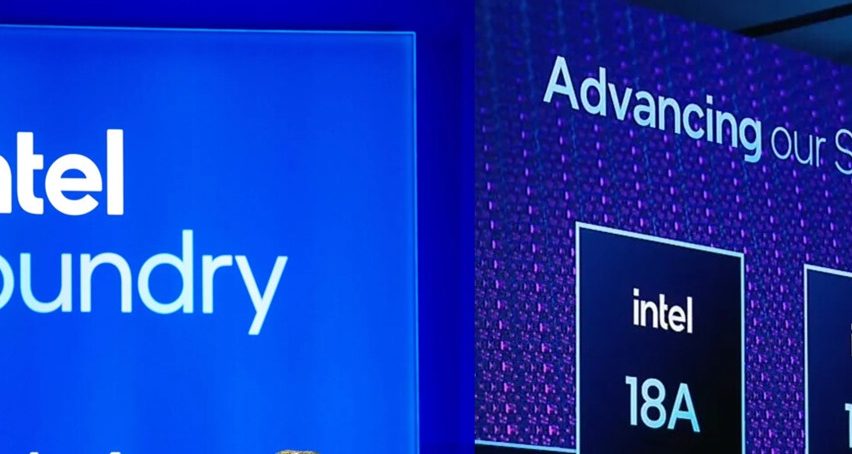
The most influential catalyst beneath the recent rally has been renewed speculation surrounding a potential foundry partnership with Apple. Reports from late November reignited discussion about Apple possibly adopting Intel’s 18AP process node for a future generation of its M-series processors. Although still unconfirmed, even early-stage talks would represent a massive shift in Intel’s foundry credibility.
New Process Design Kits expected in early 2026 could solidify whether Apple sees Intel’s roadmap aligning with its own performance, efficiency, and thermal expectations. Should the partnership move forward, production could begin as early as mid-2027, potentially elevating Intel into one of the most prestigious manufacturing ecosystems in the world. For investors, the mere possibility has been enough to reframe Intel’s multi-year transformation as not only plausible, but strategically validated.
Panther Lake Ushers In Intel’s Next Architectural Era
Alongside external partnerships, Intel’s internal innovation engine is gaining momentum. Recent performance database entries revealed early sightings of a Core Ultra 9 386H chip—part of the anticipated Panther Lake generation—under testing in an Acer Predator platform. While still preliminary, the results suggest that Panther Lake is emphasizing power efficiency and real-world performance over raw core count escalation.
This shift signals a strategic recalibration: Intel is targeting premium laptop and gaming segments with an architecture designed to restore competitiveness in markets where efficiency, thermal stability, and integrated AI performance matter most. If execution remains tight, Panther Lake could reaffirm that Intel’s architectural roadmap is regaining the discipline and clarity it lacked in recent years.
A Strengthened Competitive and Policy Environment
The competitive field has also shifted in Intel’s favor. AMD, which dominated much of 2024, now faces margin compression and cooling enthusiasm around certain key product lines. This moderation gives Intel valuable space to rebuild market share without the same degree of direct pressure.
At the policy level, the global drive to localize semiconductor supply chains continues to rise. Intel stands to benefit directly from nearly $16 billion in CHIPS Act incentives, strengthening both its balance sheet and its capacity for manufacturing reinvention. Leadership under CEO Lip-Bu Tan has brought more direct oversight to engineering and manufacturing, restoring strategic focus at a critical moment.
- Check out our free forex signals
- Follow the top economic events on FX Leaders economic calendar
- Trade better, discover more Forex Trading Strategies
- Open a FREE Trading Account
- Read our latest reviews on: Avatrade, Exness, HFM and XM

Related Articles
Sidebar rates

Related Posts
 Save
Save