Analysts Doubts, AI Costs, Employee Protests Send Amazon Stock AMZN in A 5 Day Dive
As investors question if Amazon's AI ambitions will justify the increasing expenses, the stock has declined for five straight sessions...

Quick overview
- Amazon's stock has declined nearly 17% after reaching record highs, as investor confidence wanes amid rising costs associated with its AI ambitions.
- The company is adjusting its European seller fee structure to enhance competitiveness in the budget-friendly fashion market, responding to pressure from rivals.
- Analyst downgrades are raising concerns about the long-term profitability of Amazon's AI investments, suggesting they may require significantly more capital than traditional cloud services.
- Despite market skepticism, Amazon is committing to a $50 billion investment in AI infrastructure, aiming to solidify its role in government technology while facing scrutiny over its financial sustainability.
Live AMZN Chart
[[AMZN-graph]]
As investors question if Amazon’s AI ambitions will justify the increasing expenses, the stock has declined for five straight sessions, sharply reversing the company’s remarkable November climb.
Amazon’s Rally Unwinds As Confidence Weakens
Amazon entered November on a surge of strength, riding enthusiasm for its cloud business, artificial intelligence strategy, and expanding retail ecosystem. That excitement pushed AMZN to fresh record highs of $258.60, capping one of its strongest multi-week performances of the year. But the mood shifted quickly. As November progressed, buying pressure faded, profit-taking intensified, and conviction began to weaken across the broader tech sector.
The reversal was sharp. After touching its peak, Amazon slid nearly 17%, giving back gains accumulated following its third-quarter earnings release. The downturn emerged just as the market began reassessing the valuation premium placed on AI-driven growth—particularly among the largest technology firms, where expectations had arguably become unsustainably high.
AMZN Chart Daily – The 20 SMA Rejected the Price
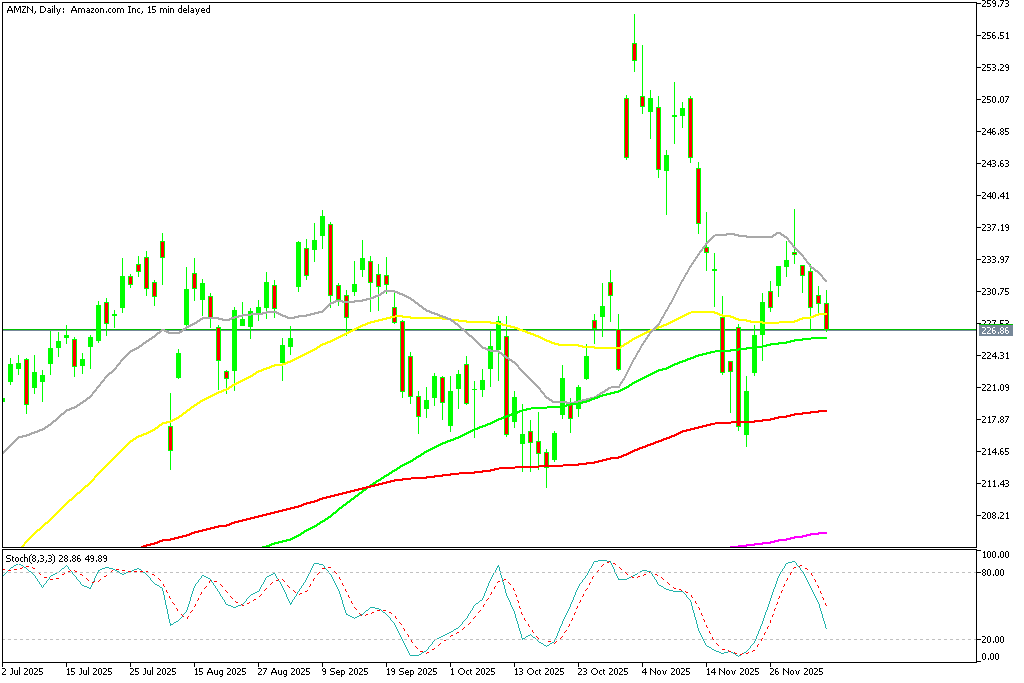
Though the long-term trajectory for Amazon remains intact, recent trading shows how fragile sentiment has become. The stock failed to reclaim the October high last week, and the 20-day simple moving average acted as firm resistance, rejecting multiple attempts by buyers to regain control. The result: Amazon has now fallen for five consecutive sessions and opened the new week with a further 1.20% decline, hinting that bearish pressure may persist.
Fee Adjustments In Europe Add A Competitive Twist
Alongside the market pullback, Amazon revealed upcoming changes to its European seller fee structure, set to begin December 15. The company plans to reduce referral fees by roughly 2 percentage points for clothing and accessory items priced under €15 or £15. For products priced between €15–20 or £15–20, the cut will be even larger at around 5 percentage points.
These changes are designed to encourage more budget-friendly fashion listings—an area where rivals such as Shein and Temu have gained rapid traction. By lowering barriers for sellers and improving price competitiveness, Amazon is aiming to reclaim share in one of e-commerce’s most price-sensitive categories.
Analyst Downgrades Intensify Concerns Over AI Economics
One of the strongest drivers of Amazon’s recent decline has been a wave of analyst downgrades questioning the long-term profitability of generative AI. While AWS remains the company’s crown jewel, analysts argue that the economics of AI look far more challenging than traditional cloud computing. Some estimates suggest generative AI may require up to six times more capital investment to generate the same incremental revenue.
This discrepancy has fueled doubts about the sustainability of Amazon’s aggressive AI strategy. With capital expenditures climbing at an unusually fast pace, investors are becoming more insistent on clarity regarding returns, scalability, and the timeline for monetization.
At the same time, similar downgrades across other mega-cap tech names indicate that Amazon is not being singled out—rather, the entire AI narrative is undergoing a period of scrutiny. The once-unquestioned assumption that AI investment would automatically translate into superior growth is being replaced with more pragmatic expectations.
Amazon Employees Refuse AI Replacement
Adding to the tension, more than 1,000 Amazon employees recently signed an open letter expressing deep concerns about the potential societal risks of AI. While the number is small compared with Amazon’s 1.53 million-strong workforce, the letter underscores growing internal and external unease.
Technical Setup Shows A Critical Test Ahead
From a technical standpoint, Amazon is sitting at a crossroads. The pullback from all-time highs was forceful, but the stock initially found support at the 50-week moving average—a level that has historically acted as a stabilizing boundary. Last week’s bounce, however, was weak and short-lived. Selling pressure resumed almost immediately and has continued into this week.
AMZN Chart Weekly – Will The 50 SMA Break This Time?
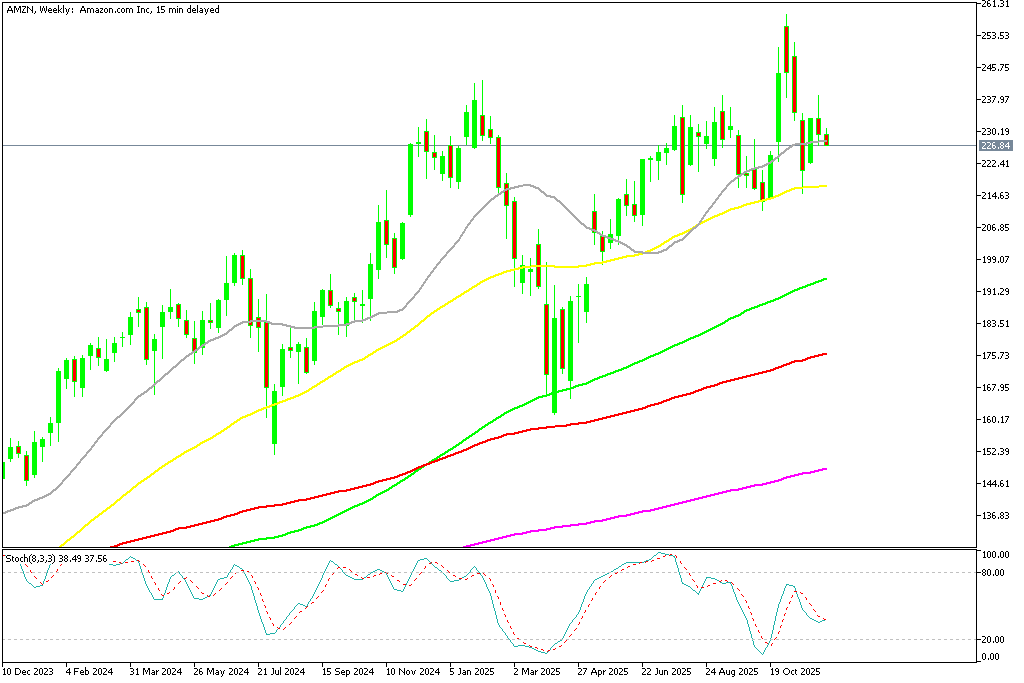
A decisive break below $216, the region near the 50-week support, could open the door to a deeper slide toward the 100-week moving average, a level much lower on the chart and one that represents the next major structural support zone.
If buyers cannot defend current levels, the technical picture may shift from consolidation to a more pronounced correction.
Amazon Doubles Down On AI Infrastructure Despite Criticism
In the midst of the market’s growing skepticism, Amazon has shown no sign of retreating from its long-term ambitions. The company recently announced a massive $50 billion investment aimed at dramatically expanding its AI and supercomputing infrastructure for U.S. government use. The initiative is intended to deliver advanced computing resources across federal agencies, supporting needs ranging from cybersecurity to scientific analysis.
Strategically, this positions Amazon as a core partner in building the next generation of government technology. But it also reinforces the very concern haunting the stock: soaring costs with long payback periods. The scale of investment required could pressure margins for years before the returns are fully realized.
Conclusion: Amazon now finds itself in a delicate balance between ambition and market patience. Its commitment to AI, infrastructure, and long-term cloud leadership remains clear, but investors are increasingly demanding proof that these massive investments will translate into sustainable profitability. With the stock testing key support levels, analyst sentiment turning cautious, and capital expenditure surging, the next phase for Amazon will depend on whether it can convert bold spending into tangible returns—or whether the market’s reassessment signals a deeper shift in expectations.
- Check out our free forex signals
- Follow the top economic events on FX Leaders economic calendar
- Trade better, discover more Forex Trading Strategies
- Open a FREE Trading Account
- Read our latest reviews on: Avatrade, Exness, HFM and XM

Related Articles


Sidebar rates

Related Posts
 Save
Save