MSFT Stock Rebounds Off Support as India Investment Offsets Chatbot Regulation
Microsoft's stock is still under pressure despite a temporary rebound because investors are skeptical of the company's aggressive...
Quick overview
- Microsoft's stock has declined over 13% from record highs as investors express concerns about rising AI-related costs and spending commitments.
- Regulatory scrutiny has intensified, with U.S. state attorneys general warning major tech firms about risks associated with AI chatbots, further impacting investor sentiment.
- Despite announcing a $23 billion investment in India to bolster cloud infrastructure and AI capacity, concerns about escalating capital expenditures persist.
- Technical indicators suggest that Microsoft's stock momentum is weakening, with critical price levels needing to be reclaimed to restore investor confidence.
Live MSFT Chart
[[MSFT-graph]]
Microsoft’s stock is still under pressure despite a temporary rebound because investors are skeptical of the company’s aggressive AI and global expansion plans.
Microsoft’s Rally Stalls as AI Costs Cast a Long Shadow
Microsoft’s share price has spent the past two months in a steady decline, falling more than 13% from its record highs above $555 as investors grow wary of the company’s rising costs and vast spending commitments tied to artificial intelligence. What was once viewed as a dominant AI leader with unmatched scale is now being reevaluated through a more cautious lens. The slip below the $500 threshold this week signaled a broader shift in sentiment: enthusiasm for high-priced AI bets is fading, and the market is becoming less tolerant of mounting expenses without visible near-term returns.
The stock briefly stabilized on Thursday following news of a large new investment initiative, but the rebound did little to erase the emerging view that Microsoft’s AI-driven expansion may be approaching its limits.
Regulatory Concerns Resurface as AI Scrutiny Intensifies
Adding to the pressure was fresh criticism from U.S. state attorneys general, who issued warnings to Microsoft, Apple, Google, and Meta about potential risks tied to their AI-enabled chatbots. Although Microsoft has navigated regulatory storms before, the renewed scrutiny weighed on sentiment, reminding investors that the company remains a central target in the fast-evolving debate over AI governance and safety.
These warnings triggered additional selling on Wednesday, compounding the market’s cautious stance toward major AI-exposed technology firms. For a stock already drifting lower, the timing was unwelcome.
A Massive Investment in India Raises New Questions
Despite the regulatory pressure, Microsoft attempted to regain momentum by announcing a sweeping $23 billion investment package—its largest commitment in Asia to date. Of that, $17.5 billion is earmarked for cloud infrastructure and AI capacity in India, a nation poised for explosive digital growth over the next decade.
The expansion underscores Microsoft’s belief that global demand for AI and cloud services will continue to accelerate, but it has also heightened investor concerns about runaway capital expenditures. The scale of the plan comes as Amazon prepares its own $35 billion push in India, suggesting that major U.S. tech firms are entering what some analysts call a hyperscale “expense race”—one in which margins risk becoming collateral damage.
Technical Strain Builds Despite Thursday’s Bounce
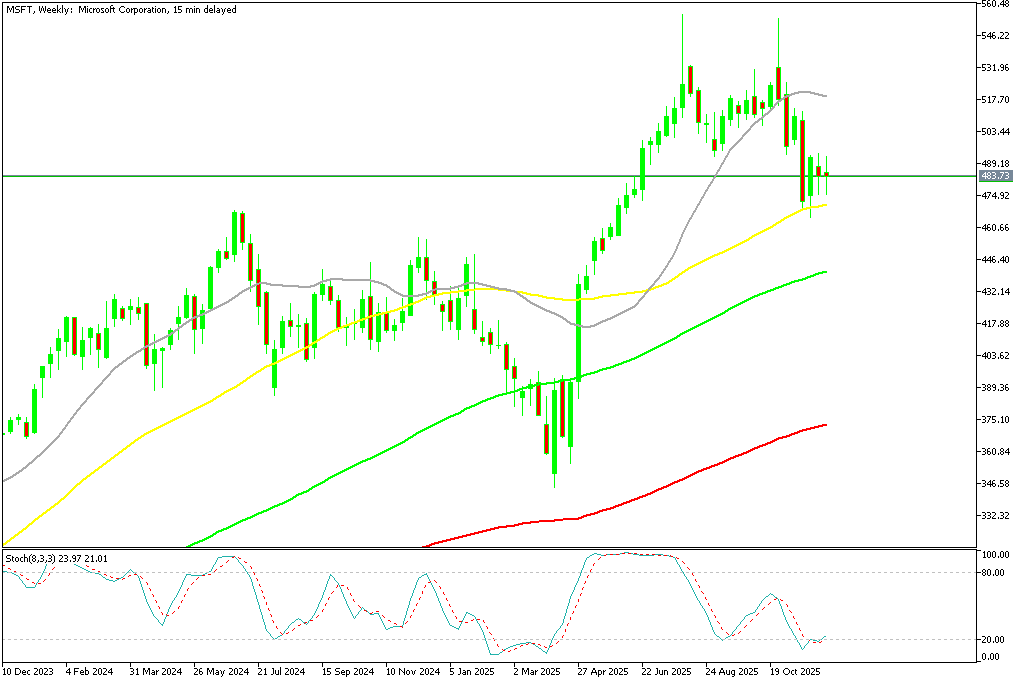
Microsoft’s recent price action has reinforced the impression that the stock’s steady uptrend may be losing momentum. After failing to hold the highs near $553–$555, shares broke decisively below the 50-day moving average (yellow) and eventually slid toward the 100-day SMA (red), where a rebound finally emerged on Thursday.
MSFT Chart Daily – The 100 SMA Is Holding As Support

But even with that bounce, the technical picture remains fragile. The stock is now trading below the 20-week moving average (gray), a sign that medium-term momentum has weakened. Although the 50-week SMA has acted as support for now, traders are wary of a deeper correction. A break toward the $468 region remains on the radar should selling pressure return, while $500 has re-emerged as a critical ceiling that will need to be reclaimed to restore investor confidence.
MSFT Chart Weekly – Diving Below the 20 SMA
Compounding matters, Microsoft’s Vice Chair and President Brad Smith recently sold more than 30,000 shares—an action that, while not unusual on its own, has added to perceptions that leadership may be bracing for a more volatile stretch.
AI Spending Turns From Strength to Concern
Even with strong quarterly earnings—$3.72 per share on revenue of $77.67 billion—the discussion among analysts has shifted. Instead of highlighting performance, the conversation now centers on whether Microsoft’s AI investments are becoming an overhang. More than $3.1 billion in OpenAI-linked expenditures eroded nearly forty cents per share in the previous quarter, signaling how quickly costs are climbing.
CFO Amy Hood has warned that these spending pressures will intensify throughout 2025 as Microsoft expands its data-center footprint, GPU capacity, and AI model integrations. What once served as the company’s biggest growth catalyst may now be threatening margin stability, raising doubts about the timing of future profitability from AI-driven services.
Partnership Tensions and Strategic Risks Multiply
Microsoft’s sprawling network of AI alliances was once seen as a competitive advantage, but it is increasingly becoming a source of complexity. Its deepening collaboration with Nvidia and Anthropic promises broader model availability on Azure, yet it also fragments Microsoft’s AI ecosystem at a moment when investors are asking for clearer strategic focus.
More troubling is the growing tension with OpenAI, Microsoft’s most important partner. Reports of OpenAI exploring its own chip partnerships with Broadcom—and even developing tools that could rival LinkedIn—suggest that Microsoft may be losing some strategic influence just as AI competition intensifies.
Operational Setbacks and Reputational Risks Add Pressure
Microsoft’s challenges extend beyond finances and partnerships. Recent internal leaks tied to AI system development have revived concerns about data security and oversight, key issues for a company that positions itself as a leader in enterprise trust. Meanwhile, the Xbox division continues to underperform, adding to the narrative that some business units are losing ground.
Reputational pressures are also mounting. Employee unrest has grown louder in response to defense-related AI contracts and large-scale data-center agreements in politically sensitive regions. Microsoft’s multibillion-dollar UAE partnership has drawn criticism from human-rights organizations and several institutional investors—risk factors that could influence future capital flows.
Outlook: A Rebound, But Not a Resolution
Thursday’s recovery offers a temporary reprieve, but the deeper issues surrounding Microsoft’s stock remain unresolved. The company continues to balance exceptional long-term opportunity with intensifying near-term costs, regulatory headwinds, and strategic uncertainties.
Unless Microsoft can demonstrate that its soaring AI expenditures will translate into durable revenue growth—and not just infrastructure bloat—the stock may continue to struggle for stability in the months ahead.
- Check out our free forex signals
- Follow the top economic events on FX Leaders economic calendar
- Trade better, discover more Forex Trading Strategies
- Open a FREE Trading Account
- Read our latest reviews on: Avatrade, Exness, HFM and XM

Related Articles

Sidebar rates

Related Posts
 Save
Save