Solana Struggles at $121 as Network Activity Declines While Competitors Surge
Technical indicators point to continued weakness as Solana (SOL) falls 32% since November amid shrinking on-chain metrics

Quick overview
- Solana's price has dropped 32% since November, significantly underperforming the broader altcoin market's 21% decline.
- On-chain fundamentals indicate weakening demand, with weekly transaction fees decreasing by 36% and decentralized application sales down 30%.
- Despite growing institutional support through Solana ETFs, the overall market sentiment remains negative due to declining network utilization.
- Technical analysis suggests further downside risk for SOL, with potential support levels between $100 and $110 if current trends continue.
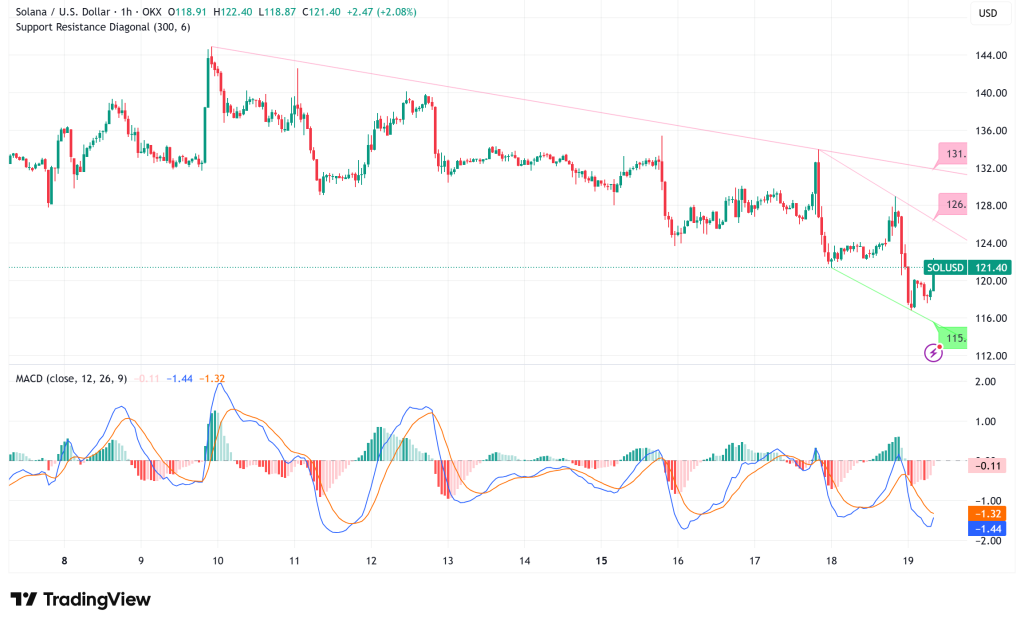
As the top smart contract platform encounters increasing pressure from dwindling network activity and escalating competition from layer-2 alternatives, Solana SOL/USD is trading at $121, down 1.2% in the last day. The token’s 32% loss since November has greatly lagged behind the 21% decline in the altcoin market as a whole.
Network Fundamentals Signal Weakening Demand
Declining on-chain fundamentals that point to a decline in demand for Solana’s network services are reflected in the discrepancy between SOL’s price movement and the larger cryptocurrency market. Two months ago, weekly transaction fees were $7 million; now, they are $4.5 million, a 36% decrease. More worrisome, Solana’s decentralized application sales have decreased 30% in the same period, from their peak of $26 million per week.
These figures show that users and developers are gradually switching to other platforms despite Solana’s reputation as a high-performance blockchain. When contrasting Solana’s meager 4% monthly transaction growth with rivals like Base (34% growth), Arbitrum (21% growth), and Polygon (89% growth), the change is very noticeable. With a 13% increase in transactions, even Solana’s immediate rival Tron beat her.
Institutional Support via Solana ETFs Fails to Lift Price
The institutional adoption of SOL is still growing in spite of deteriorating fundamentals. The REX-Osprey SOL+Staking ETF was introduced in July, and since then, the US Solana ETF market has amassed $636 million in assets. As a treasury reserve approach, major companies like Forward Industries, Solana Company, and Sharps Technology have added 20.35 million SOL tokens totaling more than $2.5 billion to their balance sheets.
Furthermore, during the course of two months, the total number of staked tokens increased from 410 million to 418 million, locking up roughly 68% of SOL’s circulating supply. Staking yields above 6% relieve immediate selling pressure while generating revenue for validators. But this institutional investment hasn’t been enough to offset the general market attitude brought on by dwindling network utilization.
SOL/USD Technical Analysis Points to Further Downside Risk
Technically speaking, SOL’s poor performance in comparison to the entire cryptocurrency market capitalization indicates that the token is still in a bearish period. Compared to the market’s 21% decrease, the 32% decline from November highs suggests persistent selling pressure unique to Solana rather than widespread weakness in the cryptocurrency market.
A fall below the $120 level, which is the key support being challenged, could lead to intensified selling toward the $100–$110 range. At $135, where prior support turned into overhead supply after November’s drop, resistance has developed.
Solana Price Prediction: Limited Upside Without Activity Revival
In the short term, SOL’s technical and fundamental outlook is still difficult. The token’s performance disparity with the larger altcoin market is unlikely to shrink unless there is a noticeable turnaround in on-chain activity indicators. Market share is still being fragmented by competition from Ethereum layer-2 networks, which together have more value locked than Solana’s $8.5 billion.
Other competitive challenges are brought about by recent innovations in the BNB Chain ecosystem, such as well-liked decentralized apps supported by Binance’s user base and marketing infrastructure. Solana’s market positioning is further threatened by the exchange’s entry into prediction markets.
Price targets: If network indicators continue to decline, SOL may attempt $100–$110 support in a bearish situation. Range-bound trading between $115 and $130 is maintained by a neutral outlook. A positive case for $150 would only be supported by a persistent reversal in fee generation and DApp sales exceeding $7 million and $35 million weekly, respectively.
- Check out our free forex signals
- Follow the top economic events on FX Leaders economic calendar
- Trade better, discover more Forex Trading Strategies
- Open a FREE Trading Account
- Read our latest reviews on: Avatrade, Exness, HFM and XM

Related Articles


Sidebar rates

Related Posts
 Save
Save