EUR/USD Price Forecast: Holds 1.1660 as CPI Eases and Fed Signals Keep Dollar in Play
EUR/USD is trading near 1.1660, showing some strength, even though the US dollar is still pretty well-supported overall...
Quick overview
- EUR/USD is trading near 1.1660, showing strength despite a well-supported US dollar.
- US inflation data for December met expectations, with core inflation slowing to its lowest in four years.
- Job growth remains steady, supporting the Fed's cautious approach and keeping EUR/USD in a tight range.
- Upcoming US retail sales data and Fed officials' speeches are expected to influence near-term market volatility.
EUR/USD is trading near 1.1660, showing some strength, even though the US dollar is still pretty well-supported overall. Inflation in the US for December wasn’t bad enough to make anyone really lose faith in the Federal Reserve’s course of action – in fact, headline CPI rose 0.3% month over month and 2.7% year over year, which was exactly where people had been expecting it to be. And it turned out that core inflation had slowed to 0.2% month over month and 2.6% year over year, the lowest it’s been in four years.
It’s been a while since we’ve seen core inflation decline like that, and usually that would be negative for the dollar. But this time it didn’t seem to have any real impact, and one of the reasons for that is the big players like the eurozone central bank and the Bank of England came out in support of Fed chair Jerome Powell – that probably helped give people a bit more confidence about the independence of US policy.
The euro got a bit of a boost from traders selling their dollar positions, not because they suddenly thought the fundamentals favoured the euro, but because they were looking to cut their losses on the dollar side.
Jobs Data Supports a Steady Fed Narrative
Labor market numbers just came out, which adds a bit more to our picture. The latest ADP numbers for the last four weeks showed 11.75 thousand new jobs added, marking a fifth straight week of job growth. It’s not exactly explosive, but overall, employment conditions look pretty stable, which means there isn’t much pressure on the Fed to make big changes to interest rates in the short term.
The combination of inflation coming down without a huge hit to growth has made markets pretty comfortable with the idea that the Fed is just going to sit back and wait & see before making any moves, which is keeping EUR/USD pretty much stuck in a tight range. Some people are selling the euro because prices are soft, while others are holding back because the economy is still going strong.
The key drivers right now are things like:
- US core inflation is coming down without a big hit to growth
- Job numbers are showing steady growth, which is supporting the Fed’s cautious approach
- Profit-taking on the dollar, rather than a fundamental shift in the market
Next Up: Retail Sales and a Few Fed Speakers
Now that we’ve got labor market data out of the way, next up are the US retail sales numbers, which are expected to rise by 0.4%, driven largely by stronger car sales. If we exclude autos, sales are also expected to be up 0.4%, the same as last month. We’ve also got several Fed officials speaking in the coming days, including John Williams and Raphael Bostic, and people will be listening carefully to see if they offer any clues about the timing and scope of future interest rate moves.
With little data coming out of Europe, the US numbers are likely to determine near-term market volatility.
EUR/USD Technical Picture Remains Balanced
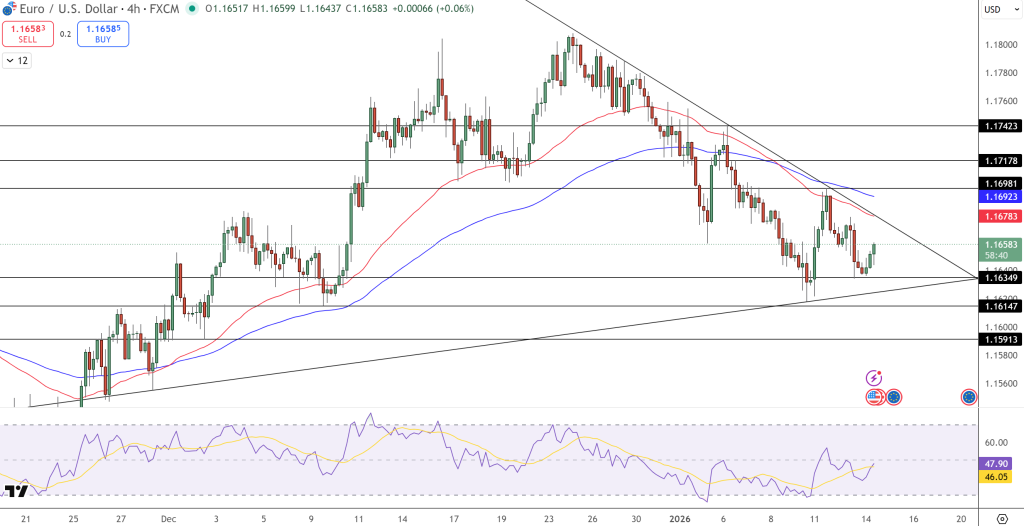
From a purely technical point of view, EUR/USD is stabilizing after a brief pullback from its late December highs. On the 4-hour chart, the pair is still stuck in a declining channel, but recent price action suggests buyers are emerging around 1.1630–1.1615. Price is still holding above a rising trend line from November, which keeps the broader picture looking pretty constructive.
The level where the pair used to be weak (1.1690–1.1710) is now acting as resistance near the 50-period moving average, while the 200-period average is adding a bit of pressure from above. RSI is sitting around 48, which is roughly neutral. A breakdown below 1.1615 could expose 1.1590, while a move above 1.1700 could open the door to a push towards 1.1740–1.1780.
Trade idea: If the pair can get back above 1.1700, then the next stop would be 1.1740–1.1780. Stop loss below 1.1630.
- Check out our free forex signals
- Follow the top economic events on FX Leaders economic calendar
- Trade better, discover more Forex Trading Strategies
- Open a FREE Trading Account
- Read our latest reviews on: Avatrade, Exness, HFM and XM

Related Articles


Sidebar rates

Related Posts
 Save
Save