Tesla Stock TSLA Finds Footing as Autonomy, Robotics Drive Investor Conviction
As investors shift their focus back to robotics, autonomy, and the company's long-term AI-driven development trajectory, Tesla shares...
Quick overview
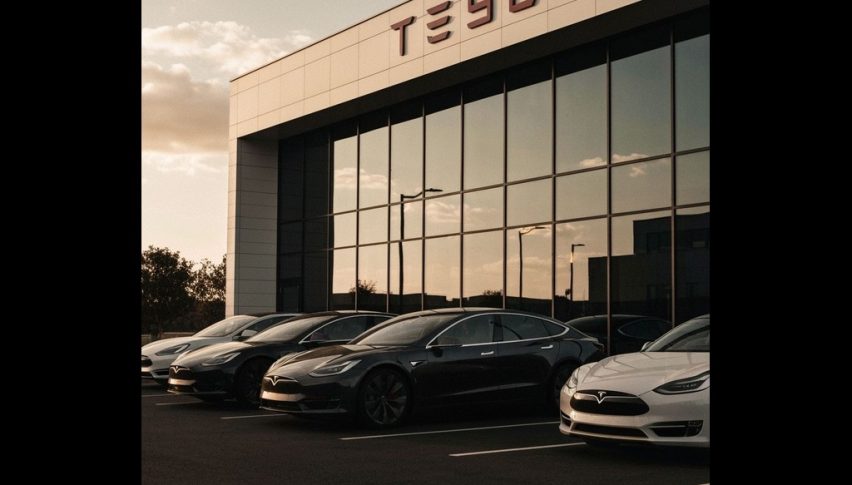
- Tesla shares are stabilizing after a 25% pullback from record highs, as investors focus on the company's long-term AI-driven growth.
- Despite CEO Elon Musk's cautious remarks on production timelines, investors remain optimistic about Tesla's potential in autonomy and robotics.
- Recent developments at CES and real-world scenarios have reinforced Tesla's competitive edge in autonomous driving technology.
- Tesla's long-term vision extends beyond electric vehicles, targeting new revenue streams through robotaxi services and humanoid robots.
Live TSLA Chart
[[TSLA-graph]]
As investors shift their focus back to robotics, autonomy, and the company’s long-term AI-driven development trajectory, Tesla shares are stabilizing after a sharp slide from record highs.
Tesla Regains Balance After a Strong Run
Tesla closed out 2025 with powerful upside momentum, pushing its share price to a fresh all-time high just below $500. That surge, however, was followed by a predictable period of consolidation as investors locked in profits after a steep advance.
Shares pulled back roughly 25% from the December peak of $498.80, briefly testing support near $417. The decline was exacerbated by broader market jitters linked to President Donald Trump’s renewed tariff threats tied to Greenland-related negotiations. Despite the pressure, selling proved short-lived. Tesla rebounded strongly, climbing more than 3.5% in the latest session—roughly $20 higher—as dip buyers returned.
The price action suggests consolidation rather than structural weakness. While near-term volatility remains, the underlying investment case has not materially changed.
Musk’s Caution Fails to Deter Long-Term Buyers
Tesla’s rebound came even as CEO Elon Musk struck a cautious tone on production timelines. He warned that early manufacturing of the Cybercab robotaxi and the Optimus humanoid robot would be “agonizingly slow” before eventually scaling.
Under normal circumstances, such remarks might have unsettled markets. Instead, investors appeared willing to look beyond early-stage inefficiencies, interpreting Musk’s comments as realistic rather than alarming. The market response reflects a growing acceptance that transformational technologies rarely scale smoothly at inception.
Rather than focusing on short-term execution challenges, investors appear more interested in the magnitude of the opportunity Tesla is targeting.
CES Puts Autonomy Back in the Spotlight
The Consumer Electronics Show (CES) played a pivotal role in re-centering the market’s attention on autonomous driving. While Tesla did not dominate headlines at the event, announcements from competitors and partners underscored just how central autonomy has become across the automotive and technology landscape.
Nvidia’s expanded push into automotive AI attracted particular interest. Its unveiling of a next-generation platform to support a robotaxi alliance involving Lucid, Nuro, and Uber highlighted intensifying competition. Mercedes-Benz also revealed plans to roll out a new city-capable driver-assistance system in the U.S. later this year.
Ironically, these developments reinforced Tesla’s position rather than weakening it. As rivals accelerate their efforts, the market is increasingly reminded of Tesla’s unmatched real-world driving data and vertically integrated autonomy stack.
A Shift in How Tesla Is Valued
Tesla’s valuation framework has continued to evolve. The company is no longer viewed solely through the lens of vehicle deliveries or traditional auto metrics. Instead, investors are increasingly treating Tesla as an AI and software platform, with transportation serving as its first mass-market application.
This reframing was a key driver behind Tesla’s rally into record territory late last year. Even during the recent pullback, long-term shareholders remained focused on Tesla’s progress in neural networks, vision-based autonomy, and large-scale deployment.
The renewed emphasis on autonomy has helped stabilize sentiment and re-anchor expectations after weeks of volatility.
Deliveries Disappoint, But Context Matters
Tesla’s fourth-quarter 2025 delivery figures highlighted near-term challenges. The company delivered 418,227 vehicles during the quarter, down 15.6% year over year and modestly below analyst expectations.
Model 3 and Model Y accounted for the bulk of deliveries, while higher-end and specialty models made up a smaller portion. For the full year, Tesla delivered 1.636 million vehicles, also reflecting a year-over-year decline.
Several factors weighed on results. Intense global competition—particularly from China’s BYD—continued to pressure volumes. In the U.S., the expiration of the $7,500 federal EV tax credit late in the third quarter likely pulled demand forward, making fourth-quarter comparisons appear weaker.
Notably, Tesla’s energy storage business stood out, posting a record 14.2 GWh deployed in Q4. That strength reinforced the diversification of Tesla’s revenue base beyond vehicles.
Robotaxi Developments Take Center Stage
Attention is increasingly shifting toward Tesla’s robotaxi ambitions. In Austin, Texas, Cybercab prototypes have been spotted operating on public roads, marking an important validation phase for the program.
These vehicles are testing Tesla’s vision-only Full Self-Driving system in real-world conditions, currently with temporary controls to satisfy regulatory requirements. Investors view progress in Austin as a critical step toward commercialization.
Elon Musk has indicated that Tesla could expand robotaxi testing to eight to ten cities over the coming year, with broader production expected in 2026. Each incremental milestone reinforces the long-term optionality embedded in Tesla’s valuation.
Real-World Events Strengthen Tesla’s Autonomy Case
Recent real-world scenarios have further bolstered confidence in Tesla’s approach. During a widespread power outage in San Francisco that disrupted traffic signals, some competing autonomous services reportedly struggled or paused operations.
Tesla vehicles, however, continued operating without significant issues. Musk cited the incident as evidence of the robustness of Tesla’s camera-based system, which relies less on fixed infrastructure and high-definition maps.
For investors, the episode highlighted the scalability and resilience of Tesla’s autonomy strategy—an advantage that becomes increasingly important as systems move toward broader deployment.
Technical Structure Remains Constructive
From a technical perspective, Tesla’s chart continues to look supportive. After clearing its prior 2024 high near $488, the stock briefly approached the psychologically important $500 level before pulling back.
TSLA Chart Weekly – The 20 Moving Average Provides Support Again

The 20-week simple moving average has acted as a key reference point during recent volatility. While shares briefly slipped below that level earlier in the week, buyers quickly stepped in, pushing the stock back above the average.
This behavior suggests strong dip-buying interest. If momentum continues to rebuild, a renewed test of the $500 zone appears increasingly plausible.
Legal Clarity Reduces Overhang
Sentiment also improved following a major legal development late in 2025. The Delaware Supreme Court overturned a ruling that had invalidated Elon Musk’s 2018 compensation package, restoring his performance-based incentives.
The decision removed a lingering governance overhang and reassured investors about alignment between management incentives and long-term shareholder value. Markets viewed the outcome as supportive of strategic continuity.
Beyond Cars: Tesla’s Broader Ambitions
Tesla’s long-term vision extends far beyond electric vehicles. The company is simultaneously advancing robotaxi services and preparing to scale Optimus V3, its next-generation humanoid robot, with a targeted rollout in 2026.
Together, autonomy and robotics position Tesla at the intersection of transportation, AI, and automation. If executed successfully, these initiatives could unlock entirely new revenue streams and reshape Tesla’s earnings profile over the next decade.
Conclusion: Conviction Returns, Volatility Remains
Tesla’s recent rebound underscores a familiar pattern: short-term volatility often gives way to renewed conviction when the company’s long-term vision comes back into focus.
While delivery softness and production challenges remain real, investors are once again prioritising autonomy, AI, and robotics—the pillars of Tesla’s future growth story. As long as progress in those areas continues, pullbacks are likely to be viewed less as warning signs and more as opportunities.
- Check out our free forex signals
- Follow the top economic events on FX Leaders economic calendar
- Trade better, discover more Forex Trading Strategies
- Open a FREE Trading Account
- Read our latest reviews on: Avatrade, Exness, HFM and XM

Related Articles
Sidebar rates

Related Posts
 Save
Save