MSFT Stock Rallies Into Earnings as Microsoft Maia 200 Reframes Chip Debate
Since the company launched the Maia 200 AI processor, which reduced reliance on outside suppliers, Microsoft's shares have recovered into...
Quick overview
- Microsoft's shares have rebounded as the company introduced its Maia 200 AI chip, signaling a strategic shift to reduce reliance on external suppliers.
- Despite the positive momentum, investors remain cautious about costs and the pace at which AI investments will yield profits.
- Analysts have adjusted price targets for Microsoft, reflecting broader pressures in the software sector rather than concerns over weak earnings.
- The company's ambitious global expansion plans come with heightened scrutiny regarding the financial implications of its AI infrastructure investments.
Live MSFT Chart
[[MSFT-graph]]
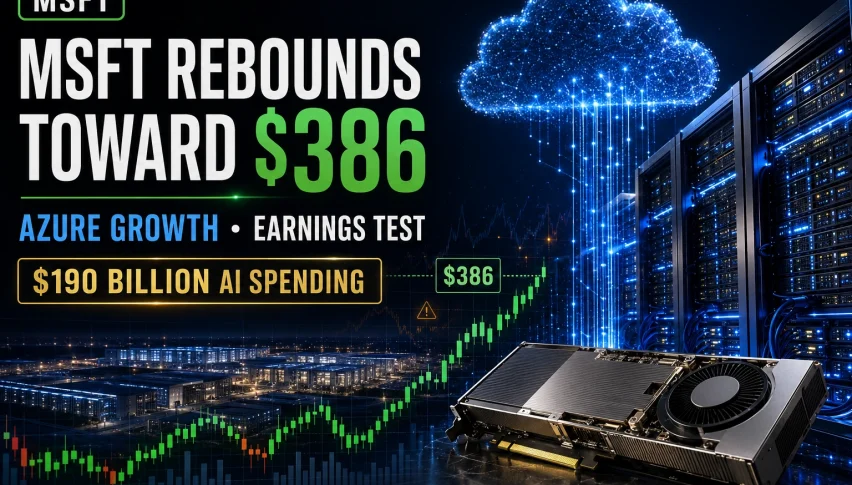
Since the company launched the Maia 200 AI processor, which reduced reliance on outside suppliers, Microsoft’s shares have recovered into results, despite investors’ continued concerns about costs, margins, and execution.
A Rebound That Reflects Relief More Than Conviction
Microsoft enters the heart of earnings season with momentum returning to its share price—but the rally carries a different tone than in prior quarters. After peaking above $555 in October, the stock endured a sharp reset, shedding more than $100 at its lows and briefly dipping below $440 last week. That pullback reflected growing unease around costs, valuation, and the pace at which AI investments would translate into profit.
Over the past week, however, sentiment has improved meaningfully. Shares rebounded strongly on expectations of a solid fiscal second-quarter report, and upside extended further after Microsoft unveiled its latest in-house AI chip. The move has given investors a reason to re-engage—but not necessarily to suspend skepticism.
Maia 200 Signals a Strategic Shift
Microsoft’s announcement of the Maia 200 AI accelerator marked a meaningful evolution in its AI strategy. The chip, now coming online at a data center in Iowa with a second deployment planned in Arizona, represents Microsoft’s clearest push yet to reduce dependence on third-party silicon providers—most notably Nvidia.
Rather than positioning Maia 200 as a direct replacement for existing accelerators, Microsoft framed it as a flexible platform designed to run a broad range of AI models, including next-generation workloads from OpenAI. In effect, the company is building optionality into its infrastructure stack at a time when access to compute remains both expensive and strategically sensitive.
The timing matters. With earnings due Wednesday, investors are increasingly focused on whether Microsoft’s AI ambitions can begin to show efficiency gains—not just scale. By the way, the public is all excluded and not really interested in all AI boom, so who’s paying for all this? Are the trillions being “invested” just AI digital numbers on a screen?
Closing the Software Gap Matters as Much as the Chip
Alongside the hardware, Microsoft announced a suite of tools aimed at improving developer adoption. That includes support for Triton, an open-source programming framework with major contributions from OpenAI, designed to reduce reliance on Nvidia’s CUDA ecosystem.
This is a subtle but important signal. Nvidia’s advantage is no longer just hardware performance—it is software lock-in. By investing in alternative tooling, Microsoft is attempting to narrow that gap and give developers more flexibility across platforms.
Whether that effort can meaningfully shift developer behavior remains uncertain. But it underscores Microsoft’s recognition that control over both hardware and software is becoming essential in the AI era.
Wall Street Adjusts Expectations, Not the Thesis
Recent analyst activity reflects a more nuanced view of Microsoft’s outlook. Several firms have trimmed price targets while maintaining bullish ratings. Cantor Fitzgerald lowered its target to $590 from $639 but kept an Overweight rating. UBS made a similar move, cutting its target to $600 from $650 while reiterating Buy.
Notably, these adjustments were not driven by fears of weak earnings. Instead, analysts cited broader pressures across the software sector: rising capital expenditures, valuation compression, and fatigue around AI narratives that have yet to deliver margin expansion.
Consensus expectations remain strong. Microsoft is projected to report fiscal Q2 earnings per share of $3.92—up more than 21% year over year—on revenue growth of roughly 15%, to about $80.3 billion. The challenge is that strong results are now expected, not rewarded.
Azure Still Grows Fast—But Expectations Are Higher
Azure will once again dominate the earnings discussion. Microsoft previously guided to 37% year-over-year Azure growth for the quarter, down modestly from the prior period but still exceptional by industry standards.
Some analysts believe Microsoft could exceed that guidance, driven by sustained enterprise demand for AI workloads. The issue is not the pace of growth—it is the quality of it. Azure’s expansion is fully reflected in the valuation, leaving limited room for upside unless margins improve alongside revenue.
Investors want to see signs that AI workloads can scale profitably, not just rapidly.
Technical Damage Repaired, But Not Forgotten
From a technical standpoint, Microsoft’s chart reflects the shifting psychology. The stock repeatedly failed to reclaim the $500 level during its recent slide, and last week it briefly broke below both the 50-week SMA (yellow) and 100-week moving average (green)—levels that had provided durable support for much of the past two years.
MSFT Chart Weekly – Jumping Above MAs Again

The rebound has since pushed shares back above key moving averages, including the 50-week SMA, suggesting the broader uptrend may be resuming. Even so, technicians remain cautious. Reclaiming support is not the same as re-establishing leadership, and overhead resistance remains significant.
Data Centers Under a Harsher Spotlight
Investor scrutiny is increasingly focused on Microsoft’s data-center footprint. The company’s AI ambitions require unprecedented infrastructure investment, and management has committed to a series of long-term obligations—covering full electricity costs, replenishing water usage, expanding grid capacity, and forgoing certain tax incentives.
While these commitments align with environmental and political priorities, they come with lasting financial implications. Data centers were once viewed as sources of operating leverage. Today, they are increasingly seen as fixed-cost structures that may grow faster than revenue if AI pricing power proves limited.
The market’s reaction has been telling: announcements emphasizing scale over efficiency have weighed on the stock.
Valuation Has Reset—But Confidence Hasn’t Returned Fully
Microsoft’s valuation has already adjusted meaningfully. The stock now trades around 27–29 times forward earnings, down from peak levels and below its recent multi-year average.
In another cycle, that compression might have attracted aggressive dip-buyers. This time, investors appear more cautious. Without clearer evidence that earnings growth can accelerate despite elevated capital spending, the valuation alone has not been enough to anchor sentiment.
Skepticism is growing that consensus forecasts fully capture the long-term cost of Microsoft’s AI buildout.
Regulatory Risk Re-Enters the Picture
Just as valuation concerns were easing, regulatory scrutiny resurfaced. Switzerland’s Competition Commission opened a preliminary investigation into Microsoft’s licensing and pricing practices following complaints from both private firms and public institutions.
The inquiry remains early-stage, but the market response was immediate. Shares sold off, underscoring how sensitive sentiment has become to regulatory headlines—particularly when they intersect with pricing power.
For investors who believed Microsoft’s regulatory overhang had largely faded, the episode served as a reminder that dominance still invites scrutiny.
OpenAI: Strategic Asset With Growing Complexity
Microsoft’s relationship with OpenAI remains central to its AI narrative, but it is no longer viewed as an unqualified advantage. While Microsoft provides infrastructure and holds a significant economic stake, OpenAI has increasingly explored alternative models, deployment strategies, and hardware paths.
Any meaningful diversification away from Azure would weaken one of Microsoft’s key strategic pillars. At the same time, competition among large language models has intensified, with rivals narrowing perceived gaps and open-source solutions gaining traction.
What once looked like a clear moat now appears more contested.
Global Expansion Adds Scale—and Pressure
Microsoft’s global ambitions remain expansive. Recent commitments include a $23 billion investment across Asia, with $17.5 billion earmarked for India alone.
Strategically, the rationale is clear. Financially, the timing is more challenging. These investments reinforce concerns that Microsoft is committing to years of elevated spending before meaningful returns materialize.
In a market increasingly focused on efficiency over scale, that trade-off is becoming harder to ignore—making this earnings report more pivotal than usual.
- Check out our free forex signals
- Follow the top economic events on FX Leaders economic calendar
- Trade better, discover more Forex Trading Strategies
- Open a FREE Trading Account
- Read our latest reviews on: Avatrade, Exness, HFM and XM

Related Articles

Sidebar rates

Related Posts
 Save
Save