Palantir Valuation Reckoning: PLTR Stock Breaks Support as Market Loses Patience Pre Earnings
Palantir enters 2026 facing a decisive test, as lofty valuations collide with political scrutiny, shifting investor priorities, and and...
Quick overview
- Palantir Technologies faces significant challenges in 2026, with high valuations, political scrutiny, and elevated earnings expectations creating a precarious situation.
- The company's stock has experienced a rapid decline, dropping over 15% year-to-date as investor sentiment shifts from accumulation to capital preservation.
- Political exposure and regulatory concerns have heightened market volatility, impacting Palantir's share price despite its strong government contracts and commercial partnerships.
- As Palantir approaches earnings season, the need for exceptional growth to justify its premium valuation has intensified, leaving the stock vulnerable to further declines.
Live PLTR Chart
[[PLTR-graph]]
Palantir enters 2026 facing a decisive test, as lofty valuations collide with political scrutiny, shifting investor priorities, and an earnings bar set uncomfortably high.
A Shaky Start to the Year
Palantir Technologies began 2026 with confidence carried over from a powerful rally late last year, but that optimism faded quickly. Within weeks, the stock reversed course as investors reassessed whether premium valuations still made sense amid rising regulatory noise and macro uncertainty.
Instead of extending its momentum, PLTR slipped into a defensive pattern. Early selling pressure set the tone for January, and risk appetite continued to erode as traders moved to protect gains ahead of earnings.
With Q4 results approaching, expectations are elevated. Consensus forecasts point to revenue growth north of 60% year-over-year and improving earnings leverage. That setup has created a binary outcome: a strong beat could reinforce the AI-driven growth thesis, while even a modest miss risks exposing how little margin for error remains.
A Rapid Pullback Signals Changing Psychology
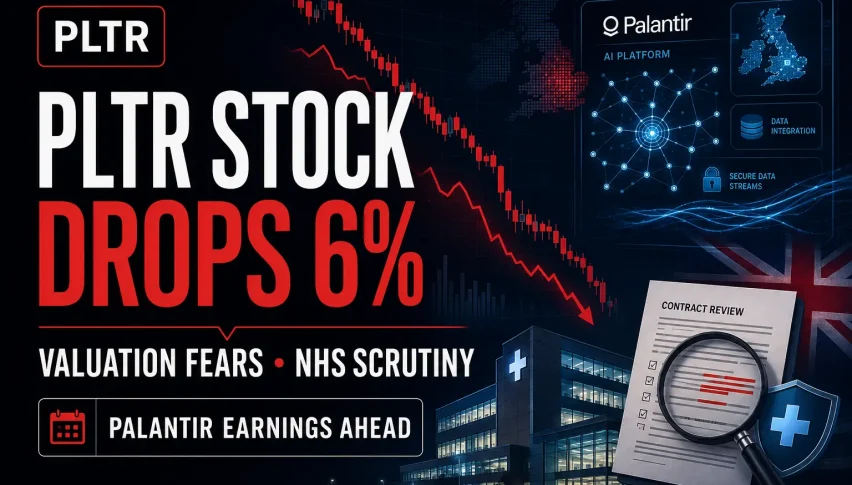
The reversal was swift and decisive. Palantir dropped more than 12% in just days, wiping out most of December’s gains and pushing the stock into correction territory. By late January, shares were down over 15% year-to-date, trading below $160 and drifting toward key technical support.
What mattered most was not the size of the decline, but the speed. Investors moved from accumulation to capital preservation almost immediately, underscoring how fragile conviction had become after the late-2025 surge.
No Single Trigger—But Risks Are Converging
Palantir’s decline hasn’t been tied to one headline or earnings warning. Instead, pressure has emerged from several directions at once.
A telling example came when Innodata announced a partnership with Palantir focused on AI data annotation and training services for event analytics and computer vision. While Innodata shares jumped on the news, Palantir fell roughly 5% that same session and remained deeply negative on the year.
The message from markets was clear: incremental operational wins are no longer enough to offset valuation concerns and broader risk aversion.
Washington Scrutiny Adds a Political Risk Premium
Political exposure has become a more visible factor in Palantir’s price action. The company’s close ties to U.S. government agencies—long seen as a strength—now carry additional scrutiny.
Upcoming Senate hearings related to the Department of Homeland Security, including the March 3 session involving DHS leadership, have increased sensitivity around surveillance, data governance, and federal procurement. Even without direct contract risk, heightened oversight tends to widen perceived risk premiums.
For Palantir, perception matters. Political headlines have amplified volatility, producing sharper intraday swings and reinforcing investor caution.
Technical Damage Raises the Stakes
As sentiment weakened, the technical picture deteriorated. Palantir slipped below the $165 zone, breaking beneath the 50-week simple moving average that had previously acted as support. That shift signaled that sellers were regaining control.
PLTR Chart Weekly – A Break Below the 50 SMA Opens the Door for $100

While the November low near $147.50 initially held, renewed pressure late in the month increased the risk of a deeper breakdown. A sustained move below this area would open the door to a much larger retracement, with $100 emerging as a potential downside target if earnings disappoint.
With positioning still relatively crowded from last year’s rally, technical levels are likely to magnify reactions rather than absorb them.
Defense Exposure Offers Stability—Not Immunity
Palantir’s deep footprint in defense, intelligence, and national security should, in theory, provide insulation during uncertain times. Demand for advanced analytics and AI-enabled decision systems typically strengthens in periods of geopolitical stress.
Yet that thematic support has not translated into share-price resilience. Despite its strategic relevance, Palantir has struggled to find a bid, suggesting investors are prioritizing valuation discipline over long-term narratives.
Defense exposure may anchor revenues, but it does not guarantee multiple expansion.
Commercial Progress Meets Market Skepticism
Commercial momentum continues, but investor enthusiasm has cooled. Reuters recently reported that Palantir expanded its partnership with South Korea’s HD Hyundai in a multi-year agreement reportedly worth hundreds of millions of dollars.
The deal deepens adoption of Palantir’s Foundry and AIP platforms and includes a Center of Excellence aimed at integrating enterprise data and workflows. Strategically, it supports Palantir’s push beyond bespoke government contracts and into scalable commercial deployments.
Still, the stock barely reacted. Markets appear unconvinced that such wins will translate quickly enough into earnings acceleration to justify current pricing.
Valuation Remains the Central Pressure Point
Even after the pullback, Palantir remains among the most expensive stocks in the S&P 500. Depending on the metric used, shares have traded above 400 times trailing earnings and near 190 times forward earnings.
At those levels, growth, margins, and free cash flow must remain exceptional—and consistent. Relative valuation models continue to imply fair value below current prices, leaving little room for execution missteps.
In a market increasingly focused on capital efficiency, Palantir’s valuation magnifies every earnings release, contract update, and political headline.
Government Contracts Deliver Stability, Not Acceleration
Palantir’s government segment remains dependable. In December, the U.S. Navy approved progression of the ShipOS program, with potential contract value approaching $448 million following successful pilot deployments.
These wins reinforce Palantir’s dominance in mission-critical environments. However, government contracts come with constraints—long budget cycles, oversight, and uneven revenue timing that limit near-term acceleration.
At this stage, stability supports the business but does not resolve investor concerns about growth sustainability at current multiples.
Bottom Line: A Defining Moment Approaches
Palantir enters earnings season facing a pivotal moment. The company continues to execute operationally, but valuation, political exposure, and market psychology have shifted decisively.
Without a clear upside surprise—or renewed confidence that growth can justify premium pricing—PLTR is likely to remain volatile, reactive, and vulnerable to further downside as optimism gives way to realism.
- Check out our free forex signals
- Follow the top economic events on FX Leaders economic calendar
- Trade better, discover more Forex Trading Strategies
- Open a FREE Trading Account
- Read our latest reviews on: Avatrade, Exness, HFM and XM

Related Articles
Sidebar rates

Related Posts
 Save
Save