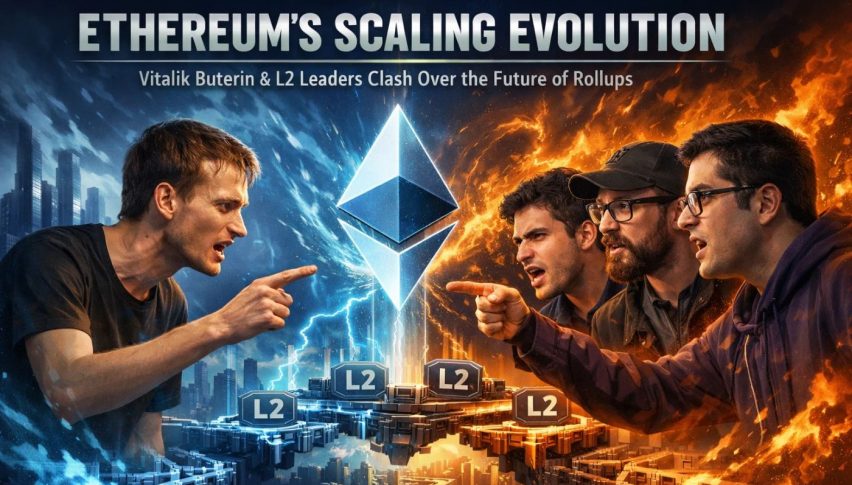
Ethereum’s Scaling Evolution: Vitalik Buterin and L2 Leaders Clash Over the Future of Rollups
The Ethereum community is rethinking its direction. In early February 2026, co-founder Vitalik Buterin questioned the long-standing...
Quick overview
- The Ethereum community is reevaluating the role of Layer-2 solutions in light of upcoming mainnet upgrades and improved Layer-1 performance.
- Vitalik Buterin criticized many L2 solutions for not truly sharing Ethereum's security, emphasizing the need for decentralization and trustless systems.
- Top L2 teams are responding by focusing on specialization and developing features that enhance their unique capabilities beyond just scaling.
- Developers anticipate that Ethereum L1 will prioritize security and global state management, while L2s will evolve into specialized environments for applications.
The Ethereum community is rethinking its direction. In early February 2026, co-founder Vitalik Buterin questioned the long-standing focus on rollups, suggesting that relying on Layer-2s (L2s) as the main way to scale the network may no longer be the best approach.
With the Ethereum mainnet set for major upgrades, top L2 teams like Arbitrum, Optimism, and Base now face a key question: If Ethereum can scale on its own, what role should L2s play?
Vitalik Buterin’s Bombshell: L2s Are Not “Scaling” Ethereum
On February 3, 2026, Buterin said that many L2 solutions do not truly share Ethereum’s security. He mainly criticized their ongoing use of multisig bridges and centralized sequencers.
“If you create an EVM that can process 10,000 transactions per second, but its connection to L1 is achieved through a multisig bridge, then you are not scaling Ethereum,” Buterin stated.
Buterin’s new view comes from two recent developments:
- L1 Performance Gains: The upcoming Glamsterdam upgrade is expected to raise Ethereum’s gas limit from 60 million to 200 million, which could boost L1 capacity to about 10,000 TPS.
- The “Stage 2” Lag: Most L2s are still at “Stage 1” decentralization. They depend on a Security Council or multisig to fix bugs, instead of being fully run by trustless code.
The L2 Response: From “Branded Shards” to Specialized Hubs
Top builders have responded quickly, mostly agreeing that L2s need to become more than just cheaper copies of Ethereum.
Optimism: Embracing the Modular Challenge
Karl Floersch, co-founder of the Optimism Foundation, saw the criticism as a chance to build a more flexible L2 system. He admitted that reaching Stage 2 decentralization has been slowed by technical problems, such as:
- Lengthy fund withdrawal windows.
- A lack of production-ready, trustless proof systems.
- Fragmented tooling for cross-chain applications.
Arbitrum: Scaling is Still the Core Value
Steven Goldfeder, co-founder of Arbitrum (Offchain Labs), strongly defended the need for L2s. He noted that at busy times, Arbitrum and Base have handled over 1,000 TPS, which is much higher than what L1 can currently do.
Goldfeder warned that if Ethereum becomes unfriendly to rollups, big organizations might leave and start their own Layer-1 chains.
A New Identity: Specialization Over Simple Throughput
As the focus on scaling returns to the base layer, L2s are starting to specialize. Jesse Pollak, head of Base, said the network is working on features like account abstraction, privacy, and bringing millions of users on board through consumer apps.
At the same time, StarkWare CEO Eli Ben-Sasson said that ZK-native rollups like Starknet are already meeting Buterin’s vision. They offer special technical features the mainnet cannot match, such as high-performance ZK-EVM precompiles.
The 2026 Roadmap: What’s Next?
| Primary Goal | High-security settlement & decentralization | Specialized apps & extreme throughput |
| Target TPS | 10,000+ (via Glamsterdam/PeerDAS) | 100,000+ (via ZK-proofs) |
| Security | Fully trustless, native consensus | Moving toward “Stage 2” (no multisigs) |
| Use Case | Global “Vault” for high-value assets | Retail, gaming, and low-latency DeFi |
Most developers agree that Ethereum L1 will focus on security and managing the “global state,” while L2s will continue by becoming specialized environments for running applications.
- Check out our free forex signals
- Follow the top economic events on FX Leaders economic calendar
- Trade better, discover more Forex Trading Strategies
- Open a FREE Trading Account
- Read our latest reviews on: Avatrade, Exness, HFM and XM

Related Articles
Sidebar rates

Related Posts
 Save
Save