India’s Budget 2026: Tough Crypto Tax Stance Meets CBDC Welfare Push
India has again shown it prefers strict regulation over market freedom in the cryptocurrency sector. In the Union Budget 2026–2027...
Quick overview
- India maintains strict regulations on cryptocurrencies, with a 30% tax and 1% TDS remaining unchanged in the 2026 Budget.
- The government is promoting its Central Bank Digital Currency (CBDC) through a pilot program for Digital Food Currency, aimed at enhancing welfare distribution.
- Over 72% of India's crypto trading volume has shifted to offshore exchanges due to unfavorable domestic tax policies, resulting in significant potential tax revenue loss.
- New penalties for non-compliance with crypto reporting are introduced, while the maximum jail term for TDS defaulters has been reduced, indicating a shift towards financial deterrents.
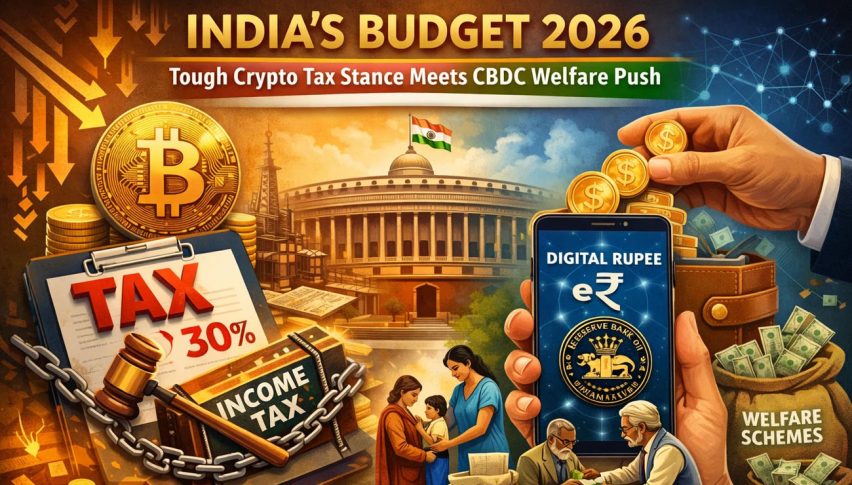
India has again shown it prefers strict regulation over market freedom in the cryptocurrency sector. In the Union Budget 2026–2027, Finance Minister Nirmala Sitharaman said the government will keep its tough tax rules for Virtual Digital Assets (VDAs).
While the private crypto market remains under heavy pressure, the government is simultaneously accelerating the adoption of its Central Bank Digital Currency (CBDC), specifically through a new “Digital Food Currency” pilot.
This dual-track strategy highlights India’s intent to harness blockchain technology exclusively within state-controlled frameworks while discouraging speculative private trading.
1. Zero Relief: 30% Tax and 1% TDS Remain Unchanged
Even after strong efforts from local exchanges and the Bharat Web3 Association, the 2026 Budget does not give any relief to crypto investors. The tax rules set in 2022 still make it very hard to enter the market:
- 30% Flat Tax: Profits from crypto are still taxed at 30%, no matter what the investor’s income level is.
- No Loss Offsets: Investors still cannot use losses from one token to balance out gains from another. Market experts say this rule is “prohibitive and unique” compared to other types of assets.
- 1% TDS (Tax Deducted at Source): 1% TDS (Tax Deducted at Source): The 1% tax on every transaction is still in place. The government calls it a “compliance tool,” but industry leaders say it has reduced liquidity on Indian platforms.
BREAKING: 🇮🇳 India’s Crypto stance, straight from Parliament:
A common belief is:
“Crypto isn’t regulated in India, so it’s basically invisible.”Parliament says otherwise 👇
What the government has made clear:
➡️ Crypto, VDAs & NFTs are not regulated
➡️ But they are very… pic.twitter.com/xtt0SPFFO3— Sapna Singh (@earnwithsapna) February 7, 2026
The Migration to Offshore Exchanges
The impact of these policies is visible in the data. Recent reports suggest that over 72% of India’s crypto trading volume has migrated to offshore platforms.
This flight of capital has resulted in an estimated loss of billions in potential domestic tax revenue, as traders seek jurisdictions with more favorable tax environments.
2. Tightening the Noose: New Penalties for Non-Compliance
The Finance Bill 2026 adds new enforcement rules, focusing more on strict reporting than just collecting revenue. From April 1, 2026, anyone who does not report VDA transactions correctly will face serious financial penalties:
| Violation | Proposed Penalty |
| Failure to file crypto disclosures | ₹200 per day until compliance is met |
| Inaccurate reporting/errors | ₹50,000 flat fine per instance |
| TDS Compliance | Continuous transaction monitoring via the 1% levy |
Interestingly, the government has balanced these fines with a slight easing of criminal liability. The maximum jail term for TDS defaulters has been reduced from seven years to two years, suggesting a shift toward proportional punishment while maintaining high financial deterrents.
3. The Sovereign Pivot: RBI’s CBDC Food Coupon Pilot
As private crypto faces more limits, the Reserve Bank of India (RBI) is focusing more on the “e-Rupee.” This month, a new pilot for CBDC-based food coupons will start in Chandigarh and Puducherry.
How the “Digital Food Currency” Works:
- Targeted Subsidy: Digital rupees are turned into tokens that can only be used to buy food.
- Closed-Loop System: These tokens can be used only at approved Fair Price Shops and cannot be taken out as cash.
- Eliminating Leakage: The pilot’s goal is to stop “ghost beneficiaries” and make sure welfare funds are used only as intended.
This program shows the government’s position: it supports blockchain for social welfare and government use, but not for decentralized finance (DeFi) or investment speculation.
Summary of India’s Digital Asset Strategy (2026)
India’s strategy is still a “walled garden” approach. By keeping taxes and penalties high for private crypto, the government is limiting retail speculation. At the same time, by using CBDC in the Public Distribution System (PDS), India aims to lead in state-run digital currency.
- Check out our free forex signals
- Follow the top economic events on FX Leaders economic calendar
- Trade better, discover more Forex Trading Strategies
- Open a FREE Trading Account
- Read our latest reviews on: Avatrade, Exness, HFM and XM

Related Articles



Sidebar rates

Related Posts
 Save
Save