Bitcoin Reclaims $70,000 as Whale Accumulation Clashes with “Crisis of Confidence”
Bitcoin is trading around $70,000 on Tuesday, leveling off from last week's sharp sell-off that briefly drove prices below $60,000. Despite
Quick overview
- Bitcoin is currently trading around $70,000 after a recent sell-off that briefly dropped prices below $60,000.
- Despite long-term holders selling 245,000 BTC, the overall long-term holder supply has increased, indicating a potential bottom formation.
- Institutional interest remains strong, with Bernstein maintaining a $150,000 price target for Bitcoin by the end of the year.
- Macroeconomic conditions may continue to create volatility, but signs suggest a recovery could be on the horizon.
Bitcoin BTC/USD is trading around $70,000 on Tuesday, leveling off from last week’s sharp sell-off that briefly drove prices below $60,000. Despite the volatility, the top cryptocurrency may be creating a bottom before a possible rise toward $150,000 by year’s end, according to a mix of onchain indicators, historical trends, and bullish institutional sentiment.
Long-Term Holders Sell, But Supply Continues to Age
According to Glassnode data, long-term Bitcoin holders (LTHs) saw the biggest daily outflow since December 2024 last Thursday, cutting their holdings by 245,000 BTC. Tight macroeconomic conditions caused Bitcoin to momentarily drop below $60,000, wiping off about $10,000 in value in a single session. This led to the enormous distribution.
A closer examination of the data, however, shows an unexpected discrepancy. According to CryptoQuant, the overall long-term holder supply rose to 13.81 million BTC from 13.63 million earlier in 2026, despite the fact that LTHs sold furiously during the downturn. Bitcoin’s time-based classification scheme is reflected in this seeming contradiction: even when older cohorts sell, existing supply automatically ages into long-term status as short-term traders decrease activity during uncertain times.
Following a period of realized losses, the long-term holder spent-output profit ratio (SOPR) has now risen above 1, indicating recovery. The technical state of Bitcoin, which is above its total achieved price of $55,000, usually corresponds with base-building or bottom creation stages.
Tether Dominance Signals Potential Bottom Formation
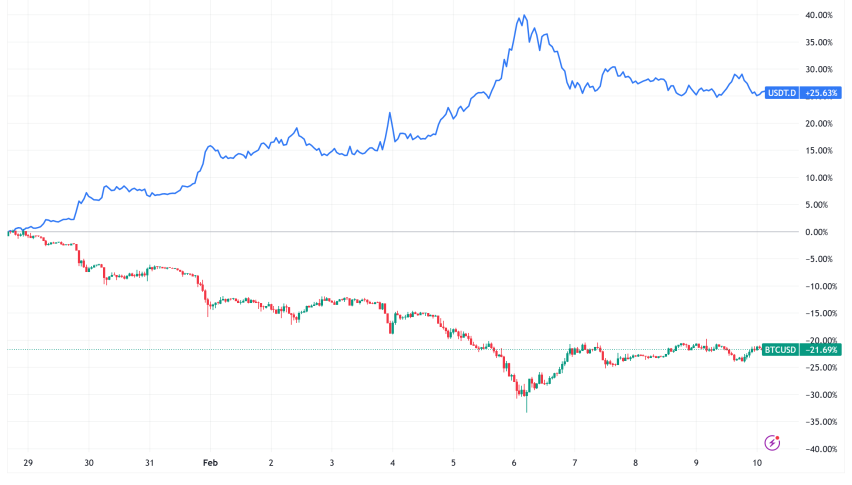
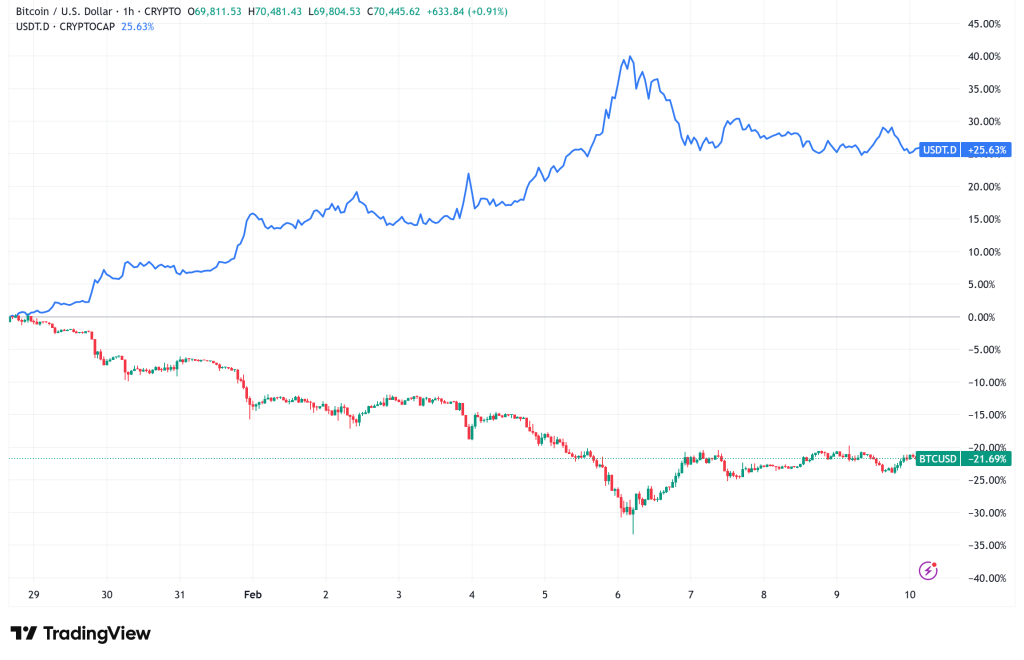
Further indication that Bitcoin might be bottoming out comes from historical research of Tether’s market dominance. In February 2026, USDt dominance returned to a crucial resistance zone that was previously associated with the bear market lows of Bitcoin in November 2022, ranging from 8.50% to 9.00%.
For safety, traders usually switch to stablecoins as USDt’s market share increases. In previous cycles, the inverse link between Tether dominance and Bitcoin price has shown itself to be trustworthy. Bitcoin roughly increased from $15,700 to over $31,000 by March 2024 after USD supremacy peaked in late 2022. After stablecoin dominance peaked in 2023–2024, Bitcoin enjoyed a roughly 200% increase in value.
Bitcoin’s weekly relative strength index (RSI) recently fell below the oversold threshold of 30, and the price recovered from the 200-week simple moving average, further supporting the positive technical picture. In the past, this combination has come before notable rallies, such as those of 1,115% (2020–2021), 350% (2018–2019), and an incredible 8,500% (2015–2017).
Institutional Buyers Step In as Bernstein Maintains $150K Target
The institutional appetite is still high in spite of the reversal. While Binance added $300 million worth of Bitcoin to its SAFU reserve and Strategy announced a new $90 million acquisition, large holders amassed about 40,000 BTC during the decline below $60,000.
The Bernstein analysts, led by Gautam Chhugani, maintained their $150,000 price forecast for 2026 in a note to clients on Monday, calling the current sell-off the “weakest bear case” in Bitcoin’s history. The analysts stressed that despite the roughly 50% price drop from October’s all-time high above $126,000, spot Bitcoin ETFs have seen relatively modest 7% net outflows, and that no significant failures have surfaced in the market infrastructure of Bitcoin. “The current Bitcoin price action is a mere crisis of confidence,” the analysts said. Bernstein dismissed worries about the dangers of quantum computing and the diversion of AI capital as exaggerated, saying, “Nothing broke, no skeletons will show up.”
Macro Headwinds Persist, But Recovery May Be Near
Macroeconomic conditions will probably continue to cause near-term volatility. Because of ongoing inflation pressures, markets give an 82.2% chance that the Federal Reserve will not lower interest rates at its March FOMC meeting. Even if the US dollar index has just fallen below 97, risk assets are still under pressure due to uncertainty around Kevin Warsh’s expected appointment as Fed chair and high treasury yields close to 4.22%.
- Check out our free forex signals
- Follow the top economic events on FX Leaders economic calendar
- Trade better, discover more Forex Trading Strategies
- Open a FREE Trading Account
- Read our latest reviews on: Avatrade, Exness, HFM and XM

Related Articles


Sidebar rates

Related Posts
 Save
Save