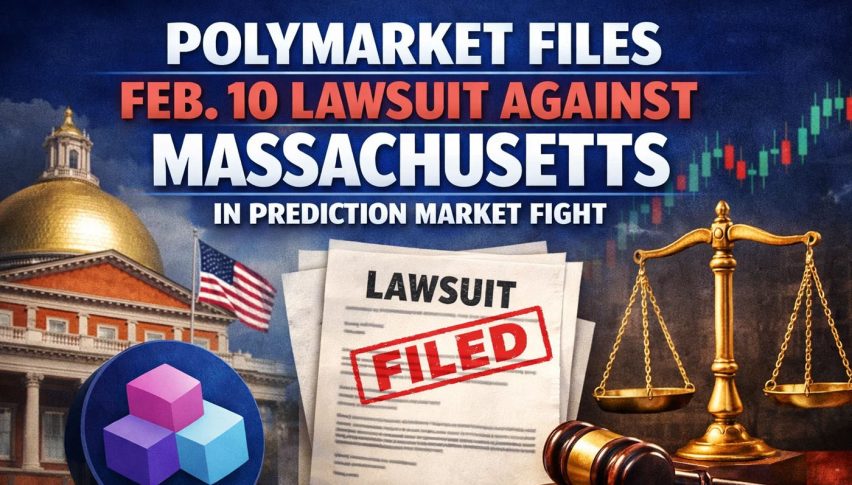
Polymarket Files Feb. 10 Lawsuit Against Massachusetts in Prediction Market Fight
A popular online prediction platform has started a new legal fight over who should oversee America’s betting-style markets.
Quick overview
- Polymarket has filed a lawsuit against Massachusetts officials, claiming that state regulations unfairly restrict its prediction market operations.
- The company argues that prediction markets should be regulated by the federal Commodity Futures Trading Commission (CFTC) rather than individual states.
- Recent regulatory actions in various states, including cease-and-desist letters and court rulings, have intensified the legal challenges faced by prediction market platforms.
- Polymarket warns that state-level regulations could lead to market fragmentation and a liquidity crisis, undermining the viability of prediction markets across the U.S.
A popular online prediction platform has started a new legal fight over who should oversee America’s betting-style markets. On February 10, 2026, Polymarket sued Massachusetts Attorney General Andrea Joy Campbell and the state’s gaming regulators, saying local officials are unfairly restricting its business and stopping users from joining.
Polymarket says it is not a traditional sportsbook. Instead, it runs “prediction markets,” where people trade contracts tied to real-world outcomes such as elections, policy decisions, or economic events. The company’s core claim is simple: because these products resemble derivatives, only the federal Commodity Futures Trading Commission (CFTC)—not individual states—should regulate them. Polymarket’s chief legal officer, Neal Kumar, stated that Massachusetts is overstepping its authority and creating legal chaos for a national platform that operates across state lines.
If every state made its own rules for the same app, it could be impossible to run the service across the country. Polymarket says this is exactly what is happening.
Polymarket is suing Massachusetts in federal court.
States like Mass. and Nevada say event prediction contracts amount to illegal gambling, while platforms argue federal law puts markets under CFTC oversight.
Read more below 👇 pic.twitter.com/PbINWYuM14
— CryptoBizzle (@CryptoBizzle) February 9, 2026
States Tighten Grip on Prediction Markets
Massachusetts is not alone. In recent months, U.S. regulators have increased pressure on this industry, turning a once small market into a major legal battle.
- Tennessee Enforcement: Last month, the Tennessee Sports Wagering Council sent cease-and-desist letters to Polymarket, Kalshi, and com, telling them to stop offering sports-related contracts that Tennessee considers illegal betting.
- The Kalshi Precedent: Polymarket’s lawsuit comes just days after its rival, Kalshi, faced a major setback. On February 6, a Massachusetts judge told Kalshi to block state residents, saying its sports contracts are more like gambling than financial trading.
- The Coinbase Offensive: Even traditional crypto firms are now in the fray. Coinbase has filed similar lawsuits against Michigan, Illinois, and Connecticut, claiming those states are trying to regulate markets that fall under the exclusive jurisdiction of the CFTC.
Timeline of Recent Regulatory Moves
| Date | Entity | Event |
| Feb. 10, 2026 | Polymarket | Files federal lawsuit against Massachusetts to block state intervention. |
| Feb. 6, 2026 | Kalshi | Ordered by MA judge to geoblock residents from sports prediction markets. |
| Jan. 2026 | Tennessee | Issues cease-and-desist to Polymarket, Kalshi, and Crypto.com. |
| Nov. 2025 | Kalshi | Hit with a class-action lawsuit accusing it of running unlicensed betting. |
| Dec. 2025 | Coinbase | Sues Michigan, Illinois, and Connecticut over prediction market rules. |
Why Polymarket Says Federal Rules Must Win
In its lawsuit, Polymarket warns that Massachusetts’ actions would cause “imminent and irreparable harm.” The company says the state is using gambling laws meant for casinos and sportsbooks on a very different kind of market.
Polymarket argues that if states act on their own, the results could be serious:
- Market Fragmentation: The U.S. prediction market could split into 50 different regulatory regimes.
- Liquidity Crisis: Trading volume would dry up if large states like Massachusetts are cut off.
- Institutional Retreat: Banks and business partners might pull back due to legal uncertainty.
Polymarket leans heavily on the idea that prediction markets are a form of derivatives (swaps), which historically fall under CFTC jurisdiction. The lawsuit cites recent comments from CFTC Chair Michael Selig, who on January 29, 2026, announced a major shift by withdrawing prior proposals that restricted event contracts. Selig signaled that the agency is moving toward a uniform federal rulemaking process to “provide clarity and support innovation.”
“Racing to state court to try to shut down Polymarket and other prediction markets doesn’t change federal law.” — Neal Kumar, Polymarket CLO
For now, this case raises a bigger question for the whole industry: will prediction markets be seen as gambling, as financial markets, or as something new? Until courts decide, Polymarket and its competitors will keep fighting in each state and court.
- Check out our free forex signals
- Follow the top economic events on FX Leaders economic calendar
- Trade better, discover more Forex Trading Strategies
- Open a FREE Trading Account
- Read our latest reviews on: Avatrade, Exness, HFM and XM

Related Articles

Sidebar rates

Related Posts
 Save
Save