Ethereum Hovers Near $1,900 as Institutional Tailwinds Build, But Bears Still Hold the Keys
ETH consolidates in a critical zone while BlackRock's staking ETF, Harvard endowment moves, and RWA dominance hint at a potential reversal
Quick overview
- Ethereum is currently trading around $1,900, struggling to recover past $2,500 since January.
- Harvard's endowment fund has shifted its investment from Bitcoin to Ethereum, indicating institutional confidence.
- Ethereum's dominance in the real-world asset market, with over $20 billion in on-chain market capitalization, highlights its long-term value potential.
- A break above $2,107 is needed for a potential rebound toward $2,500, while failure to hold $1,800 could lead to further declines.
Ethereum ETH/USD consolidates in a critical zone while BlackRock’s staking ETF, Harvard endowment moves, and RWA dominance hint at a potential reversal toward $2,500.
The Setup: Stuck Below $2,000 With a Story Worth Watching
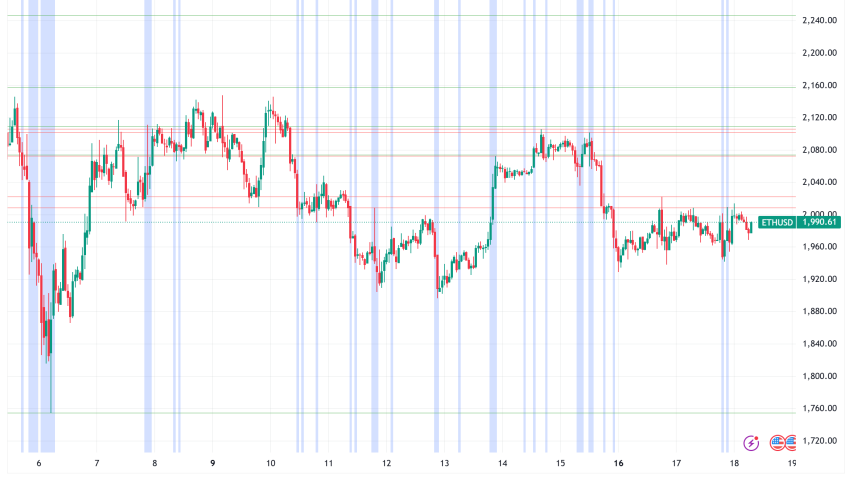
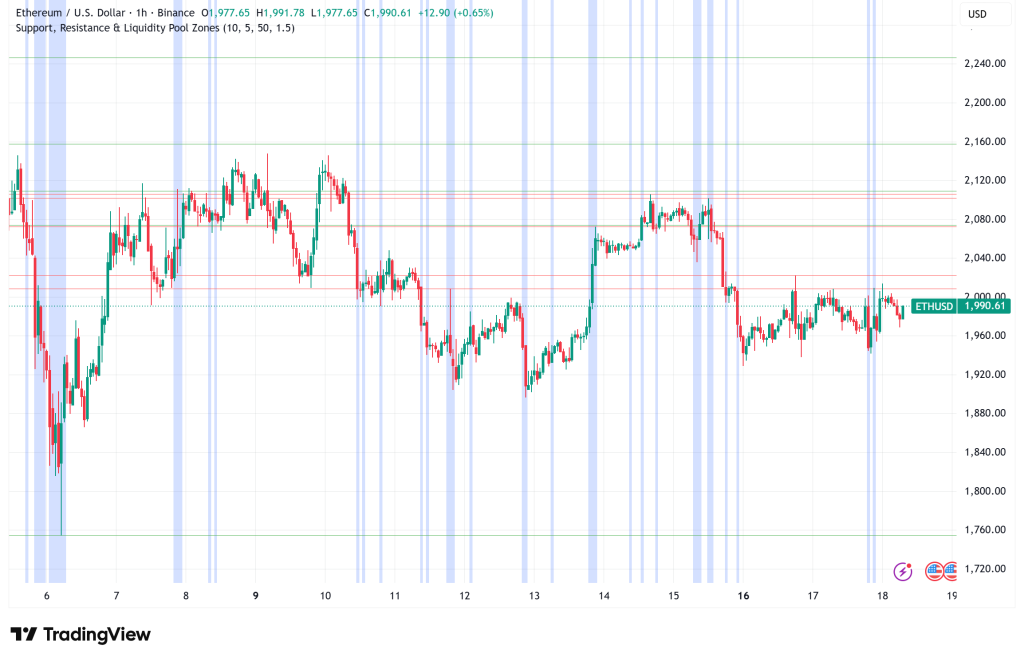
While the market processes a barrage of conflicting signals, Ethereum is currently trading at about $1,900, essentially unchanged from the previous day. After failing to recover $2,500 since January 31, the second-largest cryptocurrency by market capitalization is still recovering from its February 6 low of $1,744. Although the charts aren’t yet ready to corroborate it, a number of institutional developments are strengthening the argument that ETH may be past its worst.
Institutional Moves That the Market Is Ignoring (For Now)
Good news tends to be lost in downturn markets. With Ethereum, that seems to be precisely what is occurring at the moment.
In SEC filings this week, Harvard’s endowment fund secretly revealed that it had a $87 million stake in BlackRock’s iShares Ethereum Trust. At the same time, the fund reduced its holdings in the iShares Bitcoin Trust from $443 million to $266 million. Even though the price hasn’t changed yet, the switch from Bitcoin to Ethereum by one of the most prominent institutional investors in the world is a significant indication.
In order to compensate middlemen like Coinbase, BlackRock modified their proposal for a Staked Ethereum ETF to include a 0.25% expense ratio and retain 18% of staking profits as service fees. Although the staking cut has been criticized for being too large, the cheap management charge is a true victory for accessibility for the general public.
The $327 million in net ETF withdrawals in February may seem concerning on its own, but it represents less than 3% of all Ether ETF assets under management, which paints a considerably more nuanced picture than the headline figure suggests.
Ethereum’s RWA Dominance: The $20 Billion Institutional Vote of Confidence
With a total on-chain market capitalization of over $20 billion, Ethereum’s dominant position in the real-world asset (RWA) tokenization market is arguably the most structurally significant development for the long-term value proposition. RWA products from Franklin Templeton, Fidelity, JPMorgan Chase, and BlackRock are available on Ethereum.
US Treasuries, bonds, and money market funds have increased to $5.2 billion, while tokenized gold accounts for about half of the $13 billion in Ethereum-based RWA deposits. By contrast, BNB Chain and Solana together only make up $4.2 billion, indicating that low transaction fees are not as important to institutional capital as network security. The fact that RWA infrastructure is the focus of Dragonfly Capital’s most recent $650 million fundraising round further demonstrates that smart money is placing bets on the growth of this industry.
ETH/USD Technical Analysis: Corrective Bounce, Not a Confirmed Reversal
The graph presents a more circumspect picture. No distinct five-wave advance has seemed to indicate a long-lasting structural bottom, and Ethereum’s recovery from the $1,744 low looks corrective rather than impetuous. Liquidity clusters around $1,929–$1,946 to the downside are still active as possible sweep targets before any high-probability long setup occurs, while key resistance is located at the $2,107 weekend high.
On longer timescales, analyst Javon Marks has identified a larger Hidden Bull Divergence pattern that, if fully responded to, could push ETH above 140% near $5,000 by the middle of the year. On the other extreme, researcher Trader Tardigrade cautions that if the present consolidation breaks lower, ETH could go as low as $1,136 due to a bearish pennant that is forming on the chart. By lowering its year-end ETH target from $7,000 to $4,000, Standard Chartered has also acknowledged the potential for a decline to $1,300 before a rebound.
Ethereum Price Prediction: $2,500 in Sight, But Confirmation Still Needed
Ethereum’s hold on the RWA market, endowment reallocation, and staking ETFs are among the institutional indicators that points to a short-term rebound toward $2,500, which was formerly a crucial support level. But in order to reach that goal, buyers must firmly break over $2,107 and maintain $1,800 as a floor.
The battleground is defined by the range between $1,744 and $2,107 until an impulsive structural break appears on the chart. The most obvious short-term indication that bulls are taking back control would be a clean sweep of the $1,929 lows followed by a strong recovery. Conversely, if $1,800 is not defended, the $1,300–$1,136 area that pessimistic analysts have identified becomes accessible.
- Check out our free forex signals
- Follow the top economic events on FX Leaders economic calendar
- Trade better, discover more Forex Trading Strategies
- Open a FREE Trading Account
- Read our latest reviews on: Avatrade, Exness, HFM and XM

Related Articles



Sidebar rates

Related Posts
 Save
Save