Gold Eyes $5,000 Comeback: Is the XAU/USD Rally Returning as Middle East Tensions Rise?
Gold (XAU/USD) is trying to recover on Friday, March 20, 2026, after a tough seven-day losing streak that pushed prices down from...
Quick overview
- Gold (XAU/USD) is attempting to recover after a seven-day losing streak, stabilizing around $4,690 to $4,727.
- The recent market volatility is driven by escalating conflict in the Middle East and the Federal Reserve's decision to maintain high interest rates.
- Central banks are significantly increasing their gold reserves, with demand expected to average about 600 tonnes per quarter in 2026.
- Analysts predict a potential recovery for gold prices, with targets ranging from $5,000 to as high as $6,250 depending on geopolitical stability.
Gold (XAU/USD) is trying to recover on Friday, March 20, 2026, after a tough seven-day losing streak that pushed prices down from record highs above $5,300. Now, spot gold is stabilizing around $4,690 to $4,727, gaining nearly 1% for the day. This small rebound comes as investors weigh safe-haven demand against strict central bank policies and a strong US dollar.
Now, investors are asking if gold’s current support levels can hold up in a world where interest rates stay high for longer, not just whether the war premium will last.
The main reason for recent market swings is the growing conflict between the US, Israel, and Iran. When fighting first broke out in late February 2026, gold prices soared to new highs. Now, as the economic impact of the war becomes clearer, attacks on Middle East energy sites have caused Brent crude prices to swing between $100 and $108 per barrel. This energy shock has brought back worries about global inflation, leading the Federal Reserve to keep its strict monetary policy.
On Wednesday, the Federal Reserve’s decision to keep rates unchanged signaled that cuts are unlikely in 2026. This briefly hurt gold’s appeal and pushed the US Dollar Index (DXY) to its highest level in ten months.
The Fibonacci Wall: Technical Hurdles on the Road to Recovery
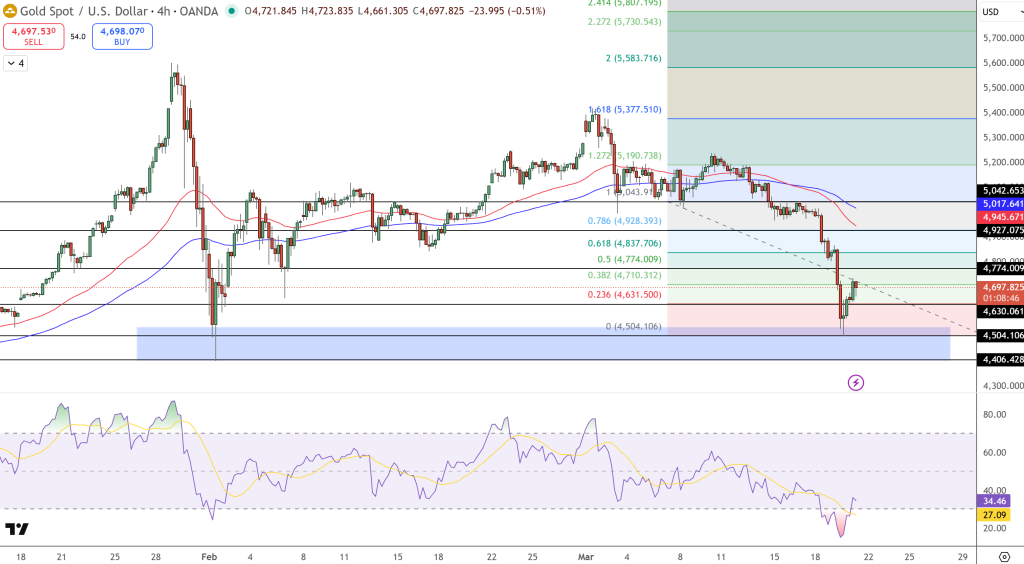
From a technical perspective, the current rebound is a classic battle against the “Fibonacci wall.” After collapsing from its $5,377 peak and slicing through the 200-period moving average on the 4-hour chart, gold found a “floor” in the $4,504 structural support zone. Professional analysts are now laser-focused on the $4,774 level, which represents a significant retracement hurdle. If bulls can reclaim this territory, it would open the door for a retest of the psychological $5,000 barrier.
But if gold cannot break through this resistance, prices could quickly fall back to recent lows near $4,406, especially if the Relative Strength Index (RSI), now in the mid-30s, does not pick up.
Market sentiment is still shaky, with sudden price swings wiping out over-leveraged long positions. Institutional investors see this as a needed consolidation within a longer-term bull market. Even though retail traders may be worried by the 17% drop from recent highs, big banks like J.P. Morgan and UBS still rate gold as “attractive.”
Their confidence comes from a major change in global reserve management: for the first time in thirty years, central banks now hold more gold than US Treasuries.
Geopolitical Risks and the Strong US Dollar
The war premium is rising again as Iran promises “zero restraint” after attacks on its energy sites. This news is pushing investors back into safe-haven assets. The negative link between gold and the US dollar is now stronger than usual. With the US budget deficit nearing $2 trillion and national debt close to $40 trillion, the long-term case for gold remains strong. Still, for now, the dollar is soaking up global liquidity, making it harder for gold to attract capital during crises.
Central banks are providing strong support for gold prices. Despite recent volatility, countries like China, India, and Turkey are buying physical gold at record rates. Estimates show central bank demand could average about 600 tonnes per quarter in 2026. This steady buying means that if prices drop to the $4,300–$4,500 range, sovereign buyers will likely step in to diversify away from Western assets.
2026 Outlook: Price Targets and Trading Ideas
For the second half of 2026, most top analysts expect a strong recovery. Many predict gold will return to $5,000, while BNP Paribas and Deutsche Bank see possible highs of $6,000 or even $6,250 if instability grows or the world economy slows. Right now, experienced investors are watching the $4,603 Fibonacci level as a key entry point for long-term trades.
- In the short term, keep an eye on resistance at $4,774 and $4,837. If gold closes above these levels, it could signal a move from a simple rebound to a full trend reversal.
- Support is holding at $4,504. If gold falls below this level, it could threaten the strength of the 2026 bull market.
- Watch the situation in the Strait of Hormuz. If it closes permanently, gold could break away from its usual link to the dollar, as inflation concerns would become more important than interest rates.
Recent price moves show that even though gold has always been a store of value, it can still be affected by today’s liquidity issues. Whether you are an experienced trader or new to the market, it’s important to look beyond the daily headlines from the Middle East and focus on the big changes happening in global finance. Gold’s path to $6,000 by year-end will depend on how long these geopolitical risks last and whether the Fed can keep inflation under control.
- Check out our free forex signals
- Follow the top economic events on FX Leaders economic calendar
- Trade better, discover more Forex Trading Strategies
- Open a FREE Trading Account
- Read our latest reviews on: Avatrade, Exness, HFM and XM

Related Articles



Sidebar rates

Related Posts
 Save
Save