WTI Crude Oil Price Recovers to $91: Can the Five-Day Reprieve Prevent a Return to $100?
The global energy market is facing significant uncertainty. On March 24, 2026, West Texas Intermediate (WTI) crude oil...
Quick overview
- The global energy market is experiencing uncertainty, with WTI crude oil rebounding to $91.27 after a significant drop due to geopolitical tensions.
- Shipping traffic through the Strait of Hormuz has plummeted by 70% due to a blockade, contributing to tight oil supply and rising prices.
- The International Energy Agency has approved a release of 400 million barrels from strategic reserves, but this is seen as a temporary fix for the ongoing supply issues.
- Global inflation is being impacted by high oil prices, with the IMF estimating that a sustained increase could complicate central bank policies.
The global energy market is facing significant uncertainty. On March 24, 2026, West Texas Intermediate (WTI) crude oil traded around $91.27 per barrel, recovering 3.5% during the day. This rebound came after a sharp drop of over 10% on Black Monday, when prices fell from the $100 mark to $87. The decline followed President Trump’s unexpected decision to delay planned military strikes on Iranian energy infrastructure for five days.
The pause in hostilities gave some short-term relief to inflation worries, but the market is still cautious. Tehran has denied that any productive talks are happening and called the U.S. announcement an attempt to influence energy prices. Since 80% of usual traffic still cannot pass through the Strait of Hormuz, supply remains tight and continues to support USOIL prices.
Technical Analysis: The $88.28 Fibonacci Floor Holds Firm
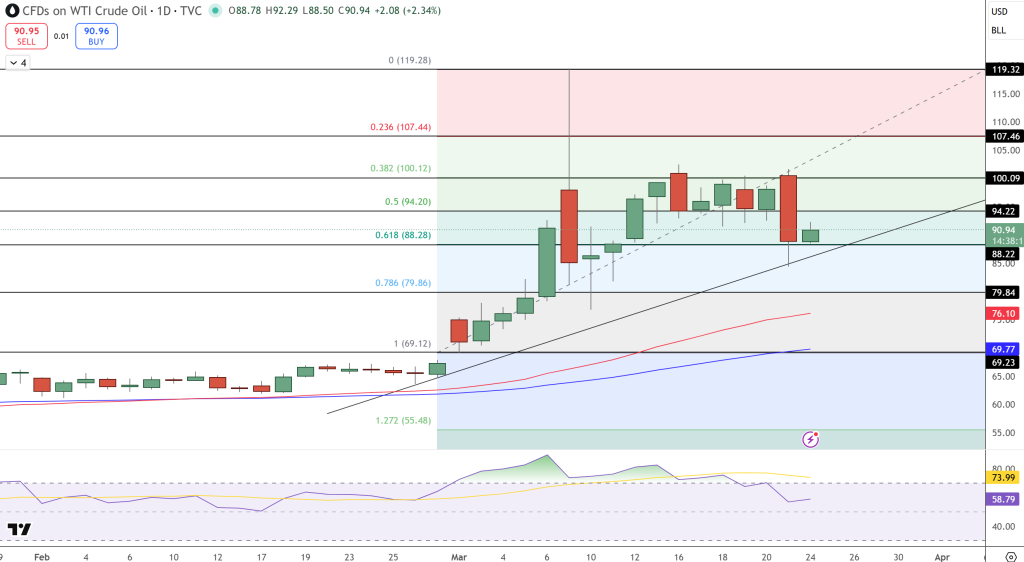
West Texas Intermediate Crude Oil (USOIL) is trading near $90.94 on the daily chart, after dropping from recent highs of about $100.09. The price is still in a broader upward trend that started from the $69.12 low. Right now, the market is staying above the 0.618 Fibonacci retracement level at $88.28, which is serving as immediate support.
The 50-day and 200-day moving averages are both below the current price, which confirms the overall trend is still upward. However, the recent drop near $100 suggests some traders are taking profits in the short term.
The Relative Strength Index is around 59, down from overbought levels but still showing positive momentum. If the price stays above $94.22, it could move toward $100.12 and $107.44. On the other hand, if it closes below $88.28, the next support may be at $79.84.
The Hormuz Chokepoint: Shipping Traffic Plummets by 70%
The extra cost in oil prices due to the conflict is closely linked to the situation at the Strait of Hormuz. Since the conflict escalated on February 28, the IRGC has kept a blockade in place, cutting maritime traffic by 70%.
- Floating Inventory: About 40 million barrels of oil are currently stored on tankers southeast of the Strait, waiting for safety guarantees that have not yet been provided.
- Insurance Crisis: War risk insurance premiums have increased four to six times in the past two weeks, making it too expensive for most commercial operators to pass through without government-backed insurance.
- IEA Intervention: The International Energy Agency (IEA) has approved a coordinated release of 400 million barrels from strategic reserves to help cover the shortfall. However, analysts warn this is only a temporary solution and cannot replace the usual 20 million barrels per day that flow through the Gulf.
Global Stagflation Risks and the 2026 Outlook
The effects of oil prices above $90 are starting to show in global data. The IMF estimates that every sustained 10% increase in oil prices raises global inflation by 0.4%. This energy tax is making it harder for central banks to set policies, leading many to keep interest rates high even as economic growth slows.
President Trump has said that prices will drop like a rock if a deal is made, but since Iran has not confirmed any diplomatic progress, the $90–$115 range may become the new normal for the second quarter of 2026. Traders should watch the March 28 deadline for the current strike postponement. If the five-day reprieve ends without a diplomatic breakthrough, WTI could quickly move back toward the $107 resistance level
- Check out our free forex signals
- Follow the top economic events on FX Leaders economic calendar
- Trade better, discover more Forex Trading Strategies
- Open a FREE Trading Account
- Read our latest reviews on: Avatrade, Exness, HFM and XM

Related Articles

Sidebar rates

Related Posts
 Save
Save