December Bitcoin Price Forecast: Will BTC Rebound Above $100K or Dive Below $80K?
Bitcoin's steady late-month increase has bolstered investors' enthusiasm for riskier assets following a period of high volatility, opening..

Quick overview
- Bitcoin's recent recovery above $90,000 follows a turbulent period that saw a $1 trillion decline in the cryptocurrency market.
- Key technical levels, particularly the 100-week Simple Moving Average, have provided crucial support, preventing a deeper market breakdown.
- Institutional demand remains strong, with significant inflows into U.S. spot Bitcoin ETFs, indicating continued confidence in Bitcoin's long-term trajectory.
- Macroeconomic factors and potential regulatory shifts are contributing to a more favorable outlook for Bitcoin and risk assets overall.
Live BTC/USD Chart

Bitcoin’s steady late-month increase has bolstered investors’ enthusiasm for riskier assets following a period of high volatility, opening the door for a $100K rebound.
Bitcoin is beginning to stabilize after a turbulent stretch that wiped roughly $1 trillion off the broader cryptocurrency market. The decline briefly pushed BTC toward the $80,000 zone before buyers returned, driving prices back above $90,000 and preventing a deeper breakdown. Although momentum has cooled beneath key resistance, Bitcoin’s ability to reclaim crucial technical levels has helped calm market nerves following one of the most volatile periods of the year.
Volatility Sends Bitcoin Sliding Before a Sharp Reversal
November brought heightened selling pressure across digital assets, mirroring weakness in global equities as investors broadly retreated from risk. The downturn materialized without a clear catalyst—fear-driven positioning and profit-taking were enough to trigger a cascade. Bitcoin slipped below the $81,000 region at the same time the crypto market’s total capitalization contracted by nearly $1 trillion.
However, the selling wave began to moderate once Bitcoin approached major historical support levels. The final week of November marked a turning point: improving sentiment around a possible December Federal Reserve rate cut helped spark a rebound in both equities and cryptocurrencies. With markets now pricing in a high probability of another 25-basis-point reduction, risk assets staged a synchronized recovery.
Key Technical Zones Prevent a Deeper Breakdown
Despite the scale of the decline, Bitcoin’s broader technical picture remained more constructive than price action alone suggested. BTC briefly dipped under the 50-week Simple Moving Average—a line that has repeatedly acted as the launch point for long-term bull cycles. While this break raised concerns, sellers failed to push the market into more decisive bearish territory.
BTC/USD Chart Weekly – Rebounding Off the 100 SMA

Instead, the 100-week Simple Moving Average near $82,000 served as the real line of defense. This level absorbed heavy selling pressure and halted further deterioration. Beneath it, the April low around $74,000 continues to stand as a major long-term demand zone.
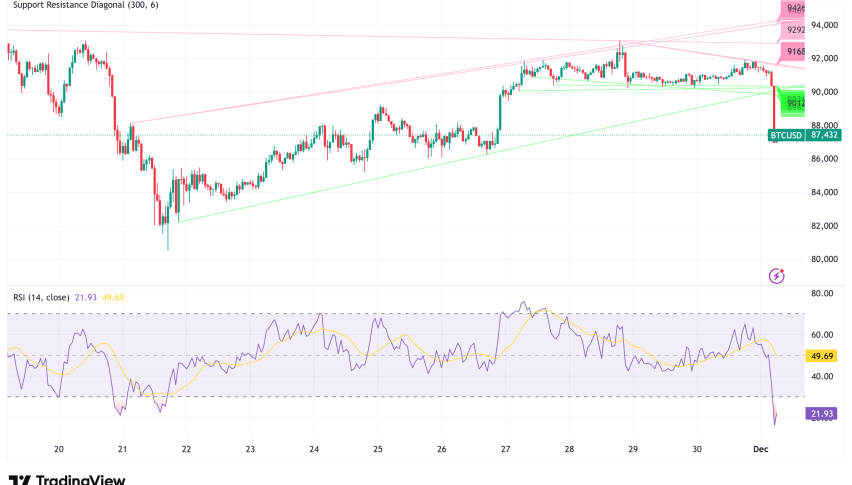
BTC/USD Chart Daily – Buyers Finding it Hard to Push Above the 20 SMA

The rebound from the 100-week SMA sent Bitcoin back above the $90,000 handle, supported by oversold readings on indicators such as the stochastic oscillator. But upside traction stalled at the 20-day SMA, which has flipped into short-term resistance. With BTC currently appearing overbought on several timeframes, traders are watching to see whether momentum carries the price toward $100,000—or whether a retest of November’s lows becomes necessary.
Cloudflare Outage Exposes Structural Fragilities
A major infrastructure outage on 18 November briefly rattled digital markets. A failure at Cloudflare disrupted at least 20% of global internet traffic at its peak, affecting key platforms including X, OpenAI, AWS, Uber, Spotify, and League of Legends.
Crypto services faced notable strain: Coinbase, Base L2, Robinhood, BitMEX, and several blockchain networks such as Cardano, Filecoin, and TON reported temporary issues. Although the disruption was short-lived, it reinforced long-standing concerns around centralized dependencies within Web3 architecture. Markets stabilized once normal operations resumed.
Institutional Participation Remains a Dominant Force
Despite wild swings in price, institutional demand continues to anchor Bitcoin’s long-term trajectory. U.S. spot Bitcoin ETFs absorbed approximately $2.7 billion in inflows during early November, with BlackRock’s IBIT and Fidelity’s FBTC leading the charge.
IBIT alone now holds nearly 800,000 BTC and is closing in on $100 billion in assets under management, positioning it as the fastest-growing ETF in U.S. history. Harvard University has significantly increased its allocation as well, tripling its IBIT holdings to 6.81 million shares—valued above $440 million before the recent dip. This stake now exceeds the university’s exposure to Microsoft, Amazon, and even gold.
JPMorgan analysts highlight Bitcoin’s estimated production cost—around $94,000—as a powerful natural floor, while projecting prices could reach roughly $170,000 by 2026 as volatility declines and Bitcoin further competes with gold’s market share.
While November saw heavy redemptions from IBIT—$2.34 billion in net outflows—these pressures eased as Bitcoin regained ground above $90,000. The ETF now shows approximately $3.2 billion in cumulative gains following the recovery.
Policy Shifts and Global Adoption Strengthen the Outlook
Macroeconomic developments continue to bolster the broader narrative. The Fed’s recent 25-basis-point rate cut reinvigorated demand for risk assets, while political developments added further support. President Trump’s decision to pardon Binance founder Changpeng Zhao has been interpreted as a signal of more crypto-friendly regulatory conditions in the United States.
International enthusiasm is also building. Thailand and Malaysia are evaluating the possibility of introducing Bitcoin into national reserves—a move that would accelerate institutional adoption globally.
- Check out our free forex signals
- Follow the top economic events on FX Leaders economic calendar
- Trade better, discover more Forex Trading Strategies
- Open a FREE Trading Account


 Save
Save