December South African Rand Forecast: Will USD/ZAR Break R17 As SARB And Treasury Reinforce Stability Goals?
South Africa’s rand is gaining renewed support as monetary easing, firmer fiscal guidance, and clearer inflation objectives enhance the...
Quick overview
- The South African rand is gaining support due to monetary easing and improved fiscal guidance, enhancing the economic outlook.
- Recent data shows a rise in money supply and private sector credit, indicating improving economic momentum.
- The South African Reserve Bank's interest rate cut and a clearer inflation target have strengthened policy coherence and investor confidence.
- Inflation trends suggest easing pressures, allowing for further policy flexibility that boosts the rand's attractiveness.
South Africa’s rand is gaining renewed support as monetary easing, firmer fiscal guidance, and clearer inflation objectives enhance the country’s economic outlook.
Rand Gains Traction As Policy Landscape Evolves
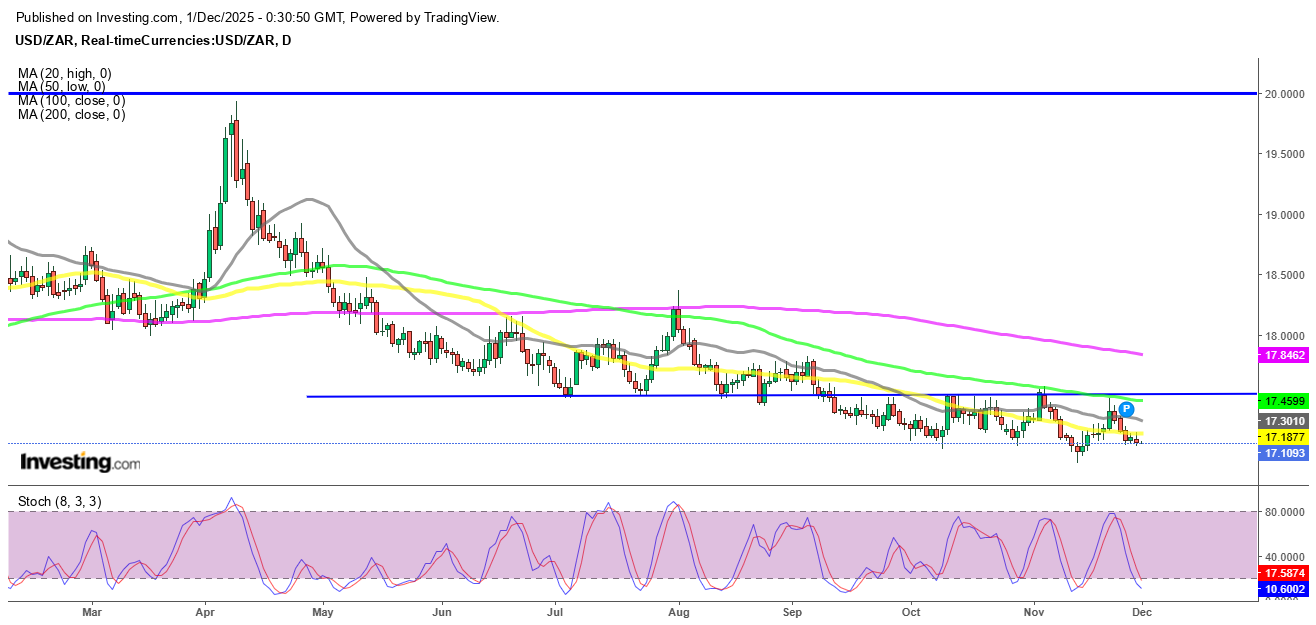
Expectations for the South African rand continue to improve as a mix of policy and economic developments reshape the currency’s long-term trajectory. The shift began in November, when USD/ZAR briefly broke below the key R17 threshold before rebounding following the South African Reserve Bank’s widely anticipated interest-rate cut. That recovery, however, stalled just under the persistent R17.50 resistance region, revealing ongoing hesitation among buyers and raising the risk of another retest of the R17 floor.
Last week’s movement reinforced those concerns. Softer U.S. economic data reduced expectations for U.S. dollar strength, allowing the rand to advance early in the session. Despite South Africa’s rate reduction — typically a bearish signal for any currency — the rand has continued to outperform. Since April, when USD/ZAR hovered near R20, the pair has steadily drifted back toward R17, underscoring the market’s confidence in South Africa’s improving macro backdrop.
USD/ZAR Chart Daily – Will Sellers Break Below R17 This Time?
Recent data releases add further nuance. The South African Reserve Bank reported M3 money supply rising 7.52% in October, up from 6.07% in September, while private sector credit expanded by 7.26%, beating consensus estimates. Trade figures also showed a surplus of R15.58 billion for October, slightly softer than expectations but still positive. Government bonds strengthened as well, with yields on 2035 maturities dropping 7.5 basis points to 8.5%. Together, these indicators point to gradually improving economic momentum.
SARB Initiates A Measured Shift With Its First Rate Cut
The key turning point came with the South African Reserve Bank’s decision to trim its benchmark rate by 25 basis points. The Monetary Policy Committee voted unanimously to cut, lowering the repo rate to 6.75% and the prime lending rate to 10.25%. After an extended period of restrictive policy designed to tame inflation, the move signaled the central bank’s rising comfort that inflation risks are easing.
This policy adjustment coincided with an important shift from the government. Finance Minister Enoch Godongwana publicly endorsed a more explicit inflation target of 3%, discarding the previous emphasis on maintaining inflation within the wider 3%–6% band. This clearer benchmark strengthens policy coherence between the Treasury and the central bank and offers investors a more predictable framework for price stability.
Improved Fiscal Indicators Boost Market Confidence
The central bank’s decision came amid a more constructive fiscal setting. In the medium-term budget review, Godongwana projected stronger-than-anticipated tax revenues and laid out a more disciplined approach to government spending. These updates helped restore South Africa’s credibility in the eyes of global financial institutions.
As a testament to that progress, S&P Global Ratings revised South Africa’s credit outlook higher — a pivotal upgrade after decades of stagnation. For investors, the shift signals not only improved governance but also the potential for smoother long-term financing conditions.
Inflation Trends Reinforce The Case For Easier Policy
Inflation data have played a central role in shaping this policy debate. While headline CPI rose slightly from 3.4% in September to 3.6% in October, the uptick was heavily driven by temporary factors such as increased red-meat prices. Structural inflation pressures continue to ease.
Crucially, inflation has undershot expectations for multiple months. A firmer rand, alongside softer assumptions for fuel prices, allowed the central bank to revise its inflation outlook lower for 2025 and 2026. This gives policymakers more flexibility to ease further without jeopardizing stability — a dynamic that enhances the rand’s appeal.
- Check out our free forex signals
- Follow the top economic events on FX Leaders economic calendar
- Trade better, discover more Forex Trading Strategies
- Open a FREE Trading Account




 Save
Save