AMD Stock Continues Falling Toward $200 As Pears Gain, Valuation Concerns And Competitive Risks Weigh
AMD's once-dominant 2025 surge has faded due to a rapid reversal driven by competition concerns, valuation pressures, and waning enthusiasm.
Quick overview
- AMD's stock has sharply declined, losing nearly one-fifth of its value as investors reassess the sustainability of the AI boom.
- Despite strong quarterly results, AMD's performance failed to meet high expectations, leading to a swift sell-off post-earnings.
- The company's partnership with OpenAI, once seen as a major catalyst, is now viewed with skepticism due to unclear revenue contributions and increasing competition.
- AMD faces intensified rivalry in the AI chip market, with competitors like Nvidia and Intel gaining ground, further complicating its growth narrative.
AMD’s once-dominant 2025 surge has faded due to a rapid reversal driven by competition concerns, valuation pressures, and waning enthusiasm for AI.
AMD Pulls Back As Market Reprices AI Expectations
After a remarkable performance earlier in 2025, Advanced Micro Devices has entered a far more turbulent chapter. The stock, which had been buoyed by relentless optimism surrounding artificial intelligence and accelerated computing, is now facing intensified pressure as investors reassess how sustainable the AI boom truly is.
In November, AMD’s share price began to unwind rapidly. Tuesday’s additional 4% drop extended the slide that had already erased nearly one-fifth of the stock’s value the previous week. While much of the technology sector managed to stabilise, AMD remained one of the notable laggards, signalling that sentiment toward the company has shifted more decisively than toward its peers.
Momentum Cools After A Stellar Rally
AMD’s retreat follows an extraordinary climb that pushed the stock into overbought territory. Valuation stretched considerably during the AI-driven run, and as analysts began downgrading major tech names across the sector, AMD quickly found itself vulnerable. The broader market’s fear that AI leaders had rallied “too far, too fast” added fuel to the sell-off.
Part of the decline also reflects expectations fatigue. At highs near $260, the market had priced in an almost flawless growth trajectory. As soon as the stock lost its technical footing, traders quickly shifted to profit-taking mode, driving the reversal deeper.
Strong Fundamentals, But A Weak Reaction
AMD’s latest quarterly results did little to stem the downturn—despite being objectively strong. The company posted:
- Revenue of $9.25 billion, up 36% YoY
- Non-GAAP EPS of $1.20
- Guidance of around $9.6 billion for the current quarter
Both its data center and PC segments contributed meaningfully, underscoring AMD’s solid positioning across high-growth markets.
But in today’s market, backward-looking strength is not enough. With expectations at historic highs, investors concluded that the performance, while solid, lacked the outsized surprise needed to justify the lofty valuation. The swift sell-off immediately after the earnings release confirmed that confidence had already been fragile.
The OpenAI Deal Loses Its Spark
A widely hyped catalyst behind AMD’s earlier surge was its agreement with OpenAI. The arrangement, which included access to AMD’s Instinct accelerators and a 10% equity stake in OpenAI, was initially seen as a breakthrough in AMD’s AI ambitions.
However, the glow surrounding this partnership has dimmed. Analysts and investors have begun questioning the deal’s long-term commercial impact, citing:
- A lack of guaranteed hardware volume
- Unclear revenue contribution timelines
- Heavy reliance on a small number of hyperscale customers
- Intensifying competition at the top of the AI hardware stack
What once looked like a transformational relationship now appears more uncertain, contributing to the shift in sentiment.
Technical Signals Turn Bearish
AMD’s chart is also giving traders reasons for caution. The stock fell decisively below its 50-day moving average, a key support level that has now flipped into resistance. A brief recovery attempt was rejected, reinforcing the dominance of sellers.
AMD Chart Daily – Selling Pressure Returns at These Levels
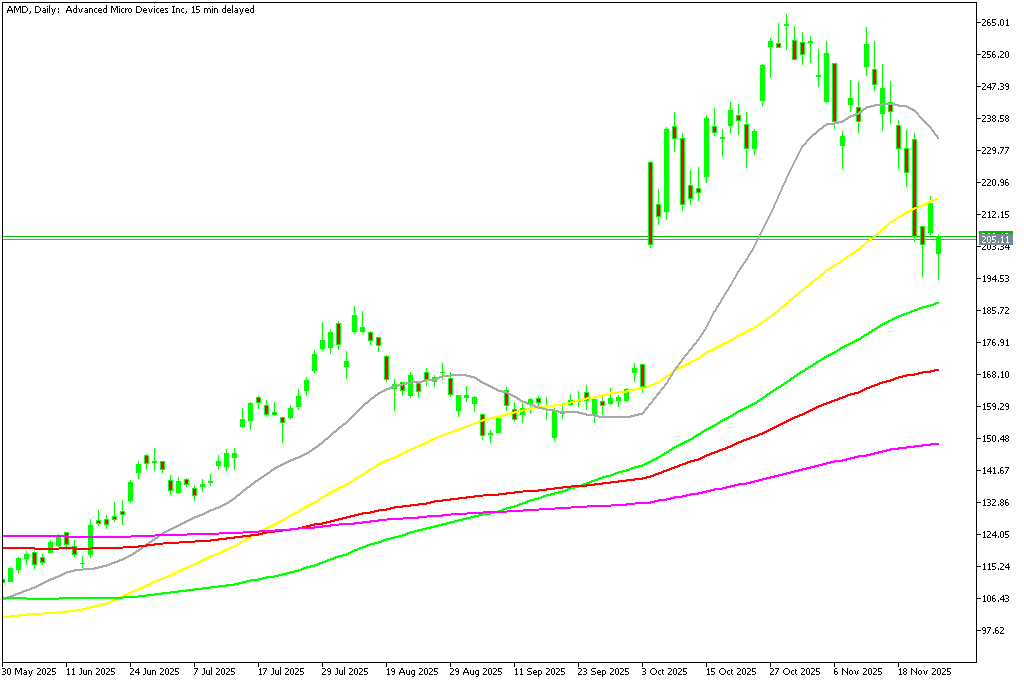
AMD also slipped back into the region of its early-October gap, briefly breaking below the $200 level before staging a modest rebound. Yet this bounce lacked conviction. The 50-day average rejected the price again today, and AMD finished in the red despite broader strength across major indices and tech peers.
This kind of relative weakness is often viewed as a warning sign: if a stock cannot rally when the market is strong, it tends to fall harder when conditions deteriorate.
Competition Heats Up Across The AI Chip Landscape
Compounding the pressure, AMD now faces escalating rivalry in the AI processor market. Nvidia remains the clear leader, and Intel has reasserted itself through new partnerships and aggressive investment. Recent collaborative moves between Nvidia and Intel have raised new questions about AMD’s long-term position.
Meanwhile, players like Broadcom are entering the space with advanced custom silicon for enterprise and cloud clients, further fragmenting a market AMD had hoped to capture more decisively.
A Market Rewriting AMD’s AI Narrative
Only weeks ago, AMD stood as a symbol of investor confidence in the AI revolution. Today, that narrative is being redefined. The market is transitioning from enthusiasm to scrutiny, weighing:
- stretched valuations
- competitive pressures
- the unclear payoff from high-profile partnerships
- a tougher macro environment for high-growth tech
The long-term AI opportunity remains intact, but AMD must now prove that it can convert potential into durable, diversified revenue. Until the company demonstrates consistent execution and secures more predictable growth drivers, the stock is likely to remain under pressure—and far more sensitive to shifts in market sentiment.
- Check out our free forex signals
- Follow the top economic events on FX Leaders economic calendar
- Trade better, discover more Forex Trading Strategies
- Open a FREE Trading Account



 Save
Save