Ethereum Reclaims $3,000 With 8% Daily Surge: Technical Indicators Show Skepticism Despite Strong Recovery
Ethereum is trading above $3,000, which is an 8% increase in the last 24 hours. This is a big bounce back that temporarily took the second
Quick overview
- Ethereum is currently trading above $3,000, marking an 8% increase in the last 24 hours, but traders remain skeptical about sustaining this momentum.
- Despite the price rise, derivatives markets show persistent bearish positioning, indicating a lack of confidence among traders.
- The recent Fusaka upgrade aims to enhance Ethereum's transaction capacity, but market enthusiasm remains low due to declining network activity and competitive pressure from rival chains.
- The key question for Ethereum is whether it can maintain support at $3,000, as failure to do so could lead to further declines.
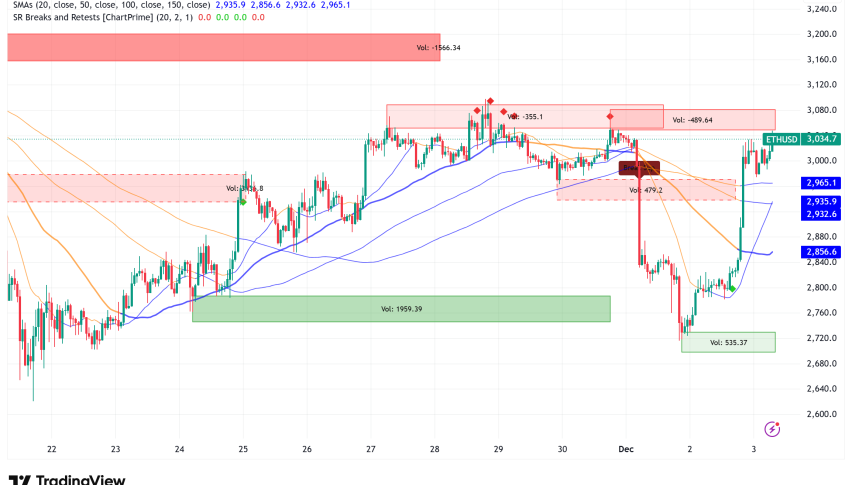
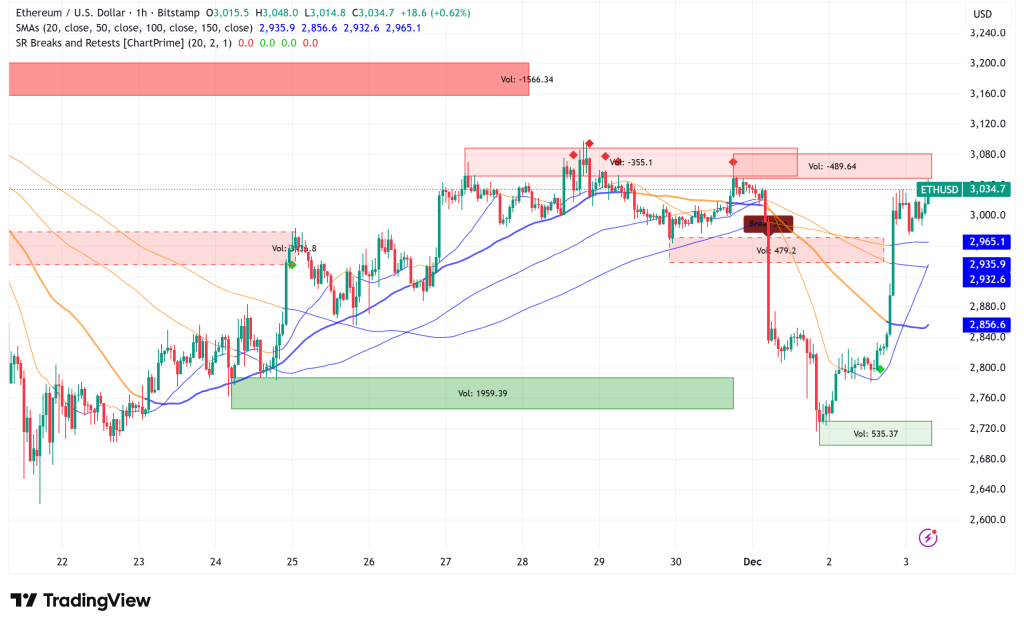
Ethereum ETH/USD is trading above $3,000, which is an 8% increase in the last 24 hours. This is a big bounce back that temporarily took the second-largest cryptocurrency past a critical psychological level. Even though the daily increase was impressive, derivatives markets are still sluggish and network activity is falling, which makes it clear that traders are still very doubtful that ETH can keep up the momentum above this important level.
The rise followed the larger cryptocurrency market as traders priced in increased chances of further economic stimulus, especially after Japan’s government-bond market was stressed out on Monday. Ethereum, on the other hand, is still behind the US stock market recovery, which raises questions about how long this surge will last.
ETH/USD Technical Analysis: Testing Resistance at Critical $3,000 Level
Ethereum’s 8% rise is a significant short-term comeback, but the technical picture is still difficult. ETH had already broken through all of the main moving averages on the 3-day chart—the 50 SMA, 100 SMA, and 200 SMA—showing that it was going into a decline on a larger time frame. The latest advance back toward $3,000 is a test to see if bulls can get back to these important technical levels.
The 50 SMA has crossed below the 100 SMA, and both are moving down toward the 200 SMA. This is a sign that a long-term correction is about to happen. Ethereum has to turn $3,000 into support instead of resistance and then recapture the 50 SMA with confidence and more volume for a real reversal to happen.
Before today’s rise, prices had been moving in a series of lower highs and lower lows, which confirmed the bearish market structure. The recent bounce examines if buyers can defend the $2,750-$3,000 zone with enough vigor to stop the downturn. If momentum slows down and ETH drops below $3,000 again, the next major support levels are around $2,750, $2,550, and $2,300.
Macroeconomic Support Provides Tailwind
As investors were more sure that US monetary policy will become less stringent, sentiment improved. On December 1, the Federal Reserve stopped its initiative to reduce its balance sheet. Traders think that the interest rate will go down on December 10. Major banks and other financial institutions are using repurchase agreements a lot more, which makes short-term funding markets more liquid.
The Nasdaq index, which is full of tech stocks, has made up most of the losses it had in November and is currently only roughly 3% off its all-time high. Today’s crypto surge happened in a good environment for risk assets, but Ethereum’s poor performance compared to traditional markets is still worth noting.
ETH Derivatives Markets Show Persistent Bearish Positioning
Even if the price went up 8%, ETH derivatives positioning is still very tight, which suggests that optimistic traders aren’t too sure of themselves. The annualized premium on ETH monthly futures compared to spot markets stayed at 3%, the same as the week before. Readings below 5% show that there isn’t much demand for leveraged long exposure, which makes sense as Ether has down 22% in the last 30 days.
The constant stress in the options markets is more worrisome. ETH put (sell) options were 6% more expensive than similar call (buy) options, which is a sign of bearish conditions. This is a change from the neutral 4% skew saw on Friday, which means that professional traders are hedging heavily even though the price has gone up and are still not sure if it will go up more.
The continuous drop in open interest across major derivatives platforms is probably the most worrying thing. Ethereum’s open interest on Binance has been going down continuously for more than three months. Open interest hit an all-time high of $12.6 billion on August 22, but it has since dropped by half, with about $6.4 billion in derivative bets disappearing. This brought ETH’s open interest down to $6.2 billion, a dramatic 51% drop.
This coordinated drop affects all major exchanges. For example, Gate.io went from $5.2 billion to $3.5 billion, and Bybit went from $6.1 billion to $2.3 billion. The fact that so many people are lowering their leverage shows that the market is going through a bigger structural reset than usual declines. Even though prices are bouncing, investors are not rushing to get back into their positions.
Ethereum Fusaka Upgrade Launches Amid Mixed Market Sentiment
Today, Ethereum’s Fusaka upgrade went live. It added PeerDAS (Peer Data Availability Sampling) and raised the block gas cap from 45 million to more than 60 million units. These changes could make the Layer 2 ecosystem able to handle more than 100,000 transactions per second while using 87.5% less bandwidth.
But the market’s lack of enthusiasm for today’s price rise implies that technical improvements alone may not be enough to change people’s minds about the market being gloomy. In the past few months, demand for decentralized apps has dropped a lot, which is why fees are at an all-time low, even if the Fusaka enhancements have been made.
Network Activity and Competitive Pressure Raise Concerns
Ethereum network fees fell to their lowest level in more than three years, going from $5.1 million four weeks ago to $2.6 million over a seven-day period. This dip is because there is less activity on decentralized exchanges, as volumes fell from a high of $36.2 billion in August to $13.4 billion now.
Even more worrying, rival chains Tron and Solana saw a 9% rise in seven-day fees within the same time period. This suggests that Ethereum is having trouble keeping up with the competition. The competition makes people wonder if Ethereum can stay on top in the smart contract space, even while the network gets ready for big technological improvements.
Ethereum Price Outlook: Can Bulls Defend $3,000?
The most important question for Ethereum right now is whether the 8% rise today is the start of a long-term comeback or just a short-term rally in a larger downturn. For bulls to take charge, a number of things need to happen: derivatives markets need to show increased interest, with futures basis rates rising above 5%, network activity needs to pick up, with DEX volumes going up, and ETH needs to set $3,000 as strong support.
If Ethereum can stay above $3,000 and get back over the 50 SMA on the 3-day chart with a lot of volume, it might climb above $3,400-$3,600 in the near future. But if the present levels aren’t held, another drop to $2,750 or below could happen, which would make the correction that has seen ETH decline 43% from its August highs last longer.
- Check out our free forex signals
- Follow the top economic events on FX Leaders economic calendar
- Trade better, discover more Forex Trading Strategies
- Open a FREE Trading Account
- Read our latest reviews on: Avatrade, Exness, HFM and XM





 Save
Save