Sasol Share Price JSE: SOL Returns Lower After Failing at Resistance as Weak Oil Weighs
Sasol’s strong rebound earlier this year is now losing traction, as weak oil prices and renewed bearish sentiment weigh on the stock.

Quick overview
- Sasol's stock has experienced a significant decline due to weak oil prices and a downgrade from Morgan Stanley, raising concerns about long-term stability.
- Despite a strong operational performance in Q1 FY26, Sasol's overall revenue has been shrinking, leading to worries about sustainable growth.
- The company is facing legal challenges regarding its monopoly in ethylene supply, which could introduce further regulatory scrutiny.
- Sasol's management is focused on efficiency and debt reduction, but the suspension of dividends has disappointed income-oriented investors.
Sasol’s strong rebound earlier this year is now losing traction, as weak oil prices and renewed bearish sentiment weigh on the stock.
Sasol’s Rally Stalls As Sellers Regain Control
After a multi-year period marked by persistent selling, Sasol (JSE: SOL) finally mounted an impressive comeback from April onward. Rising crude oil prices, stronger operational trends, and improving investor sentiment helped drive the stock sharply higher. Yet, despite that momentum, buyers repeatedly struggled to push the share price above the R130 threshold. Over the last two weeks, selling pressure has returned, reversing much of the earlier optimism.
A key trigger for this shift came in September, when Morgan Stanley downgraded Sasol from Overweight to Equal Weight. The call raised fresh concerns about long-term operational stability, debt management, and the sustainability of recent improvements. The downgrade prompted intense selling that temporarily overshadowed signs of balance-sheet recovery and cost efficiencies.
Market Pullback Amid Softer Crude Prices
Sasol’s shares fell 3.6% on Tuesday, highlighting the renewed caution among investors. The drop aligns with continued weakness in energy markets, with US WTI crude trading below $60, undermining sentiment toward oil-linked equities.
Earlier in 2025, Sasol had ranked among the strongest performers on the JSE, soaring from R55 in April to R127 by early September—a gain of more than 120%. But as oil prices softened and profit-taking intensified, the rally fizzled. The share price has since retreated toward the R100 region, erasing a large share of its recent gains.
Technical Picture: Resistance Still Dominant
From a technical perspective, Sasol continues to struggle with long-standing resistance levels. The stock briefly broke above its 50-day SMA in August, triggering a wave of renewed buying interest. That momentum carried Sasol back to its 100-week SMA, a key level that has capped upside moves for years.
SOLJ Chart Weekly – The 100 SMA Rejects the Price Again
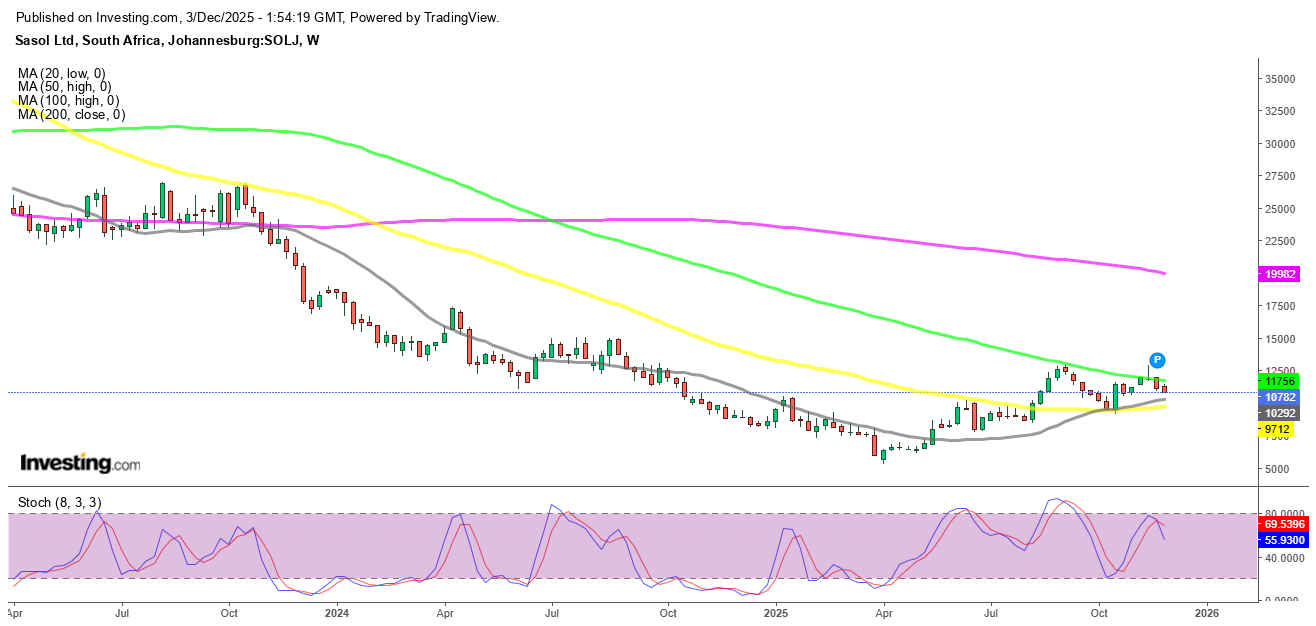
Although buyers briefly managed to push above this barrier, the move quickly reversed. The weekly candle formed an upside-down pin bar, a classic bearish reversal signal. In the two weeks that followed, Sasol dropped roughly 16%, reinforcing the view that long-term resistance remains intact.
Meanwhile, the 50-week SMA continues to act as a reliable support area, reflecting the tug-of-war between short-term recovery bets and long-term structural concerns.
Operational Strength: Solid Q1 FY26 Performance
Despite recent market turbulence, Sasol’s Q1 FY26 operational update showed meaningful progress across key divisions:
- Mining: Saleable production rose 18% QoQ, supported by improved output at the destoning plant.
- Secunda Operations: Volumes increased 4% QoQ and 9% YoY, highlighting improved reliability.
- International Chemicals: Revenue grew despite pressure from lower U.S. chemical prices.
- Fuel Sales: Outpaced last year, lifted by stronger demand from the mobility channel.
Management reported that these gains translated into higher revenue and adjusted EBITDA compared with Q1 FY25—signaling that underlying operations are on a more stable footing.
Financial Health: Progress With Caveats
For FY2025, Sasol posted encouraging improvements:
- Headline EPS: +93% YoY to R35.13
- Free Cash Flow: +75% to R12.6 billion
- Net Debt: Down 13% to R64.96 billion
- Liquidity: Boosted by a R4.3 billion Transnet settlement
However, overall turnover fell 9% to R249.1 billion and EBITDA declined 14%, indicating that much of the progress reflects favorable market conditions rather than durable structural change.
Revenue has also been shrinking over the past three years, down 8.7%, raising concerns about long-term growth. Looking ahead, analysts forecast revenue growth of just 4.6% annually over the next three years—well below the 18% industry average.
Legal Pressure: Ethylene Monopoly Challenge
Adding to the uncertainty, Sasol faces a lawsuit from KAP Industrial, parent company of Safripol. Filed with South Africa’s Competition Commission, the case alleges that Sasol has abused its monopoly position in ethylene supply, calling for a formal investigation under the Competition Act. The legal process could bring additional scrutiny and potential regulatory constraints.
Strategy And Outlook: Cautious Stability
Sasol’s management remains focused on efficiency, emissions reduction, and disciplined capital allocation as outlined during its Capital Markets Day 2025 roadmap. Yet analysts emphasize that some of the recent balance-sheet improvements—such as working-capital releases and settlements—are unlikely to recur.
The dividend remains suspended as Sasol works to reduce debt below $3 billion, a prudent but unpopular move among income-oriented shareholders.
Overall, while operational improvements are encouraging, Sasol still faces challenges on multiple fronts—from structural growth concerns to legal risk and the weight of long-term technical resistance.
- Check out our free forex signals
- Follow the top economic events on FX Leaders economic calendar
- Trade better, discover more Forex Trading Strategies
- Open a FREE Trading Account
- Read our latest reviews on: Avatrade, Exness, HFM and XM



 Save
Save