Intel Stock Dips 7% – Is It Time to Buy the INTC Stock Amid New Developments?
After riding speculation and policy support into a dramatic two-week gain, Intel has returned to the forefront of market attention...
Quick overview
- Intel's stock surged nearly 33% over two weeks, driven by renewed investor confidence and speculation about a potential partnership with Apple.
- The broader market's improving sentiment and dovish Federal Reserve signals have contributed to Intel's recovery narrative.
- Despite a recent pullback, Intel's technical indicators suggest a potential for further gains if momentum can be sustained.
- The company's upcoming Panther Lake chip and strategic focus on domestic manufacturing align with current market trends and policy support.
Live INTC Chart
[[INTC-graph]]
After riding speculation and policy support into a dramatic two-week gain, Intel has returned to the forefront of market attention. However, its rise has slowed due to technical obstacles.
Intel Surges Back Into Focus As Momentum Sharpens
Intel’s resurgence over the past two weeks has reshaped its market narrative, placing the company once again at the heart of semiconductor optimism. The stock had climbed nearly 33% in a remarkably short span, reflecting renewed faith in Intel’s long-term revival. Investors were energized by legislative incentives, improving macro trends, and the possibility of technological breakthroughs that could reposition Intel as an industry leader after years of setbacks.
By Tuesday, INTC had burst through critical resistance and was trading with the conviction of a company staging a genuine comeback. Fresh speculation surrounding a high-profile foundry deal further amplified the bullish tone. Yet after the strong climb, the mood shifted mid-week. Wednesday saw consolidation, and by Thursday profit-taking accelerated, dragging the stock down from $44 to below $41 as enthusiasm temporarily cooled.
A Market Turnaround Breathes Life Into Intel’s Recovery Story
Intel’s reappearance on the market’s radar follows a steep November decline that, at the time, appeared to threaten the stability of its recovery. The stock had broken down from the low $40s, ultimately dipping under $33 in a move that spooked investors and forced a reevaluation of Intel’s trajectory. However, buyers returned with force as broader sentiment in the tech landscape improved.
The tone shifted distinctly last week when the stock closed decisively above $40, surging more than 10% in a single session. Tuesday’s continuation of that momentum pushed shares past the $43 threshold, marking a technical and psychological turning point. It was a signal that Intel’s comeback narrative—once fragile—had regained substance.
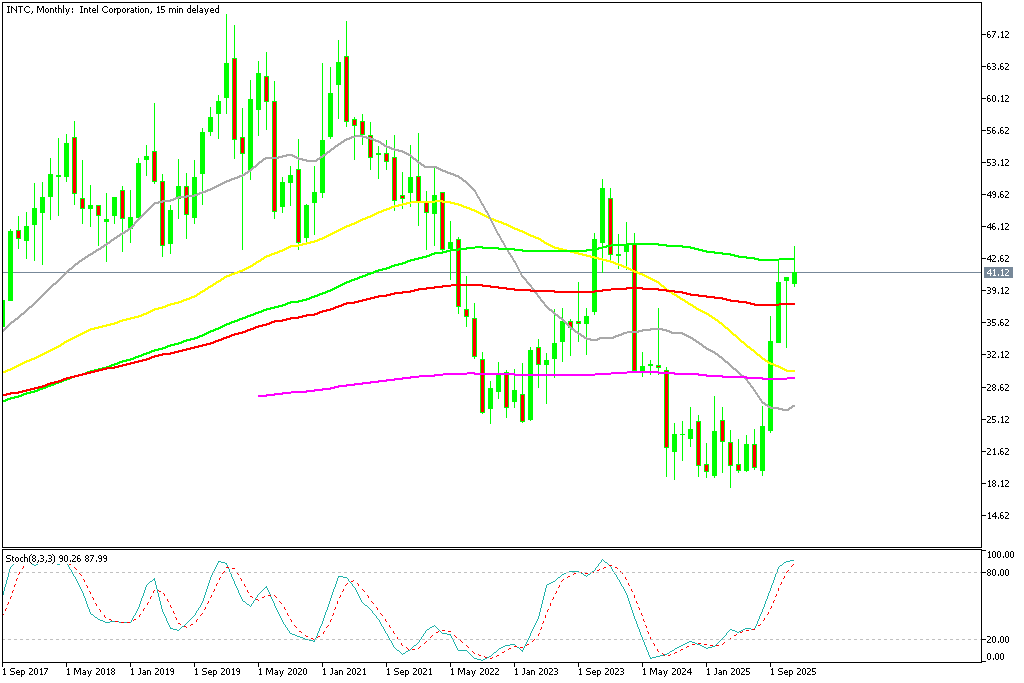
INTC Chart Monthly – Buyers Couldn’t Hold the Price Above the 100 SMA
Much of the revived enthusiasm stemmed from renewed talk of a potential Apple foundry partnership. Though unconfirmed, such a deal would be transformative, lending credibility to Intel’s ambition to re-enter the cutting-edge manufacturing arena.
Macro Shifts Reinforce Intel’s Upside Momentum
The broader market environment has been instrumental in Intel’s rally. Investors who spent weeks bracing for weakening demand, sticky inflation, and persistent high rates are now reading a softer macro landscape.
Several Federal Reserve officials adopted a distinctly dovish tone heading into December, raising speculation that rate cuts may materialize earlier than anticipated. That stance reignited interest in growth-heavy segments, particularly semiconductors, which had faced sharp selling pressure throughout the fall.
Intel emerged as one of the most responsive beneficiaries of this shift. The combination of easing macro fears and renewed enthusiasm for hardware innovation helped propel the stock into a sharp recovery.
INTC Chart Monthly – Buyers Challenge The 100 SMA Before Pullback
The technical backdrop mirrored the improving sentiment. After stabilizing near long-term moving averages, Intel began building momentum the moment shares reclaimed the $35 area. From there, the rally intensified as the stock approached the $42.50 zone—home to the 100-month simple moving average.
The breakout initially appeared convincing, adding fuel to the belief that a test of the 2024 highs above $51 might soon follow. But Thursday’s dip back below the 100 SMA reminded traders that the path upward will not be linear. Intel’s retreat toward $40 suggests resistance remains firm and that buyers will need renewed conviction to push the stock decisively higher.
Apple Foundry Speculation Strengthens Intel’s Strategic Outlook
The most powerful catalyst behind Intel’s recent rally has been the speculation surrounding a potential foundry partnership with Apple. Supply-chain reports that resurfaced on November 28 reignited hopes that Apple may rely on Intel’s upcoming 18AP node for a future generation of M-series processors.
New Process Design Kits are expected in early 2026, giving both companies a clearer sense of the node’s performance profile. Should Intel meet Apple’s efficiency and thermal targets, production could begin by mid-2027—placing Intel inside one of the world’s most prestigious and influential hardware ecosystems.
Even the prospect of winning a portion of Apple’s manufacturing volume has been enough to shift sentiment. Investors recognize that securing such a contract would validate Intel’s multi-year manufacturing overhaul and inject substantial credibility into its foundry roadmap.
Panther Lake Marks Intel’s Next Significant Technological Step
Beyond external partnerships, Intel’s internal product roadmap is beginning to gain traction. Recent performance database entries hint at the arrival of Panther Lake, including sightings of a Core Ultra 9 386H chip in an Acer Predator testing environment. Though preliminary, the listings offer an early look at Intel’s upcoming design philosophy.
Panther Lake appears to emphasize power efficiency and balanced performance—targeting premium notebook and gaming markets where Intel lost ground in recent years. Rather than chasing core counts, the architecture looks optimized for real-world performance, battery life, and thermal stability.
While pre-release data must be approached cautiously, the tone surrounding Panther Lake is promising, suggesting tighter execution and a clear strategic vision.
Competitive And Policy Winds Show Signs Of Turning In Intel’s Favor
Competitive pressure from AMD, which dominated several categories over the past year, has begun to moderate. Margins are tightening, and enthusiasm around certain high-growth segments is cooling, giving Intel additional breathing room to fortify its lineup.
Meanwhile, global interest in domestic semiconductor production has surged. The geopolitical push to diversify supply chains has elevated the strategic importance of U.S.-based manufacturing—an area where Intel’s expanding footprint aligns perfectly with policy goals. Nearly $16 billion in CHIPS Act incentives further strengthens Intel’s position and enhances its manufacturing resilience.
Leadership restructuring under CEO Lip-Bu Tan has also improved confidence. His more direct involvement in engineering and manufacturing oversight has provided clarity and renewed discipline at a time when Intel needs both.
Conclusion: A Revival Fueled By Momentum, Strategy, And Renewed Trust
Intel’s powerful two-week rally reflects more than temporary optimism. From speculation around transformative partnerships to credible progress in its product roadmap, alongside strong policy backing and improving macro conditions, the elements of Intel’s comeback are beginning to converge. The brief pullback underscores that challenges remain, but the shift in sentiment is unmistakable. For the first time in a long while, the market is treating Intel as a company with real upward potential—and INTC’s dramatic surge shows how quickly belief can return.
- Check out our free forex signals
- Follow the top economic events on FX Leaders economic calendar
- Trade better, discover more Forex Trading Strategies
- Open a FREE Trading Account




 Save
Save