Analysts Raise Micron Price Target, MU Stock Rebounds but Faces Resistance
Micron’s sharp swings this week captured the widening tension between optimism surrounding AI demand and rising market anxiety over sustaina

Quick overview
- Micron Technology experienced significant volatility this week, driven by mixed sentiment around AI demand and rising market concerns over sustainability and execution risks.
- After a record peak, Micron's shares plummeted over 23% amid a global tech selloff, raising questions about the durability of its recent surge.
- Despite strong operational performance and a raised price target from Mizuho, Micron faces challenges from growing competition and geopolitical tensions affecting the semiconductor industry.
- The broader AI supply chain is undergoing a reassessment, with analysts cautioning against continued rapid infrastructure spending, leading to increased market volatility.
Live MU Chart
[[MU-graph]]
Micron’s sharp swings this week captured the widening tension between optimism surrounding AI demand and rising market anxiety over sustainability, execution risks, and tightening industry conditions.
Mixed Sentiment Sends Micron Into a Volatile Spiral
Micron Technology entered November on a high, propelled by a surge in demand for the high-bandwidth memory that powers the world’s most advanced AI systems. Shares had climbed relentlessly all year, reaching a record peak of $261 and solidifying Micron as one of the standout beneficiaries of the AI boom. But as the month progressed, the tone shifted dramatically. A sudden global selloff hit the technology sector with unusual force, and Micron—up more than 171% year-to-date—became one of the most severe casualties.
The decline was swift and unsettling. Shares plunged more than 23%, collapsing through the symbolic $200 threshold in just a few trading sessions. The abrupt reversal rattled confidence that Micron’s surge was durable, raising a critical question: had the AI memory trade become too speculative, too crowded, and too dependent on perfect conditions?
An Attempted Recovery Meets Immediate Friction
In the aftermath of the selloff, Micron briefly found its footing. The stock stabilized near the 50-day simple moving average, a level that had repeatedly acted as a safety net throughout the year. From there, shares bounced toward the mid-$240s, hinting at the possibility of a renewed push higher. But momentum faded almost as quickly as it appeared.
The 20-day moving average, once reliable support, flipped into resistance. Market volatility sharpened. Fresh reports soon surfaced that Micron was preparing to exit its Crucial consumer division—covering SSDs and DRAM modules sold through major retail channels—with shipments expected to wind down by early 2026. Investors interpreted the exit as a strategic but disruptive shift, and the stock slid more than 5% intraday before settling slightly lower.
MU Stock Chart Daily – The 50 SMA Held As Support
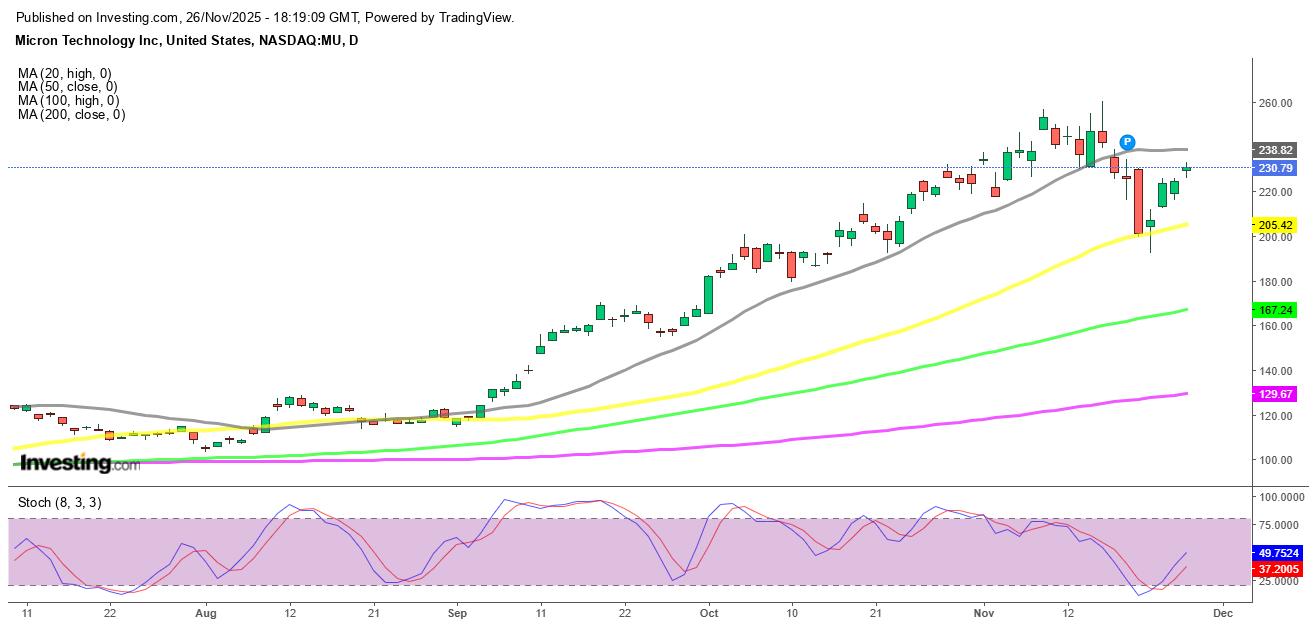
By mid-week, shares had fallen below $230, underscoring how fragile the rebound truly was. Only on Friday did stabilization reappear, with the week ending at $237.22—an improvement, yet still below the technical levels that would signal a more durable recovery.
Mizuho Raises Target
Adding complexity, Mizuho raised its price target on Micron to $270, forecasting dramatically stronger earnings in 2026 and 2027 as DRAM margins are expected to overtake HBM margins, and as demand for AI-related memory accelerates. Their projections—$56 billion in 2026 sales and nearly $18 per share in earnings—offered reassurance but did little to fully offset the week’s volatility.
Sector-Wide Reassessment Pressure Spreads Across the AI Trade
Micron’s downturn was part of a broader reassessment shaking the AI supply chain. Analysts at Rothschild & Co. and Redburn issued cautionary notes questioning whether AI infrastructure spending can continue expanding at today’s torrid pace. Fears that hyperscalers like Amazon, Microsoft, and Google might trim capital expenditures or adjust ordering cycles weighed heavily on sentiment.
As doubts spread, the AI ecosystem sold off in tandem—from cloud providers to chipmakers to component suppliers. The market’s message was clear: the era of paying steep premiums for future AI potential is giving way to a more selective environment, where investors want tangible proof of sustainable profitability. In that environment, even strong near-term fundamentals are not enough to prevent sudden bouts of volatility.
Strong Fundamentals Provide Support, Yet Don’t Eliminate Risk
Despite the selling pressure, Micron’s operational performance remains robust. The company recently reported quarterly revenue of $11.32 billion, a 46% year-over-year increase, with adjusted EPS of $3.03—well above expectations. Full-year revenue climbed to $37.38 billion, and net income surged to $8.5 billion. Demand from data centers now contributes more than half of total revenue, highlighting Micron’s central role in the rapid expansion of AI computing infrastructure.
But strong earnings do not inoculate Micron against market headwinds. Many investors argue that after such a steep rally, a significant portion of the company’s strength is already reflected in its valuation. With competitors scaling aggressively and supply dynamics shifting, future pricing power is far from guaranteed.
Even so, major investment firms remain optimistic. Morgan Stanley continues to list Micron as its top memory pick, citing ongoing tightness in DDR5 and premium DRAM markets that could support elevated margins into 2026.
Growing Competition and Global Politics Add to the Uncertainty
The landscape facing Micron is becoming more complex. Rivals Samsung and SK Hynix are accelerating their next-generation HBM4 memory programs, while manufacturers across China and Taiwan are expanding capacity at a pace that could tilt the market toward oversupply by 2026. The geopolitical stakes surrounding semiconductor production only heighten the risks. As governments emphasize national security and supply chain resilience, AI-critical components like advanced memory remain exposed to trade restrictions, export controls, and diplomatic tensions.
- Check out our free forex signals
- Follow the top economic events on FX Leaders economic calendar
- Trade better, discover more Forex Trading Strategies
- Open a FREE Trading Account


 Save
Save