BTC Price Prediction: Technicals Confirm Bullish Reversal with the FED Rate Cut to Aid Bitcoin
Due to Bitcoin's recovery from its late-November lows, investors are now expecting a potential return toward the $100,000 mark as the FED...

Quick overview
- Bitcoin's recovery from late-November lows has renewed investor confidence, with a potential target of $100,000 as the Federal Reserve prepares for a rate cut.
- The cryptocurrency market saw a significant selloff that erased nearly $1 trillion, but Bitcoin has rebounded above key technical levels, easing market nerves.
- Institutional participation is strengthening Bitcoin's long-term outlook, with significant inflows into U.S. spot Bitcoin ETFs and major universities increasing their holdings.
- The political landscape has shifted to a more crypto-friendly stance, with new regulations and policies being introduced under the current administration.
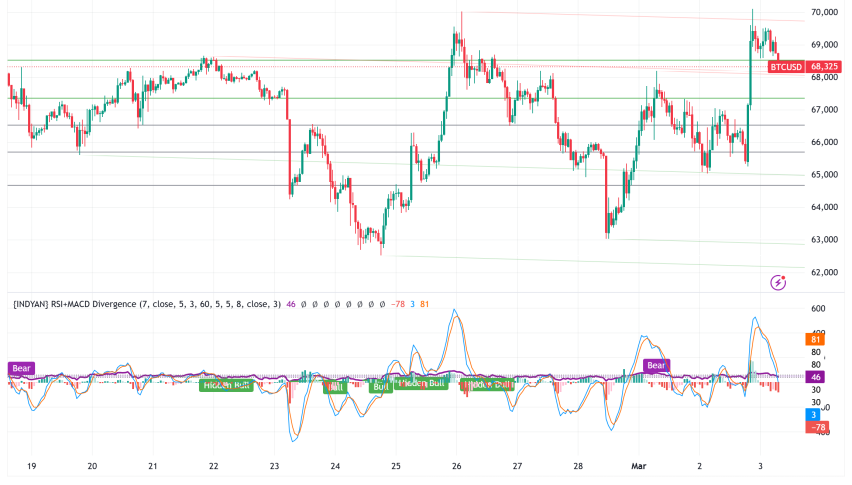
Live BTC/USD Chart

Due to Bitcoin’s recovery from its late-November lows, investors are now expecting a potential return toward the $100,000 mark as the Federal Reserve gets ready for another rate cut this week.
A Stabilizing Turn After a Brutal Shakeout
Bitcoin has steadied after a turbulent correction that erased nearly $1 trillion from the broader cryptocurrency market. The selloff briefly pushed BTC toward the $80,000 region, but the decline stalled as buyers stepped back in, driving the price back above $90,000 and preventing a deeper breakdown. Although momentum remains uneven beneath short-term resistance, Bitcoin’s recovery above several key technical thresholds has helped ease nerves after one of the most volatile stretches of the year.
November’s sharp downturn mirrored the broader retreat in global equities as investors pulled back from risk across the board. The slide was not linked to a clear catalyst; psychological pressure, profit-taking, and elevated volatility triggered a wave of selling across digital assets. BTC slipped below $81,000 at the same time crypto’s total market cap contracted by almost $1 trillion.
BTC/USD Chart Weekly – Rebounding Off the 100 SMA

Sentiment began to brighten as expectations firmed for a December Federal Reserve rate cut. Markets now widely anticipate another 25-basis-point reduction, a shift that has supported both equities and cryptocurrencies. The resulting improvement in risk appetite helped Bitcoin rebound toward the $90,000 zone, despite initial resistance at the 20-day Simple Moving Average, which has since flipped into support. The rebound from this level last week, along with consistently higher daily lows, reinforces the case for a bullish reversal.
Technical Levels That Anchored the Recovery
While the selloff was severe, Bitcoin’s broader structure remained far more constructive than headline price moves suggested. BTC temporarily broke below the 50-week Simple Moving Average—a level historically tied to major bull-market phases. However, the failure of sellers to sustain pressure below that line helped prevent a shift into a deeper bear cycle.
Instead, the 100-week Simple Moving Average near $82,000 served as Bitcoin’s true line of defense. This level absorbed heavy liquidation flows and marked the point where buyers regained control. Beneath it, the April low near $74,000 remains a critical long-term demand area that continues to define the lower boundary of the ongoing cycle.
BTC/USD Chart Daily – Buyers Finding it Hard to Push Above the 20 SMA

The rebound from the 100-week SMA carried Bitcoin back above $90,000, supported by oversold readings on multiple timeframes. Yet upside traction has slowed at the 20-day SMA, which currently acts as short-term resistance. Traders continue to assess whether the market has the momentum to challenge the $100,000 region next—or whether a corrective retest of the November lows will be required before the next leg higher.
Macroeconomic Conditions Add Fuel to the Rebound
A cluster of central bank decisions this week is adding tension to the market narrative. While the Bank of Japan, Swiss National Bank, Bank of Canada, and Reserve Bank of Australia are all expected to hold rates steady, the Federal Reserve’s December meeting is the focal point. Markets fully expect another 25-basis-point rate cut—generally supportive for risk assets, though the tone of the guidance will matter significantly.
If policymakers signal a pause, the crypto market could face short-term hesitation. But if the Fed points toward continued easing in 2025 and 2026, the backdrop becomes decisively positive for digital assets. Political developments are adding another layer of volatility: reports suggesting that Kevin Hassett is the frontrunner to replace Jerome Powell—and his preference for aggressive cuts—have not gone unnoticed.
Labor data released last week reinforced expectations for continued easing. ADP showed a 32,000 job loss, Challenger layoffs surged to more than 71,000, and even though the delayed September payrolls report came in slightly stronger at 119,000, it did little to change the bigger picture: the labor market is cooling, and monetary policy is likely to lean dovish.
Miners Face Pressure, but They’re No Longer Driving Price Direction
With Bitcoin trading near the $92,000 zone, JPMorgan notes that BTC remains close to its estimated production cost of roughly $94,000—a dynamic creating ongoing selling pressure from miners. Several high-cost mining operations have been forced to liquidate holdings to maintain solvency.
However, analysts now believe miners are no longer the decisive force behind Bitcoin’s next major move. Instead, markets are increasingly focused on large institutional holders—most notably MicroStrategy—and their ability to maintain or expand positions without becoming forced sellers during periods of stress.
A New Crypto Policy Landscape in Washington
The political backdrop has turned more crypto-friendly following Donald Trump’s return to office earlier this year. The administration has moved quickly to reshape the regulatory environment: rescinding several Biden-era directives, prohibiting a U.S. CBDC, launching a new Digital Asset Markets working group, and advancing the GENIUS Act—the first major federal stablecoin law.
Trump has also established a strategic Bitcoin reserve and rolled back multiple enforcement actions, signaling a significant shift in federal posture toward digital assets. Nevertheless, cryptocurrencies received no mention in the new national security strategy, which instead highlights artificial intelligence, quantum computing, and biotech as core strategic technologies. The omission fuels debate around whether crypto remains a political priority or simply a financial-market initiative.
Institutional Flows Tighten Bitcoin’s Long-Term Suppl
Institutional participation remains one of the most powerful forces behind Bitcoin’s long-term structure. U.S. spot Bitcoin ETFs attracted more than $2.7 billion in inflows during early November, led by BlackRock’s IBIT and Fidelity’s FBTC. IBIT alone now holds nearly 800,000 BTC and is approaching the $100 billion AUM milestone, making it the fastest-growing ETF in U.S. history.
Harvard University dramatically expanded its exposure as well, tripling its IBIT holdings to more than 6.8 million shares—valued above $440 million before the recent correction. Its Bitcoin stake now exceeds the university’s exposure to Amazon, Microsoft, and even gold.
JPMorgan analysts view Bitcoin’s estimated production cost as a strong natural floor, and they project prices could reach approximately $170,000 by 2026 as volatility diminishes and the asset continues to compete directly with gold. While IBIT saw $2.34 billion in redemptions throughout November, those outflows stabilized as Bitcoin reclaimed the $90,000 region, leaving the ETF with more than $3.2 billion in cumulative gains after the recovery.
Bitcoin’s rebound reflects a market that remains fundamentally intact despite extreme volatility. Technical support, institutional demand, improving macro conditions, and a shifting regulatory landscape all point toward a market preparing for its next major move—one that could edge Bitcoin decisively closer to the $100,000 threshold.
- Check out our free forex signals
- Follow the top economic events on FX Leaders economic calendar
- Trade better, discover more Forex Trading Strategies
- Open a FREE Trading Account
- Read our latest reviews on: Avatrade, Exness, HFM and XM




 Save
Save